Accessibility Tools

Skip to main content

Stage: Awareness

Image with text 'PDF Accessibility for EAA: How to Start, Where You Stand, and Why It Matters'. On the right side are icons representing WCAG 2, ISO 14289 (PDF/UA), a PDF document with a checkmark, and a universal accessibility symbol, emphasizing compliance and accessibility standards for digital documents under the European Accessibility Act.

PDF Accessibility and EAA: Guide for Compliance

Updated: 4 weeks ago

We rarely stop to think about how seamless our digital lives are. But with the PDF Accessibility and European Accessibility Act (EAA) deadline approaching in June 2025, organisations must act now to ensure digital equality — and legal compliance.

We scroll, shop, book, and bank without ever questioning whether the platforms we use are built for us. For the roughly 80 million Europeans living with a disability, though, the digital experience often looks very different, marked by limitations or outright exclusion.

That’s where the European Accessibility Act (EAA) comes in. From 28 June 2025, businesses offering digital services or selling certain products in the EU will need to meet strict accessibility standards. It’s a major step toward creating a more inclusive digital economy, and it’s going to impact everything — e-commerce platforms, e-books, insurance documents, ticket machines, shopping platforms, banking statements and apps. You can read more on our previous blog about how enterprises are preparing to EAA in different European countries.

The directive has been in motion for years, but many organisations still haven’t taken real steps to prepare. Meanwhile, industry leaders are quietly doing the work and positioning themselves to gain compliance and a competitive edge.

If you’re not there yet, you’re not alone. However, you are now at a decision point – move forward or fall further behind?

All Starts from Growth Mindset

There’s a tendency to frame accessibility in regulatory terms, as a box to tick, a deadline to meet, or a risk to avoid. Yet, for businesses that want to squeeze more from opportunity and lead, not just comply, the EAA offers something far more valuable. Namely, a clear reason to improve the user experience for everyone. 

Early adopters are already seeing the benefits. Some retailers, for instance, report up to a 35% increase in conversions after making their digital platforms more accessible. That’s because accessibility improvements often go hand-in-hand with better usability – not just for people with disabilities, but for everyone. We’re talking about cleaner interfaces, clearer navigation, consistent content structures, features that make digital experiences more intuitive. They reduce friction, spark innovation, build trust, and keep customers coming back. 

Essentially, being EAA-ready doesn’t only protect you from fines and sanctions, it also positions you as a business that understands where the market is going – and is prepared to lead in the right direction. 

First Steps to Get Accessibility

So what does it look like to get serious about accessibility when you may be starting a little later than others? 

The first step is very simple: figure out where you stand. That means inspecting your website, apps, service platforms and internal tools, not merely for obvious issues like missing alt texts or contrast failures, but for structural barriers that affect real user journeys. 

  • Can a customer complete a purchase without using a mouse? 
  • Is your chatbot accessible by screen reader? 
  • Do your mobile experiences meet the same standards as desktop?

Of course, these aren’t questions for a single compliance officer to answer. Accessibility touches product, design, development, customer service, and legal operations, which means it has become a shared priority, not a siloed task.

Don’t know where to start EAA preparations? For the first touchpoint, you can download our WCAG 2.1 and PDF Accessibility guides for free (no email address is required). Those guides are created for: 

  • Better understanding of your PDF/UA and WCAG compliance situation
  • What makes PDF documents and site accessible
  • Understanding on how to fix first accessibility red flags.

These guides could be your roadmap to EAA preparations and how to be compliant with PDF/UA (ISO 14289), EN 301 549, and WCAG 2.1. By the way, both of those PDFs are accessible and PDF/UA compliant 🙂

Closing the Gap Without Falling Behind

When time is short and pressure is high, it’s tempting to search for shortcuts. But accessibility isn’t something you can just add on at the end of the process. Real progress means building a roadmap that accounts for both short-term fixes and long-term change.

Yes, some updates are straightforward: adjusting colors, labelling buttons, adding keyboard support. These can and should be addressed quickly. However, other work, such as redesigning navigation flows, integrating with assistive tech, or rethinking your content strategy, takes more time, more collaboration, and more care. 

This doesn’t have to mean halting business as usual – accessibility can be integrated into agile workflows and existing development cycles. In fact, some of the most effective efforts happen incrementally. The key is to start, and to treat accessibility not as a project with an end date, but as a part of how you build and maintain digital services going forward.

Don’t Stop on Alt Text Only

It’s easy to fall into the trap of performative accessibility, making a few quick, visible changes like adding alt text or tweaking colours, and assuming the job is done. However, real accessibility is more than mere appearances, it is also about outcomes: can users with diverse needs actually complete tasks, access information, and engage with your service without barriers?

While alternative text is an essential part of accessibility, it’s only one piece of the puzzle. A truly accessible PDF requires correct tagging structure, proper reading order, logical headings, usable tables, form field labelling, colour contrast checks, and more.

Passing an audit once doesn’t guarantee long-term compliance — especially under the European Accessibility Act, where consistency and future updates matter. That’s why accessibility must be systemic, not superficial.

The truth is, accessibility is only meaningful when it works for real people navigating real challenges. That means going beyond checklists to understand how users actually experience your site or service – and whether they’re truly able to use it. 

Even a website that passes today’s audit may fail tomorrow if updates are made without accessibility in mind. Regular testing, feedback from users with disabilities, and iterative improvements are what separate superficial fixes from sustainable progress.

Additionally, there’s value in openness. Letting your customers know you’re working on accessibility,  even if you’re not there yet, can earn you credibility. It signals that you care, that you’re listening, and that you’re committed to building a better digital experience. 

Why PDF Accessibility Demands More Than Automation

Making your PDFs truly accessible isn’t as simple as running an auto-check or pressing a “Make Accessible” button in Adobe. While tools can help flag issues, they rarely deliver fully compliant, user-friendly results on their own — especially when it comes to complex layouts, interactive forms, or branded documents that rely heavily on custom styling.

The challenge? Maintaining visual consistency and brand integrity while ensuring that every element — from tables and infographics to reading order and form fields — works seamlessly with assistive technologies. Automated fixes often flatten design, strip meaning, or miss key accessibility gaps altogether. Worse, they can create a false sense of security while leaving you exposed to compliance risks.

This is not something most internal teams are equipped to handle alone — especially under time pressure. That’s why many organisations partner with accessibility experts who not only understand the technical requirements (PDF/UA, EN 301 549, WCAG 2.1), but also know how to preserve design and user experience throughout the process.

It’s Not Too Late, But It Is Time

This is your chance to step back and ask: How do users move through our services? Where do they get stuck, frustrated, or excluded? What would it look like to make every touchpoint intuitive, inclusive, and seamless?

Accessibility doesn’t sit in a vacuum. It intersects with your ESG goals, your DEI commitments, and your customer experience ambitions. Leading companies are already drawing these lines, and using them to futureproof their strategies. 

So yes, the clock is ticking, but getting serious about accessibility now puts you in a position to lead, not scramble to catch up later. 

Summary

With the European Accessibility Act deadline approaching on 28 June 2025, industry leaders are already working toward compliance and gaining a competitive edge in the process. However, even if you’re behind now, it’s not too late to start. Accessibility isn’t only about ticking boxes. Done well, it improves the experience for everyone, and early adopters are already seeing the benefits. The first step is understanding where you stand and recognising that accessibility touches every part of your organisation. It’s not a one-off project, but an ongoing commitment. Avoid the trap of quick fixes that don’t serve real users. Instead, use this moment to rethink how your digital experiences can be more inclusive and take the first step now. 

AI generated image: ancient block screen with legacy interface, situated in the office. It represents the outdated system

How Legacy Systems Are Slowing Down Modern Business Managers

Updated: 4 weeks ago

The role of a business manager today has transformed into a hybrid of strategist, analyst, and operator, all rolled into one. They’re not only keeping operations running, they’re expected to drive strategic projects, bridge gaps between teams, and turn data into actionable insights. Business managers are constantly jumping between finance, sales, supply chain matters, and people operations, trying to make sense of what’s happening across the business.

But if they’re still stuck working with legacy systems? That job becomes 10x harder than it needs to be and workload is quick as never before with facilitated day-to-day processes.

Old Tools, New Problems

We’ve seen it time and again: systems once labelled as ‘future-proof’ now block the workday. Perhaps it’s a slow ERP accessible only to the finance team, or a reporting tool that hasn’t been updated in years. In many cases, companies juggle five platforms that don’t communicate properly with each other.

As a result, more time is spent chasing data than using it. Reports are delayed, workflows are made manual and prone to error. When leadership requests insights for Monday, teams often piece spreadsheets together over the weekend.

This situation frustrates teams and creates unsustainable maintenance.

Understanding an Upcoming Strategic Risk: Outdated Systems are Not Just IT’s Problem

Too frequently, operational and business teams treat CCM systems as back-office concerns, left for IT to “eventually” sort out. Yet, business leaders feel their limitations daily by across functions. Decision-making slows down when teams can’t access performance data in real time – sales teams build forecasts on outdated figures, and managers guess inventory levels instead of knowing them. Processes follow system limits rather than team needs. For example, adjusting prices across regions typically requires manual approvals and Excel workarounds to bypass system limits. As companies scale, these inefficiencies multiply, and what worked in one market becomes a burden across five.

Meanwhile, missed opportunities pile up. One team spends hours consolidating quarterly reports while a competitor pivots strategy on live market data. As you wait for procurement data from three systems, teams may already make unnecessary purchases. These aren’t isolated cases – they’re the daily frustrations of business managers trying to lead with impact. Without visibility and flexibility, managers react to problems instead of steering the business forward. When systems dictate the pace of change, companies quietly lose agility – one of the most valuable traits in today’s environment.

Modernisation with Coffee To Go

Imagine this instead: You open one dashboard and see your key metrics, live, clean, and easy to get into. You don’t have to wait for a report or chase someone in another team for an export. Your workflows are automated where they can be and flexible where they need to be. Your systems are connected, and so is your team.

While this may sound like the ideal scenario, we at Quertum understand that you can’t switch off legacy systems overnight. That’s why we design our approach to make change as seamless as possible. Whether you manage heavily customised platforms, fragmented infrastructure, or operations across multiple countries, we handle the complexity behind the scenes, so your teams can focus on their day-to-day. Core systems keep running while we gradually introduce modern tools with minimal disruption.

Quertum brings your data together, streamlines manual processes, and enables old and new platforms to operate side by side. No lengthy implementations, no unnecessary downtime, only smarter systems that start making everyday work easier and faster than you’d expect.

What a Better Workday Looks Like

Running a business today means balancing priorities across teams, systems, and time zones, often with limited visibility and even less time. Business managers need more than reports and tools; they need clarity, speed, and systems that support smarter decisions without adding more work.

But old systems make that mission harder than it should be.

Here’s what a modern workday should feel like:

  • One clear view of the business: See revenue, stock levels, and supply chain status in real time without chasing updates from different teams.
  • Approvals that keep things moving: Purchase orders, expense reports, and hiring requests go forward as soon as they meet the right criteria. No more bottlenecks.
  • Issues flagged before they grow: Your system notifies you instantly about a delayed shipment or a spike in returns, so you can act early.
  • Everyone working from the same numbers: With one shared dataset across teams, there’s no confusion, no mismatch in the reports, and no digging through version after version.

It’s not about having more tools, more integrations or AI. We know that it’s about having the right ones, which make it easier to lead across functions, stay ahead of problems, and respond with confidence.

Ready to Work Smarter, Not Harder?

You don’t need to rip everything out to move forward. Legacy systems might still be part of the picture, and that’s okay. However, they shouldn’t define how your teams work today and how many challenges they need to tackle before having work done. We’ve prepared a quick yet insightful guide about 6 main steps on migration from legacy system. This article will show you what’s under the hood of complex migrations in regulated industries like banking and insurance.

At Quertum, we help businesses transition from rigid, outdated systems to setups that support the way teams operate today. We customise, optimise, or build systems from scratch to fit the company. That often means untangling siloed tools, streamlining manual processes, or connecting systems that never communicated before.

Our migration services minimise disruption and make change feel manageable. Whether you manage a custom ERP, local infrastructure, or global complexity, we work alongside your teams to build bridges between old and new. This way, your business runs faster and with far fewer headaches.

Let’s talk about where your legacy systems are holding you back, and how you can seamlessly migrate from obsolete systems and platforms.

Summary

Today’s business managers juggle strategy, data, and cross-functional coordination, but legacy systems make that already demanding role even harder. Outdated tools have become the biggest blocker in the workday, leading to delays, manual fixes, and unsustainable maintenance. This isn’t just an IT inconvenience, but a strategic risk that leaves teams stuck and businesses reactive. However, it doesn’t have to stay that way. Gradual system modernisation, done in a way that doesn’t disrupt daily work, can offer a more flexible and connected way of operating. Imagine an ideal workday with real-time insights, smoother workflows, and connected teams that stay in sync and ahead of problems. Because, when systems work with you, the business moves forward – not sideways.

Accessibility logo on left-hand side. PAC app accessibility checker on right-hand side.

Is Your Business Ready for the 2025 European Accessibility Act?

Updated: 8 months ago

The European Accessibility Act (EAA) is reshaping the digital landscape in the EU. At its core, the EAA aims to break down barriers. It ensures that products and services remain accessible to everyone, including millions of people with disabilities across the EU. This goes beyond using an accessibility checker. Businesses must embed accessibility into design thinking, from websites to all customer communications. A key challenge is perception. Many see the EAA’s requirements as broad, even though they remain comprehensive. As a result, many organisations fail to realise the EAA also applies to documents such as PDFs. Yet, PDFs remain critical to communication workflows.

The Cost of Non-Compliance Across EU Markets

While EU member states were required to transpose the EAA into national law by June 2022, the critical date is June 28, 2025, when full enforcement begins. This date marks when the EAA requirements become legally binding for countless businesses across the EU. The window for delaying serious action has effectively closed. Procrastination now carries significant risks, not just from a legal standpoint, but also in terms of market reach and brand perception.

Across Europe, the EAA is no longer a “nice-to-have.” It now carries a price tag on every website, mobile app, and PDF your company sends. Spain’s Ley 11/2023 tops the list with fines that scale up to €1 million per infringement, and it explicitly names electronic documents, obliging all outgoing PDFs to meet the PDF/UA tagging standard. Germany’s Barrierefreiheitsstsärkungsgesetz lets market-surveillance authorities impose penalties of €100 000 and even ban a product or service until it is accessible. Sweden will start handing out sanctions of up to 10 million SEK (~€870 000) for inaccessible e-commerce or banking interfaces when its new law takes effect on June 28th 2025. Similarly, in Finland, Traficom can now hand out fines up to €150 000. They can even escalate these daily until defects are fixed. Taken together, these moves make one thing clear: ignoring accessibility is no longer a technical oversight, but a severe financial risk for all companies operating within the EU. 

Overlooking Digital Accessibility? You’re Ignoring 15% of the Global Market

Even if your organisation believes it falls outside the direct scope of the EAA, overlooking accessibility in your communication processes is a significant strategic oversight. In today’s interconnected world, inclusivity isn’t simply a moral imperative, it’s a powerful business driver. Consider the sheer potential of reaching the approximately 15% of the global population with disabilities. This is a substantial market segment, often excluded by inaccessible communication.

By proactively making your websites, PDF materials, social media content, and customer service channels accessible, you unlock a wealth of opportunities. 

  • Imagine what could happen if every prospective customer could actually use your website, app, or documents without a struggle. Accessible design unlocks an entire segment of the market that might otherwise give up and look elsewhere. Simple steps like applying real heading tags or marking up lists properly can be the bridge that invites them in.
  • Accessibility also earns loyalty. When people see that you’ve taken the time to add descriptive alt-text to images and graphs, they recognise a brand that genuinely cares. That kind of respect sticks – it turns first-time buyers into long-term advocates.
  • And let’s be honest, in a crowded marketplace, “we’re easy for everyone to use” is a big differentiator. Companies that advertise their commitment to inclusive design attract customers who want to spend with businesses that share their values. Regular checks with an accessibility scanner or PDF-testing tool show you’re not only compliant today, but ready for whatever tomorrow’s standards require.
  • Finally, what helps some helps all. Clear language, logical structure, and keyboard-friendly navigation are more than accessibility wins. They also boost SEO and usability for every visitor. Streamline the reading order, make that checkout flow effortless, and watch both your search ranking and your customer satisfaction rise together.

The Accessibility Gap Is Closing – But Not Evenly. European Accessibility Act Is On a Way to Change it

In just two years, the share of companies actively planning for accessible PDFs and digital communications has tripled. According to industry data, 66% of surveyed companies now have a roadmap for PDF/UA compliance, signalling a clear shift toward inclusive design. At the same time, many public-facing websites, especially in the Nordics, score high on WCAG compliance. This shows what’s possible when accessibility is treated as a strategic priority.

Yet the distance between early movers and the rest of the market is growing. An early 2025 AbilityNet survey found that just 11% of organisations feel confident they’ll meet the EAA deadline. For many, the challenge isn’t a lack of intent, it’s about knowing where to start and how to scale accessibility across documents, channels, and teams. That’s where experienced partners like Quertum can help – bridging the gap between legal requirements and real-world implementation with clear audits, hands-on remediation, and long-term support. As compliance becomes a baseline expectation, the companies that act now won’t just meet the standard, they’ll help set it.

The Urgency is Real: Take the Next Step Now Towards European Accessibility Act Compliance

The June 2025 deadline is here. Organisations that postpone action on the EAA risk legal penalties and, just as critically, the loss of a sizeable customer segment. Whether you’re starting or scaling, now is the time to move beyond acknowledgement. Embed accessibility — at minimum PDF/UA compliance and WCAG AA standards — into everyday processes and communications. Now is the moment to move beyond acknowledgement and weave accessibility – at minimum PDF/UA compliance and WCAG AA standards – into everyday processes and communications. Don’t just catch up – lead the way into a more inclusive digital future.

Future-Proof Your Business with Accessibility

The European Accessibility Act is not just another regulation — it’s a turning point for digital communication and customer experience across the EU. Companies that act now will avoid legal penalties, expand their market reach, and build stronger customer trust. Those that wait risk fines, reputational damage, and lost opportunities.

At Quertum, we help organisations move beyond compliance to create accessible, user-friendly, and future-ready digital communications. From PDF/UA remediation to full-scale accessibility strategies, our team ensures your business stays ahead of both regulators and competitors.

Contact us today to discuss how we can support your accessibility journey and prepare you for the EAA deadline with confidence.

Barcelona landscape with colorful rooftops

Barcelona 2025: Quertum Celebrates Its First Global Meetup.

Updated: 10 months ago

Happy Anniversary Quertum-team! A 5 years Journey of Connection, Growth, and Development.

We’re making it happen! For the first time ever, Quertum brings the whole team together in one place. No more video calls, no more chat messages – just real, face-to-face connections. Barcelona 2025 will be our moment, a turning point that transforms us from a group of colleagues into a truly united global team.

2025 marks the 5th anniversary of Quertum, a journey of incredible growth, innovation, and success. We’ve come a long way and the momentum is only accelerating!

From the local event to vision for the future

It all started small back in September 2024, when we had our first-ever in-person meetup, but only locally. It was an unbelievable experience, but we knew it was just the beginning. 

This time, we’re going way bigger. From the very first session, the energy will be electric. Strategy deep dives, innovation workshops, security insights — every discussion will push us forward. Let’s be honest, it will feel amazing to brainstorm together in the same room instead of through a screen.

The Power of Real Connections

The real magic will happen in between — on coffee breaks, rooftop gatherings and those spontaneous, late-night conversations where ideas flow as freely as the drinks. We’ll laugh, share stories and get to know each other beyond online meetings. It will be a reminder that at the heart of everything we do, it’s people who matter most.

A Well-Deserved Celebration

Of course, no milestone should go uncelebrated. We’ve worked hard to get here and Barcelona will be the perfect place to hit pause, raise a glass and appreciate just how far we’ve come. Because this won’t just be a checkpoint—it’ll be the start of something even bigger.

Join Quertum on This Journey

As we count down the days to Barcelona 2025, we invite you to be part of this exciting moment with us. Follow us on LinkedIn for live updates and insights from our first global meetup!

Here’s to Barcelona 2025. Here’s to the future. And here’s to all the amazing moments still ahead!

Want to learn more about our story and the people behind Quertum’s success? Visit our About Us page to see who we are and what drives us forward. If you’re inspired to grow with us, check out our Career opportunities and be part of our journey.

DORA word surrounded by EU flag stars, all on planned background

Uncover the DORA Support from Quertum Service

Updated: 10 months ago

Understanding DORA 

The Digital Operational Resilience Act (DORA) is an EU regulation that strengthens digital resilience in the financial sector. It applies to banks, insurers, investment firms, and other organisations. They must manage ICT risks, secure operations, and ensure continuity against cyber threats and IT failures.

DORA is primarily focused on the Information Communication Technology (ICT) tools, systems, and third-party services used by the financial sector. Organisations must assess and mitigate ICT risks across their entire operations, including external technology providers.

With DORA becoming fully applicable on January 17, 2025, financial institutions must ensure they comply with a range of risk management, incident reporting, and resilience testing requirements.

Quertum Service in Digital Operational Resilience Act Context

While Quertum is not directly subject to DORA. In the same time, we recognise the importance of this regulation for our customers, including those who are directly impacted and those serving DORA-regulated clients.

As a provider of secure document management and customer communication management, we actively support our customers in aligning with DORA requirements. Our solutions help organisations strengthen their digital resilience, improve data security, and ensure compliance with regulatory standards.

Should your Financial Institution Trust Quertum in DORA Landscape?

At Quertum, we understand that financial institutions must ensure compliance with DORA while maintaining operational efficiency and security.

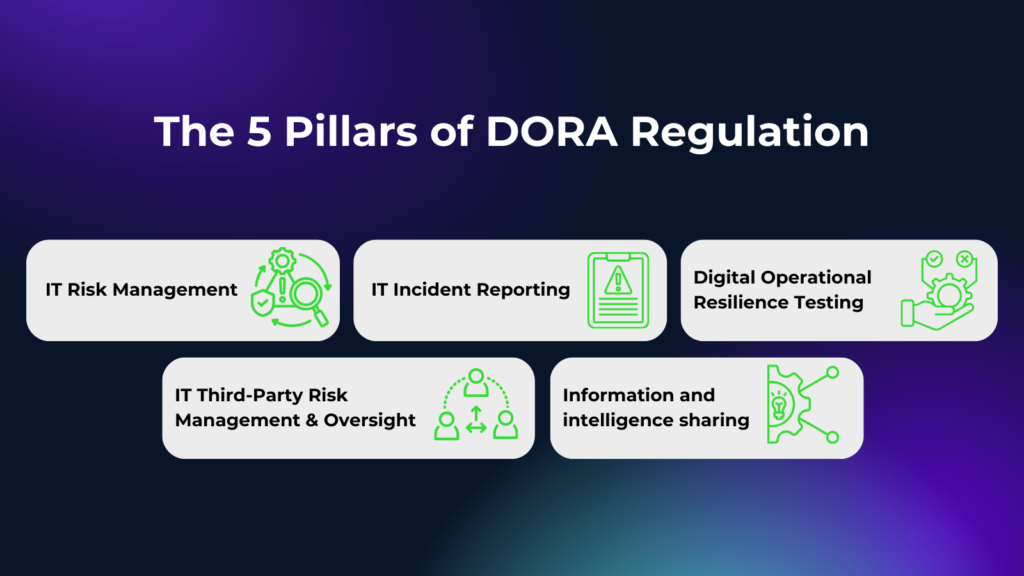
Therefore, we provide peace of mind and confidence by taking a range of actions associated with the 5 pillars of DORA regulations:


✅IT Risk Management. Institutions must establish a comprehensive IT risk management frameworks. With ISO 27001:2022, certification, we review risks carefully and take all needed actions to mitigate or remove them.

✅IT Incident Reporting. Companies must promptly report any significant ICT-related incidents to their respective regulators. We’ve got this covered too via the development of a range of Incident Management documents. Our approach to these requirements supports a coordinated response mechanism for incidents.

✅ Digital Operational Resilience Testing. We regularly test Quertum systems for business continuity, disaster recovery, and vulnerabilities. These checks future-proof our resilience against IT disruptions.

✅ IT Third-Party Risk Management and Oversight. This is a real differentiating factor for us. Moreover, we do not outsource any development activities or engage third-party IT providers.

✅ Information and intelligence sharing. Sharing information about cyber threats with different financial entities helps improve overall robustness within the industry. We are committed to sharing security awareness threads & trends with all interested parties. We also keep our team up to date with regular awareness training and source best practice advice from a range of trustworthy sources.

Get Ready for DORA Compliance with Quertum

Although Quertum is not directly subject to DORA, we still recognise the importance of this regulation for our customers and their extended networks. That’s why we’ve created a DORA-readiness overview—outlining our key commitments and actions to support financial institutions in achieving compliance.

Industries such as finance, banking, insurance ace significant challenges in an increasingly dynamic security landscape. We’re always here to answer any questions that may arise as you search for the right solution to meet your needs.

Contact

Get a free discovery call with customer communication leaders

Whether you are exploring Quadient’s capabilities, considering a move to managed services or planning a CCM migration from a legacy platform, tell us briefly about your current communication challenges.

Acceptance

Or contact our representatives directly

  • Photo of Maciej Majewski

    Maciej Majewski, CEO

    Polish Team

    [email protected]
    +48 (0)791 103 663
    Sienna 75, 00-833 Warsaw

    LinkedIn

  • Tony Alvis

    Tony Alvis, Sales Representative

    The UK Team

    [email protected]
    +44 (0)7757 968116
    Unit 2, Ash House, Tanshire Business Park, Shackleford Road, Elstead, GU8 6LB

  • Photo of Craig Prince

    Craig Prince, Founder

    USA Team

    [email protected]
    +1 (302) 208-0169
    855 Boylston Street – Suite 1000 – Boston MA 02116

    LinkedIn

Continue reading

Quadient PaaS

Transform Your Business with Quertum’s PaaS Solution

Deliver Seamless, Personalised Customer Experiences Across All Channels.

Experience unparalleled cloud performance with Inspire Flex, deployed as a fully managed Platform-as-a-Service (PaaS) through Quertum. We provide the ideal blend of Inspire Flex’s powerful features and the scalability, efficiency and cost savings of a secure cloud deployment.

Talk with Expert

Why Choose PaaS Deployment with Quertum?

  • Simplify Management

    Offload all deployment, infrastructure, and application management to Quertum experts. Eliminate the need for in-house CCM expertise or IT resources for maintenance.

  • Accelerate Value Realisation

    Minimise downtime with seamless cloud adoption and incremental scalability. Reduce IT workloads, enabling focus on transformative business initiatives.

  • Enhance Operational Efficiency

    Achieve predictable monthly costs with a subscription-based model. Optimise system performance with continuous updates, patches, and monitoring.

  • Secure and Compliant Infrastructure

    Leverage ISO 27001-certified processes and secure, single-tenant environments. Ensure data safety with geo-redundant disaster recovery, Azure Defender, and audit logging.

  • Comprehensive Services

    Continuous availability with 24x7x365 monitoring and proactive issue resolution. Automated backups, penetration testing, and application-level clustering.

Core Benefits of PaaS with Quertum

Quertum’s PaaS service ensures compliant, secure, and scalable customer communications while reducing IT stress and enabling faster CX transformation.

  • Reduced Total Cost of Ownership (TCO)

    No hidden costs – software, hardware, and hosting are bundled into a single subscription fee.

  • Seamless Cloud Modernisation

    Transition effortlessly from legacy systems to a scalable hybrid model.

  • Constant Peak Performance

    Quertum experts handle updates, patches, and security checks to keep your system running smoothly.

Flexible Tiers Tailored to Your Needs

One of the key aspects that sets us apart is our tiered approach to Inspire Flex-as-a-Managed-Service. This allows us to align the platform precisely with your specific business needs, ensuring you never overpay for infrastructure you don’t require.

Why Choose a Tiered Approach?

  • Customised Solutions: Select the tier that matches your organisation’s scale and goals.
  • Cost Efficiency: Avoid unnecessary expenses by only paying for the features and capacity you need.
  • Scalability: Upgrade or adjust tiers seamlessly as your business evolves.
  • This unique flexibility means you get the best value for your investment without compromising on performance or security.

Ready to explore the right tier for your organisation?

Talk with Expert

Why Quertum

  • 21 years experience in Customer Communication Management & Digital Transformation

  • The biggest Quadient Consulting team in Europe with more than 70 professionals

  • We speak 9 European languages to ensure perfect localisation for your business

  • Quertum serves for 15 European countries, providing top-notch Customer Experience services

  • More than 100 clients in various industries, including finance, utility, insurance and manufacturing

Continue reading

Tailored CX Solution Development

Custom CCM and CX solution development, which meets your business uniqueness

We combine cutting-edge technologies—including Quadient Inspire, .NET, Java, React, and more—with deep industry expertise to build solutions that evolve with your business needs and delight your customers.

Talk with Expert

We create solutions which does not require rework or corrections. Your system with your rules.

In today’s digital landscape, every customer interaction is an opportunity to build loyalty and drive revenue. Our tailored approach to CX and CCM ensures your communications are not only efficient and secure but are also designed to meet the unique demands of your business and customers. CX and CCM solution should be clear to your team to bring the maximum from your team’s potential.

  • Advanced Cost Efficiency

  • Support for your GDPR compliance

  • Streamlines Processes

For more than 20 years, the Quertum team has been creating solutions that not only meet modern business needs but also exceed expectations and ensure future-proof data management.

Over 100 clients from insurance, financial, manufacturing, utilities, education, and telecom industries already benefit from our  straightforward, predictable, scalable, and reliable customer communication management solutions.

REACH OUT TODAY AND START YOUR JOURNEY TO GREATER EFFICIENCY AND GROWTH.

Book a short call with our expert and benefit from truly tailored solution development

This investment brings the maximum from cost effective strategies and accelerates scalability, while staying compliant and accessible.

Talk with Expert

Continue reading

Quadient Trainings

Welcome to
Quertum Training

Empower your team with the skills and knowledge needed to maximise the value of Quadient solutions. From onboarding to advanced workflows, we tailor our training programs to meet your team’s specific needs, ensuring seamless adoption and measurable improvements.

Talk with Expert

Magnifying glass examining performance charts above layered digital platforms, illustrating technology assessment and consulting.

Uncover hidden gems of Quadient Inspire

Team of professionals having a meeting around a wooden table with laptops, notebooks, and charts, while one person presents at a whiteboard.

Our training services are designed to help your team confidently use Quadient solutions. Whether they’re new to the platform or seeking advanced skills, we ensure your team gains the expertise needed to enhance operational efficiency and achieve your organisation’s goals.

No matter where your team is located, Quertum brings expert Quadient training to your doorstep.
We offer both online Quadient training and on-site workshops in all European countries and the United Kingdom, designed to fit your location, schedule, and business needs.

Whether you’re based in Berlin, Paris, Amsterdam, Stockholm, Helsinki, Warsaw, London, or any other city across Europe — our qualified experts are ready to deliver customised training programs wherever you are.

Our 6-Step Training Process

  • Assessment

    1

    We collaborate to identify goals and training requirements.

  • Customised Plan

    2

    Togather we create a roadmap, which is tailored to your team’s needs.

  • Pre-Training Prep

    3

    Our Team will share preparatory materials for participants.

  • Training Delivery

    4

    Suiting your schedule, we conduct interactive, hands-on sessions. Available on-site and remote.

  • Knowledge Assessment

    5

    We will provide test for understanding and proficiency.

  • Support

    6

    Feel supported after: we provide post-training assistance and resources.

Why Quertum

  • 21 years experience in Customer Communication Management & Digital Transformation

  • The biggest Quadient Consulting team in Europe with more than 70 professionals

  • We speak 9 European languages to ensure perfect localisation for your business

  • Quertum serves for 15 European countries, providing top-notch Customer Experience services

  • More than 100 clients in various industries, including finance, utility, insurance and manufacturing

Ensuring Success

  • Feedback from participants ensures the training meets their needs.
  • Ongoing support, including a knowledge base and follow-up Q&A sessions, reinforces learning.
  • Tailored materials and continuous follow-ups guarantee long-term success and effective application of training.

From Training to Revenue Growth

  • Teams trained to use Quadient solutions effectively can uncover new opportunities for revenue growth.
  • Enhanced process efficiency and improved customer communication lead to cost savings and customer retention.
  • Unlock potential for upselling and cross-selling.
Reach out today and start your journey to greater efficiency and growth.

Ready to Optimise Your Quadient Experiences?

Our experts are here to help you achieve more with Quadient solutions. Whether you need consultancy to streamline processes, we’ll partner with you to unlock success.

Talk with Expert

Continue reading