Accessibility Tools

Skip to main content

Where Your CCM Lives: Choosing Deployment Models for Regulated Customer Communication Management

By the time the business realises that pushing a single template change takes weeks, because the request is behind several layers of internal infrastructure approval, the platform contract is already signed. The CCM deployment model looked like an IT detail during procurement. However, in practice, it sets your operating model for the next 5+ years.

For an enterprise architecture, the CCM questions are about the following:

  • where the data physically lives,
  • who controls data sovereignty,
  • who holds the keys to the production environment,
  • how fast a regulatory change can reach a customer’s statement.

And this is rarely about which CCM product has the longer feature list.`

This article breaks down 5 CCM platform deployment models for Customer Communications Management: On-Premise, IaaS, SaaS, PaaS, and Hybrid. Three of them are CCM cloud models, and choosing between these is what shapes your operating reality. They are compared through the factors that decide it: 

  • who controls the stack,
  • where the data sits,
  • who carries the risk,
  • what each model demands from your team.

This Is an Architecture Decision, Not a Procurement One

The Platform Deployment Model Becomes Your Operating Model

A CCM platform is far more than a hosting decision; it is a primary driver of your operating model, impacting everything from your SLAs to your team’s ability to navigate complex regulatory landscapes. When some new mandatory deadline is announced, the success depends on how quickly you can push updates to production and whether your team has the necessary authority to execute those changes. 

When facing a compressed implementation window, the platform model either facilitates a rapid deployment or forces you into a rigid, ticket-based sprint cycle. That distinction is far more significant than a line item in an IT budget, as it dictates your organisation’s ability to remain compliant under pressure. 

Even as the 2024 IDC market report notes a steady transition to cloud-native communication, it remains essential to choose a platform that aligns with how your team operates in practice instead of simply chasing industry trends.

5 CCM Platform Deployment Models at a Glance

Think of this as a quick orientation before diving into the weeds.

On one side, you have On-Premise, which offers total control but puts the entire burden of responsibility on you; on the other, you have SaaS, which gets you up and running instantly but leaves you with much less control. IaaS and PaaS sit somewhere in the middle, splitting up the tech stack in different ways. A

And since a single approach rarely works for a large, regulated organisation, many teams opt for a hybrid model to bridge the gaps.
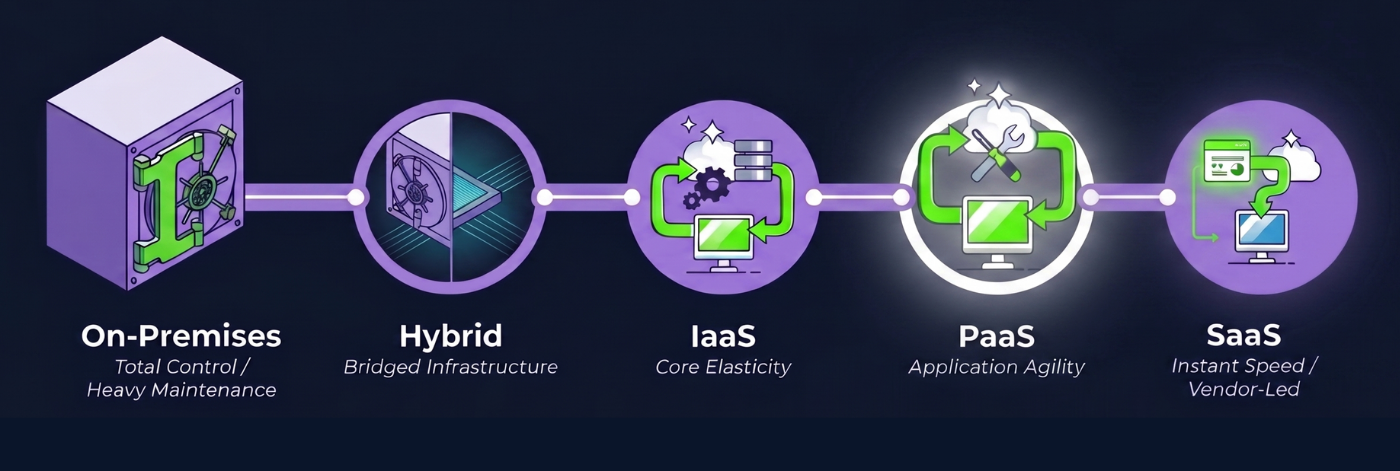
Infographic comparing five CCM deployment models: On-Premises, Hybrid, IaaS, PaaS, and SaaS. The models are shown left to right as a connected journey, with PaaS highlighted as the central focus. On-Premises is described as total control with heavy maintenance. Hybrid is bridged infrastructure. IaaS offers core elasticity. PaaS offers application agility. SaaS offers instant speed but is vendor-led.

The table below lets you just briefly compare these deployment models side by side by specific factors so you can see how they stack up against each other.

FactorOn-PremiseIaaSSaaSPaaSHybrid
Who controlsYour companyYour company (stack)VendorYour company (app)Split
Where data livesInternal serversCloud infrastructureVendor cloudCloud (Azure / AWS)Split across environments
Who responds to outagesInternal ITYour teamVendorYour teamDepends on architecture
Speed of changeLowMediumHighMedium to highMedium
Compliance controlFullHighLimitedHighComplex
Cost modelCapExOpEx + opsOpExMixedHigh overhead
Team requirementSignificantSignificantLowMature IT teamVery high
Best fitStable processesControl without a data centreFast startControl plus flexibilityLegacy plus cloud mix

How Each Model Behaves in Production

On-Premise: Predictable, Governed, and Entirely Yours

On-premise CCM runs on your servers and is managed by your internal team. You hold full authority over data residency, security, and release cycles, which suits stable workflows where regulators expect fully governed output. 

The cost is speed: every change moves through your own development and testing cycles, so when a deadline arrives, your responsiveness is capped by your IT queue. It is like owning a house outright. Much like owning your own home, this approach offers complete autonomy while requiring you to manage all aspects of maintenance and infrastructure recovery yourself.

IaaS: Rented Infrastructure, Your Own Stack

With IaaS, you rent compute and storage from a cloud provider, but you still install and operate the OS, the middleware, and the Inspire stack yourself. It is the step between on-premise and PaaS. You drop the capital cost of hardware and the burden of a physical data centre, yet you keep full responsibility for everything that runs on top. This fits teams that need cloud-grade control over the environment without owning the building it sits in. 

The trade-off is that patching, scaling, and stack stability stay your job, not the provider’s.

SaaS: When Time-to-Value Is the Priority

SaaS CCM gives you a working platform from day 1 with no infrastructure to manage, and updates arrive automatically. It is the right call when speed and simplicity matter more than granular control. 

The limit is flexibility. Customisation and data handling stay inside the vendor’s architecture, so if your compliance team needs data pinned to a specific location, you often have little room to change the vendor’s setup.

PaaS: Control Over the Application, and Responsibility for It

In a PaaS model, your CCM runs in a cloud environment such as Azure or AWS, and your team controls the application layer: templates, business logic, and configuration. For many enterprises this is the strongest balance of governance and agility. A Product Owner can push a template change without filing an infrastructure ticket, and a compliance team can keep data in a chosen jurisdiction.

In practice, ‘application layer control’ comes with significant responsibilities. Beyond templates, your team owns the runtime environment, monitoring, scaling, and uptime. 

This is the reality of PaaS: it only pays off if you have a mature team behind it. And a real conversation is about who is going to run it effectively.

Hybrid: For Estates Too Large for a Single Model

Hybrid combines 2 or more environments. A common pattern processes batch statements on-premise while notifications route through SaaS. It is typical in large organisations with legacy systems that cannot be replaced at once. The condition for success is strict architecture governance.

Without clear ownership and a mapped data flow, a hybrid estate drifts into disconnected silos running under separate and inconsistent compliance regimes.

Where the Real Risks Show Up

The Problems That Do Not Appear in a Vendor Demo

Whichever model you choose, 4 risks keep surfacing in real deployments, usually months after go-live.

Data residency gaps. Your compliance team assumes data stays inside the EU, then discovers that a SaaS provider’s CDN or backup infrastructure spans regions that were never named during the sales process.

Audit trail blind spots. Regulated industries need an unbroken record of who changed what, when, and why. Some deployment models need custom instrumentation to produce that record, and the cost rarely makes it into the original budget.

Vendor lock-in. Proprietary template formats, data structures, and integration layers build up over years of production use. The longer you wait, the more expensive migration becomes.

SLA mismatch. A vendor promising 99.9% uptime sounds reassuring until you need documents generated within 4 hours of a triggering event. Uptime and responsiveness are different commitments, and only one of them is usually in the contract.

Decision Framework: Matching Priorities to a Model

A Practical Comparison

FactorOn-PremiseIaaSSaaSPaaSHybrid
ControlFullHighVendor-ledHighSplit
Data locationInternalCloudVendor cloudYour cloudLegacy + cloud
Speed of changeLowMediumVery highHighMedium
Audit / complianceDirect accessHighLimitedCustom logsComplex
FinancesCapExOpEx + opsOpExMixedHigh overhead
ScalingManualFlexibleAutomaticCloud-nativeMixed
Main riskTeam dependencyStack loadData controlNeeds mature ITFragmentation

The rules below turn the table into a starting position.

  • Control and data sovereignty are non-negotiable: choose On-Premise or PaaS, where you keep full authority over residency and security policy.
  • Speed to launch is the priority: choose SaaS, for standard use cases with minimal infrastructure.
  • You want control over the infrastructure but will not build a data centre: choose IaaS.
  • You need cloud agility with enterprise governance and you have a mature IT team: choose PaaS.
  • You run a complex mix of legacy and modern systems: choose Hybrid, with budget set aside for governance.

CCM in Banking, Insurance and Regulated Industries: Where the Stakes Are Highest

In BFSI, utilities, telecomm and many other regulated industries, every statement and policy update is a legal record. A formatting error or a delayed delivery is a fine and a failed audit.

Quadient Inspire handles custom business logic at the template and workflow level. When a regulatory change comes up, it deploys through configuration, not through a development cycle. The compliance team gets the change, and IT does not get another ticket.

Holding a Quadient licence or not, our CCM solutions will fit the business logic, supporting multi-channel output orchestration, conditional content logic, and template versioning across print, email, portal, and SMS from a single composition layer. The most promising CCM model is already bringing value to a Dutch insurance leader, which chose to delegate what it did not want to own internally: platform maintenance, environment monitoring, and upgrade cycles while retaining full control over template design and business rules.

The PaaS model runs on a BYOL basis: you keep the licence, we manage the infrastructure layer, platform monitoring, version upgrades, and incident response, so your team focuses on communications, not on keeping the environment alive. Quadient Inspire supports all five deployment models, from on-premise to full SaaS. That matters specifically when a regulatory change requires moving data residency or when the business needs to shift from batch to real-time delivery. The architecture moves. The platform does not need replacing.

Without a clear deployment model, CCM licensing and infrastructure spend grow faster than operational output. Across our implementations, we keep that under control through three decisions made early:

  • The first is model selection: PaaS or Hybrid where it removes on-premise infrastructure cost without pushing data outside the required jurisdiction.
  • The second is operational configuration: the platform is set up so a Product Owner edits templates directly, without a developer ticket or a sprint cycle.
  • The third is compliance architecture: data residency and SLA gaps are resolved during implementation, not discovered when the compliance team flags them months later.

Migration and Model Selection Go Together

You Cannot Separate Where to Host From How to Get There

Choosing a platform model without a migration plan is like choosing a destination without checking whether the roads reach it. The model you want may require data transformation, template re-engineering, or rebuilt integrations, and those tasks shape the timeline more than the infrastructure choice itself. Teams that treat migration as a later phase run into scope creep almost every time. Our 6-step CCM data migration framework covers the pitfalls we see most.

Making the Decision on Your Terms

Your CCM platform model goes deeper than a technology preference. It decides who picks up the phone when a regulator calls, how long the business waits for a template change, and whether your data sits where your compliance team says it does.

The right model depends on your regulatory profile, your internal resources, and your team’s tolerance for operational ownership. That is why a clear view of your current total cost of ownership tells you more than any feature grid. We have set out the strategic and operational sides of legacy CCM migration, along with the accessibility pressures on legacy CCM that often force the timing.

More teams are running these numbers before a deadline forces the decision, because the calculation is easier now than at the moment when another compliance requirement or a channel gap makes it urgent.

Planning your CCM architecture and trying to balance control, compliance, and cost? PaaS Deployment is about deploying Quadient Inspire is organised in the way that fits both your team, budget, scale and regulatory safety objectives – no limitations on you with no vendor limits on how you configure, extend, or govern it.

How PaaS Enables Scalable & Controlled Customer Communication Operations in Regulated Industries 

09:15 – Compliance flags a mandatory disclosure update. One sentence across all contracts.

09:20 – You calculate the timeline: IT ticket submission, infrastructure review, middleware validation, deployment scheduling, testing windows.

Week 4 – If everything goes perfectly, the change ships. If not, you’re explaining to regulators why you missed the deadline.

Industry data for 2025 suggests that around 20% of consumers switched providers due to poor communication quality, highlighting a direct retention risk for banks and insurers where high-volume, highly adapted content is a baseline expectation. The example above – the story which happens to most of companies in regulated industries, especially with a massive template heriatage.

Most operations leaders managing customer communications in banking and insurance face a complex situation. A single contract wording change, like updating a clause for regulatory compliance or correcting a fee disclosures, requires coordinating across infrastructure teams, middleware specialists, and application developers. And the result is never satisfying: release cycles measured in weeks when the business needs changes in days.

For those who is responsible for document production, communications infrastructure reliability, and operational continuity of CCM-dependent processes, this dependency represents their single largest frustration: they’re accountable for outcomes, speed and reliability but lack control over the underlying technology that determines those outcomes.

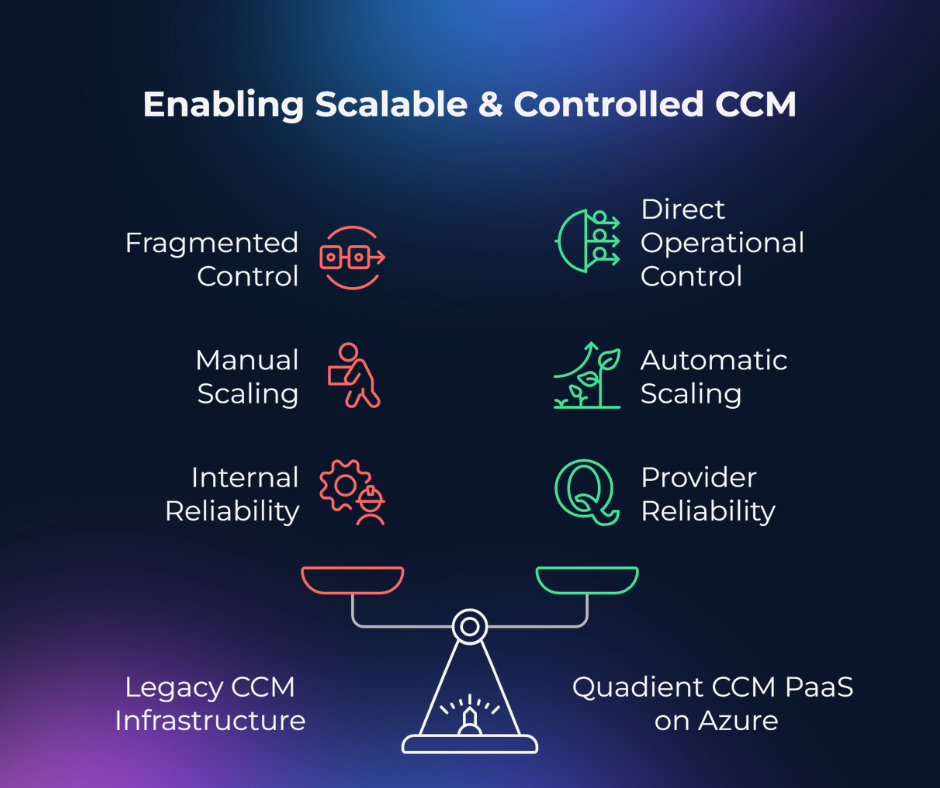
Responsibility is centralised and control is fragmented.

A transition to a Platform as a Service (PaaS) model alters how Customer Communications Management (CCM) is operated, moving it from a cost-driven function to a scalable delivery capability. Deployment architecture becomes an accelerator rather than a constraint: PaaS abstracts infrastructure management, reduces friction in release cycles, and enables faster, safer iteration.

Thus, cloud-based CCM allows organisations to deliver many content and template changes without requiring deep technical intervention for each update.

How CCM Platform-as-a-Service Architecture Changes Operational Control

A transition to Platform-as-a-Service (PaaS) in Customer Communication fundamentally alters the relationship between operations teams and the technology infrastructure. It becomes about shifting operational control from constrained dependency to managed capability.

Responsibility Split Model for Operational Autonomy

PaaS in cloud computing means that the provider handles the complete maintenance of physical servers, network infrastructure, data storage, operating systems, and the runtime environment. Internal teams stop spending their time maintaining infrastructure that does not differentiate the business. CapacityThe company focuses exclusively on business applications and data management.

What remains under operations control: business applications, template management, content authoring, and data governance. This separation matters because it eliminates the coordination overhead that creates operational delays. When template modifications don’t require infrastructure changes, or content updates don’t depend on middleware configuration, operations teams regain direct control over the communication production workflow.

Stack ComponentPaaS Model ResponsibilityImpact on the CCM System Operationability
HardwareCloud ProviderNo CAPEX and no responsibility for physical infrastructure maintenance
Operating SystemCloud ProviderAutomatic security updates and patching
Runtime / MiddlewareCloud ProviderStable and provider-validated runtime environment for document composition
CCM ApplicationsClient / Implementation PartnerComplete focus on design and business logic
Customer DataClientFull control via SSO and encryption

The practical impact of this separation becomes clear in routine operations scenarios. Consider a typical example: regulatory requirements mandate disclosure changes across all customer communications as soon as possible.

Traditional Infrastructure: Operations team submits change request. IT infrastructure team schedules capacity assessment. Middleware team validates template modifications won’t impact other systems. Database team reviews data structure changes. Security team approves deployment to production. Testing cycles occur sequentially due to environment availability constraints. Total timeline: 18-25 days consumed by coordination before operations team even begins template modifications.

PaaS Architecture: Operations team accesses test environment immediately (environments provisioned automatically via Infrastructure-as-Code). Template modifications occur directly in Quadient Interactive interface without middleware dependencies. Automated deployment pipeline moves validated changes through test-to-production environments. Security protocols (SSO, encryption) already configured at platform level. Total timeline: 3-5 days from requirement identification to production deployment, with 80% of time spent on content validation rather than technical coordination.

It’s operational reality that eliminates the dependency bottleneck operations managers identify as their primary frustration.

An infographic titled "Enabling Scalable & Controlled CCM" comparing "Legacy CCM Infrastructure" (left) with "Quadient CCM PaaS on Azure" (right) using a balance scale metaphor.

On the left (Red icons): "Fragmented Control" represented by a disconnected node icon, "Manual Scaling" shown by a person carrying a heavy box, and "Internal Reliability" shown by gears and a hard hat.

On the right (Green icons): "Direct Operational Control" shown by a centralized signal icon, "Automatic Scaling" shown by a growing plant and upward arrow, and "Provider Reliability" shown by a stylized 'Q' logo.

Bottom: The scale is perfectly balanced between the legacy and modern solutions.

Technical Enablers That Create Operational Capability

Infrastructure-as-Code: Environments On Demand

CCM PaaS leverage Infrastructure-as-Code (IaC) approaches to provision complete environments in minutes rather than weeks. This typically happens on Terraform for Quadient Inspire deployments on Azure.

Development, testing, acceptance, and production environments become identical by design, eliminating configuration drift that creates unpredictable deployment failures. When testing validates functionality, operations teams know production will behave identically. This removes the “it worked in test but failed in production” scenario that creates operational crises during critical deployments.

Capacity scaling occurs automatically in response to processing load, rather than requiring capacity planning, procurement, and provisioning cycles. During peak periods, infrastructure expands to handle volume, then contracts afterwards and operations teams no longer manage capacity constraints manually.

MetricOn-Premise InfrastructurePaaS on Azure
Environment LaunchWeeks or monthsMinutes using Infrastructure-as-Code (e.g., Terraform)
Scaling under peak loadLimited by hardware resourceAutomatic horizontal expansion
Document Processing SpeedBaseline2x Increase
System AvailabilityDependent on local redundancyGeo-redundancy aligned with Azure service-level availability targets (e.g., 99.9% for specific services under defined configurations)

Security and Compliance: Built-In Rather Than Bolted-On

  • Azure Active Directory (Entra ID) Integration: Single Sign-On (SSO) ensures only authorised employees access CCM systems, with authentication protocols operations teams already use for other enterprise applications. This eliminates separate credential management and reduces security exposure from password-based authentication.
  • Azure Application Gateway with Web Application Firewall: Protection against common web attacks (SQL injection, cross-site scripting) occurs at Layer 7, securing web interfaces business users access for template editing. Operations teams don’t manage firewall rules or security patches – platform provider handles this automatically.
  • Azure Automation Runbooks: Routine operational tasks like database backups, certificate renewals, system monitoring, execute automatically via configured runbooks. This eliminates manual intervention points that create operational risk whilst reducing operations team workload.

Strategic trade-offs in CCM PaaS implementation 

The choice of deployment model always depends on a balance between control, speed to market, and specific national regulatory constraints.

Scenarios Where PaaS Delivers Operational Relief

  • Unpredictable activity spikes
    This applies when the business has pronounced seasonality or conducts mass marketing campaigns requiring the instantaneous generation of large content volumes.
  • Hyper-personalisation
    This is an emerging practice in customer communications that gained significant momentum in 2025 and is increasingly adopted across regulated communication workflows as AI-driven capabilities mature. By combining real-time data with automation and AI, hyper-personalisation takes traditional personalised communications several steps further.
  • Business team autonomy
    Providing marketing and product teams with the ability to edit text and promotional conditions independently through the Interactive web interface removes delays. This relieves the organisation of ticket fatigue, where specialists wait weeks for developer availability to correct a single clause in a contract.

Why Operations Leaders Choose CCM PaaS?

For Heads of Operations managing customer communication workflows, PaaS resolves a structural mismatch – being accountable for outcomes whilst dependent on technology infrastructure they don’t control.

Traditional infrastructure creates operational dependency chains: template modifications require developer availability, capacity scaling requires infrastructure team prioritisation, compliance implementations require coordination across IT, security, and application teams. Every dependency creates delay, and every delay creates operational risk.

PaaS architecture doesn’t eliminate all dependencies – no operational environment operates in complete isolation. However, it eliminates the dependencies that create operational bottlenecks:

  1. Template modifications no longer require infrastructure changes. Content updates no longer depend on middleware configuration. Capacity stops being something teams have to predict months in advance, and something they get blamed for when predictions are wrong. Security updates no longer require coordinated deployment windows.
  2. What remains are business-level dependencies that operations teams expect to manage. What disappears are technical dependencies that created delays operations teams couldn’t control.

Transformation from constrained dependency to managed capability represents the operational value proposition that drives PaaS adoption in regulated industries. The technical architecture matters only insofar as it enables operational autonomy.

The primary concern for any operations leader evaluating infrastructure modernisation: “How do we transition without disrupting customer-facing operations?”

Implementation Which Saves Ages for Operations Teams

The primary concern for any operations leader evaluating infrastructure modernisation: “How do we transition without disrupting customer-facing operations?”

Successful PaaS migrations follow phased approaches designed specifically to preserve operational continuity and eliminate production risk.

Parallel Environment Construction

New PaaS infrastructure deploys fully independently from existing production systems. Operations teams continue business-as-usual while the new environment undergoes comprehensive validation.

This approach was critical for example in a Dutch Healthcare Insurer‘s transformation, where a fully isolated Azure-based environment was deployed and tested independently before any production cutover. This ensured uninterrupted policyholder communications while enabling the platform to handle peak renewal volumes with zero downtime once activated.

Systematic Template Migration

In case of Legacy System Migration projects, templates should be migrated in controlled priority order – either highest-volume communications first or lowest-complexity templates first, depending on operational risk strategy. Each migrated template undergoes full end-to-end validation, including data integration, rendering accuracy, accessibility compliance, and output integrity.

Cutover During Quiet Periods

Final production cutover is scheduled during the lowest-volume operational periods, supported by predefined rollback procedures. This guarantees immediate recovery capability in the unlikely event of unexpected behaviour.

This model enabled regulated organisations to transition fully to Azure-hosted CCM environments while maintaining uninterrupted service delivery during critical business cycles, including renewal periods and compliance-driven document updates.

Knowledge Transfer and Training

Operations teams receive hands-on training in the new operational model before assuming responsibility. This includes Interactive template management, automated deployment workflows, and real-time monitoring dashboards.

As demonstrated in production deployments, business stakeholders gained direct operational control over content changes without relying on developer availability. This removed operational bottlenecks and significantly reduced turnaround time for regulatory and customer communication updates.

Integration capabilities of Quadient and Azure 

The synergy between Quadient Inspire and Microsoft Azure creates a secure and productive environment for large-scale communications. This allows for the construction of omnichannel strategies where the customer receives an identical service level regardless of the chosen communication channel.

Security and architectural control

For projects in the financial sector, we integrate the following components to ensure enterprise-grade protection:

  • Azure Active Directory (Entra ID)
    This enables reliable Single Sign-On (SSO), ensuring that only authorised employees access the system.
  • Azure Application Gateway with WAF
    This provides protection against common web attacks, such as SQL injection and cross-site scripting. Traffic filtering occurs at Layer 7, securing the web interfaces for business users.
  • Azure Automation Runbooks
    This enables the full automation of routine operations, such as creating daily database backups, updating domain security certificates, and monitoring virtual machine status.

Summary

Most organisations don’t adopt CCM PaaS because it is technically superior. They adopt it because waiting three weeks to change a sentence is no longer operationally acceptable.

Platform as a Service (PaaS) becomes the appropriate choice for Customer Communications Management when communication volume is variable, regulatory change is continuous, and business teams require controlled autonomy – without waiting on infrastructure cycles. In these conditions, deployment architecture directly affects delivery speed, compliance risk, and operational cost.

Organisations operating under strict regulatory oversight, managing high-volume personalised communications, and relying on multiple downstream systems benefit from PaaS because infrastructure concerns are removed from the critical path of content delivery. The result is predictable scalability, repeatable environments, and compliance embedded at design time rather than enforced retroactively.

Where these constraints apply, the remaining question is not whether to modernise Customer Communication Management system, but how quickly the organisation can transition without disrupting production workloads. Our managed Quadient PaaS service on Azure addresses this transition through controlled migration, validated architectures, and regulated-industry operating models.

Explore the Customer Communication Management PaaS service to find out how this architecture could be implemented in practice to ease your operational challenges