

Where Your CCM Lives: Choosing Deployment Models for Regulated Customer Communication Management

By the time the business realises that pushing a single template change takes weeks, because the request is behind several layers of internal infrastructure approval, the platform contract is already signed. The CCM deployment model looked like an IT detail during procurement. However, in practice, it sets your operating model for the next 5+ years.
For an enterprise architecture, the CCM questions are about the following:
- where the data physically lives,
- who controls data sovereignty,
- who holds the keys to the production environment,
- how fast a regulatory change can reach a customer’s statement.
And this is rarely about which CCM product has the longer feature list.`
This article breaks down 5 CCM platform deployment models for Customer Communications Management: On-Premise, IaaS, SaaS, PaaS, and Hybrid. Three of them are CCM cloud models, and choosing between these is what shapes your operating reality. They are compared through the factors that decide it:
- who controls the stack,
- where the data sits,
- who carries the risk,
- what each model demands from your team.
This Is an Architecture Decision, Not a Procurement One
The Platform Deployment Model Becomes Your Operating Model
A CCM platform is far more than a hosting decision; it is a primary driver of your operating model, impacting everything from your SLAs to your team’s ability to navigate complex regulatory landscapes. When some new mandatory deadline is announced, the success depends on how quickly you can push updates to production and whether your team has the necessary authority to execute those changes.
When facing a compressed implementation window, the platform model either facilitates a rapid deployment or forces you into a rigid, ticket-based sprint cycle. That distinction is far more significant than a line item in an IT budget, as it dictates your organisation’s ability to remain compliant under pressure.
Even as the 2024 IDC market report notes a steady transition to cloud-native communication, it remains essential to choose a platform that aligns with how your team operates in practice instead of simply chasing industry trends.
5 CCM Platform Deployment Models at a Glance
Think of this as a quick orientation before diving into the weeds.
On one side, you have On-Premise, which offers total control but puts the entire burden of responsibility on you; on the other, you have SaaS, which gets you up and running instantly but leaves you with much less control. IaaS and PaaS sit somewhere in the middle, splitting up the tech stack in different ways. A
And since a single approach rarely works for a large, regulated organisation, many teams opt for a hybrid model to bridge the gaps.
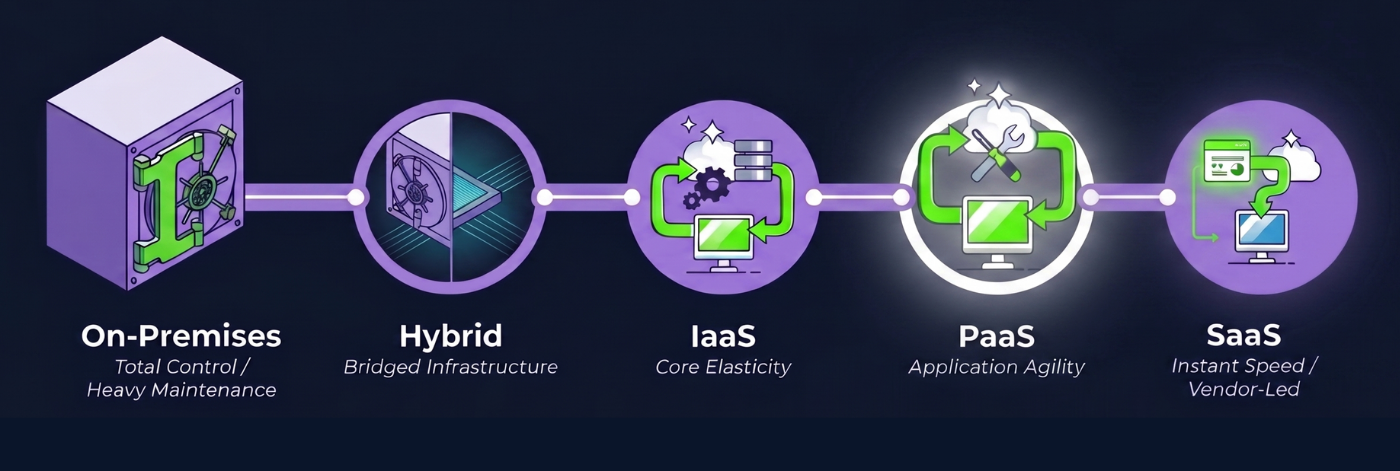
The table below lets you just briefly compare these deployment models side by side by specific factors so you can see how they stack up against each other.
| Factor | On-Premise | IaaS | SaaS | PaaS | Hybrid |
| Who controls | Your company | Your company (stack) | Vendor | Your company (app) | Split |
| Where data lives | Internal servers | Cloud infrastructure | Vendor cloud | Cloud (Azure / AWS) | Split across environments |
| Who responds to outages | Internal IT | Your team | Vendor | Your team | Depends on architecture |
| Speed of change | Low | Medium | High | Medium to high | Medium |
| Compliance control | Full | High | Limited | High | Complex |
| Cost model | CapEx | OpEx + ops | OpEx | Mixed | High overhead |
| Team requirement | Significant | Significant | Low | Mature IT team | Very high |
| Best fit | Stable processes | Control without a data centre | Fast start | Control plus flexibility | Legacy plus cloud mix |
How Each Model Behaves in Production
On-Premise: Predictable, Governed, and Entirely Yours
On-premise CCM runs on your servers and is managed by your internal team. You hold full authority over data residency, security, and release cycles, which suits stable workflows where regulators expect fully governed output.
The cost is speed: every change moves through your own development and testing cycles, so when a deadline arrives, your responsiveness is capped by your IT queue. It is like owning a house outright. Much like owning your own home, this approach offers complete autonomy while requiring you to manage all aspects of maintenance and infrastructure recovery yourself.
IaaS: Rented Infrastructure, Your Own Stack
With IaaS, you rent compute and storage from a cloud provider, but you still install and operate the OS, the middleware, and the Inspire stack yourself. It is the step between on-premise and PaaS. You drop the capital cost of hardware and the burden of a physical data centre, yet you keep full responsibility for everything that runs on top. This fits teams that need cloud-grade control over the environment without owning the building it sits in.
The trade-off is that patching, scaling, and stack stability stay your job, not the provider’s.
SaaS: When Time-to-Value Is the Priority
SaaS CCM gives you a working platform from day 1 with no infrastructure to manage, and updates arrive automatically. It is the right call when speed and simplicity matter more than granular control.
The limit is flexibility. Customisation and data handling stay inside the vendor’s architecture, so if your compliance team needs data pinned to a specific location, you often have little room to change the vendor’s setup.
PaaS: Control Over the Application, and Responsibility for It
In a PaaS model, your CCM runs in a cloud environment such as Azure or AWS, and your team controls the application layer: templates, business logic, and configuration. For many enterprises this is the strongest balance of governance and agility. A Product Owner can push a template change without filing an infrastructure ticket, and a compliance team can keep data in a chosen jurisdiction.
In practice, ‘application layer control’ comes with significant responsibilities. Beyond templates, your team owns the runtime environment, monitoring, scaling, and uptime.
This is the reality of PaaS: it only pays off if you have a mature team behind it. And a real conversation is about who is going to run it effectively.
Hybrid: For Estates Too Large for a Single Model
Hybrid combines 2 or more environments. A common pattern processes batch statements on-premise while notifications route through SaaS. It is typical in large organisations with legacy systems that cannot be replaced at once. The condition for success is strict architecture governance.
Without clear ownership and a mapped data flow, a hybrid estate drifts into disconnected silos running under separate and inconsistent compliance regimes.
Where the Real Risks Show Up
The Problems That Do Not Appear in a Vendor Demo
Whichever model you choose, 4 risks keep surfacing in real deployments, usually months after go-live.
Data residency gaps. Your compliance team assumes data stays inside the EU, then discovers that a SaaS provider’s CDN or backup infrastructure spans regions that were never named during the sales process.
Audit trail blind spots. Regulated industries need an unbroken record of who changed what, when, and why. Some deployment models need custom instrumentation to produce that record, and the cost rarely makes it into the original budget.
Vendor lock-in. Proprietary template formats, data structures, and integration layers build up over years of production use. The longer you wait, the more expensive migration becomes.
SLA mismatch. A vendor promising 99.9% uptime sounds reassuring until you need documents generated within 4 hours of a triggering event. Uptime and responsiveness are different commitments, and only one of them is usually in the contract.
Decision Framework: Matching Priorities to a Model
A Practical Comparison
| Factor | On-Premise | IaaS | SaaS | PaaS | Hybrid |
| Control | Full | High | Vendor-led | High | Split |
| Data location | Internal | Cloud | Vendor cloud | Your cloud | Legacy + cloud |
| Speed of change | Low | Medium | Very high | High | Medium |
| Audit / compliance | Direct access | High | Limited | Custom logs | Complex |
| Finances | CapEx | OpEx + ops | OpEx | Mixed | High overhead |
| Scaling | Manual | Flexible | Automatic | Cloud-native | Mixed |
| Main risk | Team dependency | Stack load | Data control | Needs mature IT | Fragmentation |
The rules below turn the table into a starting position.
- Control and data sovereignty are non-negotiable: choose On-Premise or PaaS, where you keep full authority over residency and security policy.
- Speed to launch is the priority: choose SaaS, for standard use cases with minimal infrastructure.
- You want control over the infrastructure but will not build a data centre: choose IaaS.
- You need cloud agility with enterprise governance and you have a mature IT team: choose PaaS.
- You run a complex mix of legacy and modern systems: choose Hybrid, with budget set aside for governance.
CCM in Banking, Insurance and Regulated Industries: Where the Stakes Are Highest
In BFSI, utilities, telecomm and many other regulated industries, every statement and policy update is a legal record. A formatting error or a delayed delivery is a fine and a failed audit.
Quadient Inspire handles custom business logic at the template and workflow level. When a regulatory change comes up, it deploys through configuration, not through a development cycle. The compliance team gets the change, and IT does not get another ticket.
Holding a Quadient licence or not, our CCM solutions will fit the business logic, supporting multi-channel output orchestration, conditional content logic, and template versioning across print, email, portal, and SMS from a single composition layer. The most promising CCM model is already bringing value to a Dutch insurance leader, which chose to delegate what it did not want to own internally: platform maintenance, environment monitoring, and upgrade cycles while retaining full control over template design and business rules.
The PaaS model runs on a BYOL basis: you keep the licence, we manage the infrastructure layer, platform monitoring, version upgrades, and incident response, so your team focuses on communications, not on keeping the environment alive. Quadient Inspire supports all five deployment models, from on-premise to full SaaS. That matters specifically when a regulatory change requires moving data residency or when the business needs to shift from batch to real-time delivery. The architecture moves. The platform does not need replacing.
Without a clear deployment model, CCM licensing and infrastructure spend grow faster than operational output. Across our implementations, we keep that under control through three decisions made early:
- The first is model selection: PaaS or Hybrid where it removes on-premise infrastructure cost without pushing data outside the required jurisdiction.
- The second is operational configuration: the platform is set up so a Product Owner edits templates directly, without a developer ticket or a sprint cycle.
- The third is compliance architecture: data residency and SLA gaps are resolved during implementation, not discovered when the compliance team flags them months later.
Migration and Model Selection Go Together
You Cannot Separate Where to Host From How to Get There
Choosing a platform model without a migration plan is like choosing a destination without checking whether the roads reach it. The model you want may require data transformation, template re-engineering, or rebuilt integrations, and those tasks shape the timeline more than the infrastructure choice itself. Teams that treat migration as a later phase run into scope creep almost every time. Our 6-step CCM data migration framework covers the pitfalls we see most.
Making the Decision on Your Terms
Your CCM platform model goes deeper than a technology preference. It decides who picks up the phone when a regulator calls, how long the business waits for a template change, and whether your data sits where your compliance team says it does.
The right model depends on your regulatory profile, your internal resources, and your team’s tolerance for operational ownership. That is why a clear view of your current total cost of ownership tells you more than any feature grid. We have set out the strategic and operational sides of legacy CCM migration, along with the accessibility pressures on legacy CCM that often force the timing.
More teams are running these numbers before a deadline forces the decision, because the calculation is easier now than at the moment when another compliance requirement or a channel gap makes it urgent.
Planning your CCM architecture and trying to balance control, compliance, and cost? PaaS Deployment is about deploying Quadient Inspire is organised in the way that fits both your team, budget, scale and regulatory safety objectives – no limitations on you with no vendor limits on how you configure, extend, or govern it.
Let’s drive your Digital Transformation Together.
Schedule a free consultation with our team to explore how we can help you achieve your goals.
See also

Adobe Experience Manager End of Life: What It Means for Communications-Generating Teams in Banking and Insurance

Modernise vs Migrate the CCM: How BFSI Decide on Their CCM Transformation
