Accessibility Tools

Skip to main content

Stage: Consideration

How PaaS Enables Scalable & Controlled Customer Communication Operations in Regulated Industries 

09:15 – Compliance flags a mandatory disclosure update. One sentence across all contracts.

09:20 – You calculate the timeline: IT ticket submission, infrastructure review, middleware validation, deployment scheduling, testing windows.

Week 4 – If everything goes perfectly, the change ships. If not, you’re explaining to regulators why you missed the deadline.

Industry data for 2025 suggests that around 20% of consumers switched providers due to poor communication quality, highlighting a direct retention risk for banks and insurers where high-volume, highly adapted content is a baseline expectation. The example above – the story which happens to most of companies in regulated industries, especially with a massive template heriatage.

Most operations leaders managing customer communications in banking and insurance face a complex situation. A single contract wording change, like updating a clause for regulatory compliance or correcting a fee disclosures, requires coordinating across infrastructure teams, middleware specialists, and application developers. And the result is never satisfying: release cycles measured in weeks when the business needs changes in days.

For those who is responsible for document production, communications infrastructure reliability, and operational continuity of CCM-dependent processes, this dependency represents their single largest frustration: they’re accountable for outcomes, speed and reliability but lack control over the underlying technology that determines those outcomes.

Responsibility is centralised and control is fragmented.

A transition to a Platform as a Service (PaaS) model alters how Customer Communications Management (CCM) is operated, moving it from a cost-driven function to a scalable delivery capability. Deployment architecture becomes an accelerator rather than a constraint: PaaS abstracts infrastructure management, reduces friction in release cycles, and enables faster, safer iteration.

Thus, cloud-based CCM allows organisations to deliver many content and template changes without requiring deep technical intervention for each update.

How CCM Platform-as-a-Service Architecture Changes Operational Control

A transition to Platform-as-a-Service (PaaS) in Customer Communication fundamentally alters the relationship between operations teams and the technology infrastructure. It becomes about shifting operational control from constrained dependency to managed capability.

Responsibility Split Model for Operational Autonomy

PaaS in cloud computing means that the provider handles the complete maintenance of physical servers, network infrastructure, data storage, operating systems, and the runtime environment. Internal teams stop spending their time maintaining infrastructure that does not differentiate the business. CapacityThe company focuses exclusively on business applications and data management.

What remains under operations control: business applications, template management, content authoring, and data governance. This separation matters because it eliminates the coordination overhead that creates operational delays. When template modifications don’t require infrastructure changes, or content updates don’t depend on middleware configuration, operations teams regain direct control over the communication production workflow.

Stack ComponentPaaS Model ResponsibilityImpact on the CCM System Operationability
HardwareCloud ProviderNo CAPEX and no responsibility for physical infrastructure maintenance
Operating SystemCloud ProviderAutomatic security updates and patching
Runtime / MiddlewareCloud ProviderStable and provider-validated runtime environment for document composition
CCM ApplicationsClient / Implementation PartnerComplete focus on design and business logic
Customer DataClientFull control via SSO and encryption

The practical impact of this separation becomes clear in routine operations scenarios. Consider a typical example: regulatory requirements mandate disclosure changes across all customer communications as soon as possible.

Traditional Infrastructure: Operations team submits change request. IT infrastructure team schedules capacity assessment. Middleware team validates template modifications won’t impact other systems. Database team reviews data structure changes. Security team approves deployment to production. Testing cycles occur sequentially due to environment availability constraints. Total timeline: 18-25 days consumed by coordination before operations team even begins template modifications.

PaaS Architecture: Operations team accesses test environment immediately (environments provisioned automatically via Infrastructure-as-Code). Template modifications occur directly in Quadient Interactive interface without middleware dependencies. Automated deployment pipeline moves validated changes through test-to-production environments. Security protocols (SSO, encryption) already configured at platform level. Total timeline: 3-5 days from requirement identification to production deployment, with 80% of time spent on content validation rather than technical coordination.

It’s operational reality that eliminates the dependency bottleneck operations managers identify as their primary frustration.

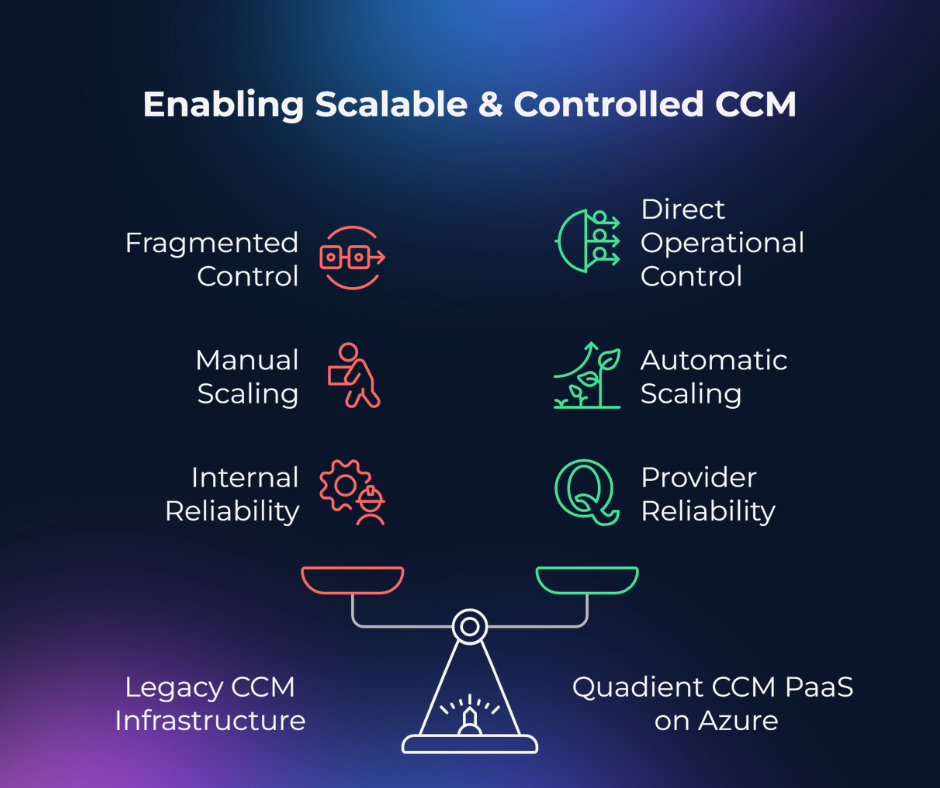
An infographic titled "Enabling Scalable & Controlled CCM" comparing "Legacy CCM Infrastructure" (left) with "Quadient CCM PaaS on Azure" (right) using a balance scale metaphor.

On the left (Red icons): "Fragmented Control" represented by a disconnected node icon, "Manual Scaling" shown by a person carrying a heavy box, and "Internal Reliability" shown by gears and a hard hat.

On the right (Green icons): "Direct Operational Control" shown by a centralized signal icon, "Automatic Scaling" shown by a growing plant and upward arrow, and "Provider Reliability" shown by a stylized 'Q' logo.

Bottom: The scale is perfectly balanced between the legacy and modern solutions.

Technical Enablers That Create Operational Capability

Infrastructure-as-Code: Environments On Demand

CCM PaaS leverage Infrastructure-as-Code (IaC) approaches to provision complete environments in minutes rather than weeks. This typically happens on Terraform for Quadient Inspire deployments on Azure.

Development, testing, acceptance, and production environments become identical by design, eliminating configuration drift that creates unpredictable deployment failures. When testing validates functionality, operations teams know production will behave identically. This removes the “it worked in test but failed in production” scenario that creates operational crises during critical deployments.

Capacity scaling occurs automatically in response to processing load, rather than requiring capacity planning, procurement, and provisioning cycles. During peak periods, infrastructure expands to handle volume, then contracts afterwards and operations teams no longer manage capacity constraints manually.

MetricOn-Premise InfrastructurePaaS on Azure
Environment LaunchWeeks or monthsMinutes using Infrastructure-as-Code (e.g., Terraform)
Scaling under peak loadLimited by hardware resourceAutomatic horizontal expansion
Document Processing SpeedBaseline2x Increase
System AvailabilityDependent on local redundancyGeo-redundancy aligned with Azure service-level availability targets (e.g., 99.9% for specific services under defined configurations)

Security and Compliance: Built-In Rather Than Bolted-On

  • Azure Active Directory (Entra ID) Integration: Single Sign-On (SSO) ensures only authorised employees access CCM systems, with authentication protocols operations teams already use for other enterprise applications. This eliminates separate credential management and reduces security exposure from password-based authentication.
  • Azure Application Gateway with Web Application Firewall: Protection against common web attacks (SQL injection, cross-site scripting) occurs at Layer 7, securing web interfaces business users access for template editing. Operations teams don’t manage firewall rules or security patches – platform provider handles this automatically.
  • Azure Automation Runbooks: Routine operational tasks like database backups, certificate renewals, system monitoring, execute automatically via configured runbooks. This eliminates manual intervention points that create operational risk whilst reducing operations team workload.

Strategic trade-offs in CCM PaaS implementation 

The choice of deployment model always depends on a balance between control, speed to market, and specific national regulatory constraints.

Scenarios Where PaaS Delivers Operational Relief

  • Unpredictable activity spikes
    This applies when the business has pronounced seasonality or conducts mass marketing campaigns requiring the instantaneous generation of large content volumes.
  • Hyper-personalisation
    This is an emerging practice in customer communications that gained significant momentum in 2025 and is increasingly adopted across regulated communication workflows as AI-driven capabilities mature. By combining real-time data with automation and AI, hyper-personalisation takes traditional personalised communications several steps further.
  • Business team autonomy
    Providing marketing and product teams with the ability to edit text and promotional conditions independently through the Interactive web interface removes delays. This relieves the organisation of ticket fatigue, where specialists wait weeks for developer availability to correct a single clause in a contract.

Why Operations Leaders Choose CCM PaaS?

For Heads of Operations managing customer communication workflows, PaaS resolves a structural mismatch – being accountable for outcomes whilst dependent on technology infrastructure they don’t control.

Traditional infrastructure creates operational dependency chains: template modifications require developer availability, capacity scaling requires infrastructure team prioritisation, compliance implementations require coordination across IT, security, and application teams. Every dependency creates delay, and every delay creates operational risk.

PaaS architecture doesn’t eliminate all dependencies – no operational environment operates in complete isolation. However, it eliminates the dependencies that create operational bottlenecks:

  1. Template modifications no longer require infrastructure changes. Content updates no longer depend on middleware configuration. Capacity stops being something teams have to predict months in advance, and something they get blamed for when predictions are wrong. Security updates no longer require coordinated deployment windows.
  2. What remains are business-level dependencies that operations teams expect to manage. What disappears are technical dependencies that created delays operations teams couldn’t control.

Transformation from constrained dependency to managed capability represents the operational value proposition that drives PaaS adoption in regulated industries. The technical architecture matters only insofar as it enables operational autonomy.

The primary concern for any operations leader evaluating infrastructure modernisation: “How do we transition without disrupting customer-facing operations?”

Implementation Which Saves Ages for Operations Teams

The primary concern for any operations leader evaluating infrastructure modernisation: “How do we transition without disrupting customer-facing operations?”

Successful PaaS migrations follow phased approaches designed specifically to preserve operational continuity and eliminate production risk.

Parallel Environment Construction

New PaaS infrastructure deploys fully independently from existing production systems. Operations teams continue business-as-usual while the new environment undergoes comprehensive validation.

This approach was critical for example in a Dutch Healthcare Insurer‘s transformation, where a fully isolated Azure-based environment was deployed and tested independently before any production cutover. This ensured uninterrupted policyholder communications while enabling the platform to handle peak renewal volumes with zero downtime once activated.

Systematic Template Migration

In case of Legacy System Migration projects, templates should be migrated in controlled priority order – either highest-volume communications first or lowest-complexity templates first, depending on operational risk strategy. Each migrated template undergoes full end-to-end validation, including data integration, rendering accuracy, accessibility compliance, and output integrity.

Cutover During Quiet Periods

Final production cutover is scheduled during the lowest-volume operational periods, supported by predefined rollback procedures. This guarantees immediate recovery capability in the unlikely event of unexpected behaviour.

This model enabled regulated organisations to transition fully to Azure-hosted CCM environments while maintaining uninterrupted service delivery during critical business cycles, including renewal periods and compliance-driven document updates.

Knowledge Transfer and Training

Operations teams receive hands-on training in the new operational model before assuming responsibility. This includes Interactive template management, automated deployment workflows, and real-time monitoring dashboards.

As demonstrated in production deployments, business stakeholders gained direct operational control over content changes without relying on developer availability. This removed operational bottlenecks and significantly reduced turnaround time for regulatory and customer communication updates.

Integration capabilities of Quadient and Azure 

The synergy between Quadient Inspire and Microsoft Azure creates a secure and productive environment for large-scale communications. This allows for the construction of omnichannel strategies where the customer receives an identical service level regardless of the chosen communication channel.

Security and architectural control

For projects in the financial sector, we integrate the following components to ensure enterprise-grade protection:

  • Azure Active Directory (Entra ID)
    This enables reliable Single Sign-On (SSO), ensuring that only authorised employees access the system.
  • Azure Application Gateway with WAF
    This provides protection against common web attacks, such as SQL injection and cross-site scripting. Traffic filtering occurs at Layer 7, securing the web interfaces for business users.
  • Azure Automation Runbooks
    This enables the full automation of routine operations, such as creating daily database backups, updating domain security certificates, and monitoring virtual machine status.

Summary

Most organisations don’t adopt CCM PaaS because it is technically superior. They adopt it because waiting three weeks to change a sentence is no longer operationally acceptable.

Platform as a Service (PaaS) becomes the appropriate choice for Customer Communications Management when communication volume is variable, regulatory change is continuous, and business teams require controlled autonomy – without waiting on infrastructure cycles. In these conditions, deployment architecture directly affects delivery speed, compliance risk, and operational cost.

Organisations operating under strict regulatory oversight, managing high-volume personalised communications, and relying on multiple downstream systems benefit from PaaS because infrastructure concerns are removed from the critical path of content delivery. The result is predictable scalability, repeatable environments, and compliance embedded at design time rather than enforced retroactively.

Where these constraints apply, the remaining question is not whether to modernise Customer Communication Management system, but how quickly the organisation can transition without disrupting production workloads. Our managed Quadient PaaS service on Azure addresses this transition through controlled migration, validated architectures, and regulated-industry operating models.

Explore the Customer Communication Management PaaS service to find out how this architecture could be implemented in practice to ease your operational challenges

EAA-ready Document Communications for Banking: Implementing Accessible Templates for a Leading Polish Bank

While nearly 45% of EU companies have yet to begin their accessibility efforts, this Polish bank chose a different path. Instead of waiting for regulatory pressure, they launched a forward-looking programme to bring all customer-facing documents in line with the highest accessibility standards ahead of the European Accessibility Act deadline. In practice, they set out to build EAA-ready document communications, treating accessibility not as a last-minute obligation, but as a core element of service quality, trust, and customer experience.

The Business Context: Why This Bank Acted Early

A 2025 Irish study shows that 61% of organisations identify technical implementation as the biggest barrier to EAA compliance. This bank recognised that challenge long before most of the market and chose to act early, turning what many firms see as a burden into a competitive advantage. The bank recognised that challenge early and addressed it proactively through partnership rather than struggling internally with education, manual implementation, document remediation and supporting the cross team collaboration.

Serving 1.5 million consumer finance customers, the bank viewed accessibility not simply as regulatory hygiene but as part of a broader strategy rooted in sustainability, inclusivity, and service excellence. By moving ahead of the EAA curve, they strengthened customer trust, reduced future remediation costs, and ensured operational continuity when enforcement tightens.

Same time, the bank’s upcoming collaboration with Quadient Inspire Technology positioned them well for this transition. However, implementing accessibility at scale across diverse document types required specialist expertise they didn’t possess internally. That’s where Quertum’s partnership became essential.

Facts Summary

Client: One of Poland’s largest financial institutions specialising in consumer credit and automotive financing. The Polish branch operates within an international banking group serving approximately 7.5 million customers nationwide, including around 1.5 million in the consumer financing division. In practical terms, 1 in 5 Polish citizens uses this bank’s services.

Service Delivered: Accessibility implementation for 53 multipage Word-based document templates using Quadient Inspire

Project Duration: Early March 2025 – April 2025

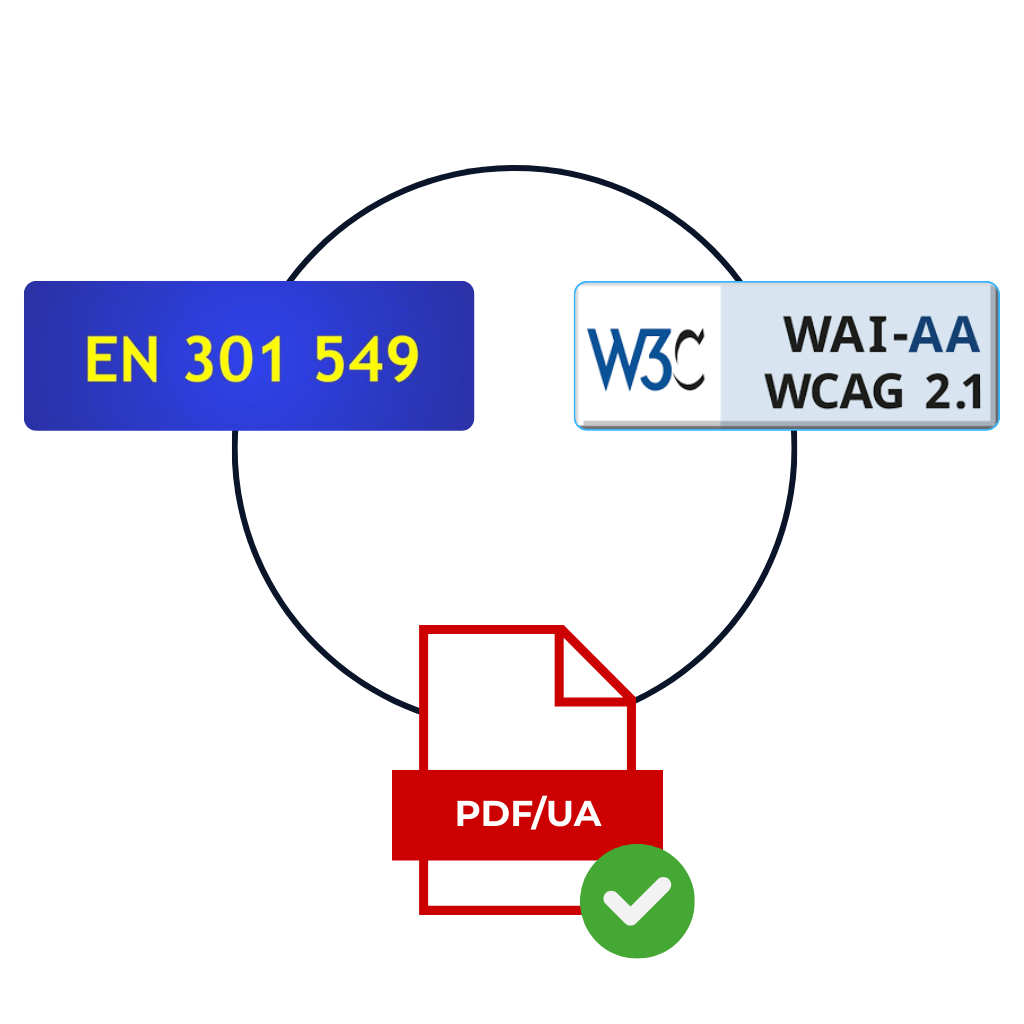
Challenge: Adapt high volumes of customer-facing documents to meet WCAG 2.1 AA, PDF/UA, and EN 301 549 accessibility standards within tight deadlines whilst maintaining document logic and operational continuity.

Outcome: 100% on-time delivery of accessible templates with zero disruption to customer communications, establishing a scalable process for ongoing EAA compliance across multiple departments.

Business Challenges: Scale, Speed, and Standards before EAA deadline

While accessibility was a new challenge for many teams within the industry, the bank team showed remarkable initiative and engagement to support their commitment to make the company inclusive and regulation-ready.

Same time bank’s team faced 4 interconnected challenges that made this project particularly complex:

1. High-Volume Delivery Under Tight Timelines

The most intensive project phase occurred in March 2025, requiring a high volume of documents to be adapted within a compressed timeframe. This added complexity and placed significant pressure on maintaining both speed and quality — two factors that typically conflict in accessibility implementations.

2. Technical Translation of Business Logic in CCM System

The bank needed to ensure templates met accessibility standards without compromising document logic or structure. Customer communications often contain complex conditional content, variable data fields, and regulatory disclosures that must remain accurate whilst becoming accessible. Translating this business logic into technically feasible templates within Quadient Inspire required deep expertise in both CCM platforms and accessibility standards.

3. Maintaining Quality at Scale

With multiple document types spanning different product lines and customer segments, the bank couldn’t afford inconsistent accessibility implementation. Every template needed to meet WCAG 2.1 AA, PDF/UA (ISO 14289), and EN 301 549 requirements uniformly, regardless of document complexity or department ownership.

4. Building Sustainable, Scalable Processes

This wasn’t a one-time remediation project. The bank needed an efficient, transparent process that could support ongoing rollout across additional departments as new templates were developed or existing ones updated. Accessibility had to become embedded in their document development workflow, not treated as an afterthought.

Project Goals: Building Trust Through Delivery

From the outset, the project was driven by clear, measurable objectives:

  1. Implement 53 Word-based templates by end of April 2025 – meeting both accessibility standards and business requirements without compromise.
  2. Deliver outputs fully aligned with bank’s internal and department’s specifications whilst offering constructive improvement suggestions that enhanced both accessibility and operational efficiency.
  3. Implement accessibility in a way that works seamlessly within existing CCM logic, ensuring no degradation during routine operations.

Implement EAA-ready Document Communications: Structured Collaboration and Clear Ownership

Phase 1: Laying the Groundwork Through Face-to-Face Engagement

The project began with a well-structured and collaborative setup designed to build trust from day one.

Quertum’s Project Manager and the implementation team travelled to Wrocław to meet the bank’s Product Owner in person. This initial face-to-face interaction helped establish rapport and engagement between:

  • Solution architects from Quertum’s side
  • Technical team leader from Quertum’s team
  • A developer from the bank
  • Members of the bank’s IT-related management

Further strengthening this foundation was the hands-on way our technical leads and solution architects approached the early phase of the project. Because our implementation team has spent years delivering CCM solutions in highly regulated environments, they navigated the bank’s architecture, approval flows, and operational specifics with ease. Instead of long discovery cycles or guesswork, early decisions were made quickly and confidently, the team understood how financial institutions structure their systems, govern changes, and protect customer communications.

Phase 2: Collaborative Template Development and Validation

With internal ownership on the client side, business teams prepared Word documents using newly developed accessibility guidelines aligned with WCAG 2.1 Level AA and EN 301 549. The templates were structured to support generating PDF outputs that meet PDF/UA requirements once implemented in the CCM system. These templates were then reviewed to:

  • Validate document structure for accessibility compliance
  • Map variables and conditional logic
  • Assess technical feasibility for Quadient Inspire implementation
  • Identify potential issues before development began

This joint review approach allowed both sides to address challenges early and ensured templates would meet accessibility requirements whilst functioning seamlessly from a technical standpoint.

Phase 3: Implementation with Built-In Quality Control

From the very beginning, we emphasised clarity of roles and robust process controls:

Core Implementation Team:

  • Dedicated Business Analyst translating requirements into technical specifications
  • Developer implementing accessible templates in Quadient Inspire
  • Separate resource focused exclusively on code reviews

Quality Assurance:

  • Standalone Quality Control step prior to deployment
  • Rigorous testing against WCAG 2.1 AA, PDF/UA, and EN 301 549 standards
  • Validation with assistive technologies (screen readers, keyboard navigation)

Project Coordination:

  • Solution Architect providing overarching guidance and participating in daily meetings
  • Real-time resolution of questions to prevent delays
  • Project Manager tracking technical discussions and transforming them into concrete next steps

For the bank, having a consistent and responsive point of contact made a tangible difference. Consolidated updates, fast follow-ups, and minimal back-and-forth significantly eased internal coordination — a benefit highlighted by the client throughout the engagement.

Common Document Accessibility Issues We Identified and Resolved

During implementation, we encountered recurring accessibility barriers that every Product Owner managing customer communications and cares about accessibility should recognise:

1. Missing or Incorrect Tagging

Documents lacked semantic structure (headings, lists, tables) that screen readers rely on for navigation. We implemented comprehensive tagging that defines content hierarchy and reading order.

2. Absence of Meaningful Alternative Text for Graphics

Images, charts, and logos either had no alt text or used meaningless descriptions like “image1.png.” Our team created contextually appropriate alternative text that conveys visual information to screen reader users.

3. Improperly Defined Logical Reading Order

Document elements appeared in illogical sequences when read by assistive technology, despite looking correct visually. Our specialists established proper reading order that follows natural document flow.

4. Tables Used for Page Layout Purposes

Tables were misused for visual positioning rather than data presentation, confusing assistive technologies. We restructured layouts using appropriate PDF structure elements whilst maintaining visual design.

These issues are pervasive across the banking industry. Addressing them systematically at the template level ensures every generated document is accessible by design, the same time eliminating the need for costly per-document remediation.

Rigorous Testing and Continuous Improvement

During the testing phase, the bank’s testers identified a few issues requiring resolution. Whilst none fell outside acceptable limits for a project of this scale and complexity, their identification highlighted the importance of close collaboration and rigorous quality assurance.

Thanks to proactive involvement from both teams, all issues were addressed efficiently, ensuring continuity and confidence in the delivery process. This testing phase validated both the technical implementation and the effectiveness of our collaborative working model.

Over time, the bank began viewing Quertum not merely as implementers executing specifications, but as strategic partners contributing expertise that strengthened their overall approach.

Key Results: EAA-ready Document Communications

53 multipage Word-based Templates became Fully Accessible

Accessibility implemented at the template level ensures the rendered PDF meets PDF/UA, WCAG 2.1 AA and EN 301 549

Full Integration with the Bank’s CCM Quadient Inspire

The Competitive Advantage of Early Adoption

Whilst most Polish banks are still assessing EAA requirements, this institution has:

  • Established proven accessible template processes
  • Built internal competencies through partnership
  • Eliminated compliance risk for implemented document types
  • Positioned themselves to capture the 24% of EU citizens with disabilities as loyal customers

More importantly, they’ve demonstrated that accessibility implementation, which done correctly, doesn’t disrupt operations, compromise document quality, or create unsustainable costs. It’s an investment that pays dividends in customer trust, regulatory confidence, and operational efficiency.

Ready to Implement Template-Based Accessibility for Your Institution?

Quertum has delivered accessible document solutions for leading European banks, insurers, and financial services organisations. Our expertise in Quadient Inspire and other CCM platforms, combined with deep accessibility knowledge, ensures implementations that meet both business requirements and regulatory standards.

Contact us for a consultation on template-based accessibility implementation, or explore our PDF accessibility services to learn how we help financial institutions achieve EAA compliance at scale.

Comparing TOP Customer Communication Management Systems. How to Choose a Modern CCM Platform That Actually Fits?

In our previous blog we discussed how legacy systems are slowing down modern business managers and here you are: realised the price for sticking to outdated systems and now it’s time to choose an efficient and clear CCM system. In this top CCM systems comparison, we’ll help you understand how to confidently choose the right modern communication platform that actually fits your business, without falling into the same traps that legacy systems create.

When you’re ready to migrate away from a legacy Customer Communication Management (CCM) platform, one thing becomes clear fast: there’s no shortage of options. From cloud-native innovators like Quadient or Smart Communications to heavyweight platforms like OpenText and Papyrus, each solution promises to improve efficiency, compliance and customer experience.

But picking the right CCM platform doesn’t merely include ticking off technical features. It’s also a strategic decision that shapes your agility, customer satisfaction and compliance readiness. This all factors will dictate you success for internal and external communications.

Here’s how to make that decision confidently.

Why Migrate at All – Fast Break Through

Just to refresh the information from the previous blog post, here is a brief review.

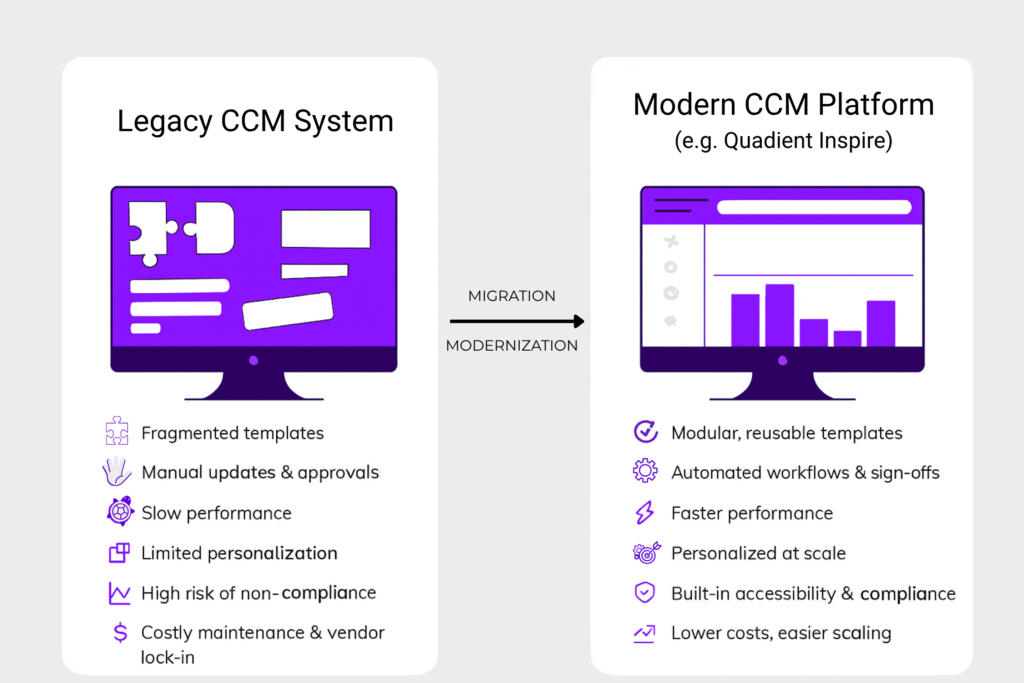
Legacy CCM systems are holding many businesses back. They’re often rigid, expensive to maintain, risky for long-play company development and difficult to adapt to new accessibility or data privacy laws. They also limit customer experience improvements – something today’s buyers increasingly expect.

Why it matters:

What to Look for in a Modern CCM Platform

When evaluating platforms, it helps to go beyond the product brochure and ask: What will this look like in action in our business, with our processes and compliance requirements?

Here are six essential criteria:

1. The right deployment model for your business

Cloud-native CCM platforms are growing rapidly due to their scalability, fast deployment and lower IT overhead. However, the right choice depends on your organisations’ reality. Highly regulated industries or businesses with complex legacy systems may still benefit from on-premise or hybrid deployments. 

🧠 Our tip: Look for platforms that offer deployment flexibility without sacrificing modern capabilities like API access or low-code tooling. 

2. Omnichannel communication delivery

Modern customers expect a seamless experience whether they’re interacting via email, app, post, or portal. A good CCM platform enables you to design communications once and deliver them across all relevant channels, without duplicating work or causing formatting issues.

🧠 Our tip: Look for native support for print, web, SMS and mobile–plus responsive preview tools to test each format before sending. 

3. Ease of integration with existing systems

Your CCM solution doesn’t operate in a vacuum. It needs to connect with your CRMs, ERPs, archiving systems and sometimes even bespoke internal tools. Seamless integrations speed up implementation, reduce human error and help futureproof your stack.

🧠 Our tip: Prioritise platforms with pre-built connectors and open APIs, especially if you’re working in a multi-vendor IT environment.

4. Compliance & accessibility readiness

The compliance bar is rising. From GDPR to the European Accessibility Act (EAA), your customer communications must be secure, traceable and usable by everyone including users with disabilities.

🧠 Our tip: Ask vendors whether their platform supports:

  • Accessible document templates
  • Real-time audit trails
  • Role-based controls
  • Automated compliance checks

If you want to go deeper, it’s worth understanding what accessibility-ready document templates require and why seemingly small mistakes in structure or tagging can break compliance entirely. We also see many organisations repeating the same issues during implementation, which is why recognising common document accessibility mistakes organisations still make can save months of rework, audit risk, and unnecessary remediation costs later on.

This difference becomes visible in real projects. In one of our recent cases focused on EAA-ready document communications for a Polish bank, moving to a modern CCM setup meant rethinking document logic, templates, and approval workflows so they could scale and evolve over time. Compliance and accessibility were treated as integral parts of the CCM architecture, not as add-ons. This allowed the bank to standardise communications, maintain full auditability, and give business teams greater control, all without increasing operational complexity.

5. User experience for both your teams and end customers

It’s not enough for a platform to be powerful. It must also be usable by your content creators, legal reviewers, CX managers and other business stakeholders. A modern CCM tool should empower cross-functional teams, not bottleneck them behind IT. 

🧠 Our tip: Look for role-based interfaces, drag-and-drop templates and approval workflows that allow collaboration without code. 

6. Vendor partnership & long-term fit

Technology is only a part of the equation. Migration support, training, roadmap transparency and service responsiveness all play a role in the success of your new CCM platform. 

🧠 Our tip: Ask about post-sale support, local partner networks and how each vendor supports clients as business and compliance needs evolve.

Choosing the Best CCM System for Regulated Industries

Disclaimer: This top CCM systems comparison highlights that there is no one-size-fits-all solution. There’s no universally “best” CCM platform. Only the most suitable combination of tools, tactics, and collaboration conditions tailored to your organisation’s needs.

Below, we’ve summarised four of the most widely adopted platforms in the CCM space. Each one has unique strengths, deployment models and ideal use cases.

Quadient Inspire

Quadient offers a strong balance between user-friendliness and enterprise-grade power.
For leadership teams, Quadient Inspire often signals a high-performing, long-term investment in communication architecture. It’s modular, highly customisable and integrates with a wide variety of systems.

CTOs and CIOs tend to appreciate its scalability and robust architecture, especially for organisations undergoing transformation or with plans to consolidate multi-channel communication systems.
It’s particularly well-suited for marketing-driven organisations thanks to its intuitive omnichannel composition tools, real-time previews and role-based interface that empowers business users without relying heavily on IT. It supports cloud-native and hybrid deployments, integrates seamlessly with CRMs like Salesforce and Microsoft Dynamics. In practice, this kind of integration makes a material difference: in one of our PaaS projects for a Dutch insurance company, Quadient Inspire was deployed across print and digital channels with existing CRM logic intact with working at scale. For the organisation, this meant faster rollout of new communication use cases, lower integration risk, and a more predictable operating model as volumes and channels grew. For Product Owners, it translated into shorter change cycles, better visibility into template behaviour, and the ability to adjust content and logic without waiting for heavy IT involvement — all while keeping governance and compliance under control.

However, that power comes with a trade-off. The platform rewards those willing to develop or partner with skilled Quadient experts, turning what seems like complexity into a long-term differentiator. In this way, the early investment becomes a launchpad for sustained independence and strategic agility, which could serve for decades.

From a compliance perspective, Quadient Inspire is a solid bet. It offers granular control over messaging logic, audit trails and versioning, making it suitable for regulated industries such as banking and insurance. Legal teams often find comfort in its ability to document every step of a communication journey. Accessibility and auditability are built into its cloud capabilities, making it a right choice for organisations looking to futureproof compliance and UX.

The end user (i.e., your customer) usually never sees the complexity under the hood. What they do see, if Inspire is well implemented, is a hyper-personalised, consistent and timely communication experience across print, digital and mobile. That’s a major competitive advantage.

OpenText

OpenText is often the default choice for institutions already embedded in the OpenText enterprise ecosystem which was widely adopted in the early 2000s to mid-2010s. It’s a heavyweight in the enterprise CCM space.

It appeals to leadership with its legacy of trust and stability, especially in large document-centric environments. CFOs often like the idea of extending existing OpenText investments rather than introducing a new vendor. Known for its robustness and deep legacy system support, it’s often the platform of choice for large organisations operating in highly regulated industries like insurance, utilities, or public sector. Its support for on-prem and hybrid deployments makes it appealing to businesses with strict infrastructure requirements.

Operationally, however, OpenText can be more rigid. Teams working within Exstream environments often report that configuration and development are IT-heavy, with limited room for rapid iteration by business teams. This creates a bottleneck when it comes to deploying and testing new communication strategies. Developers and analysts accustomed to agile, cloud-native environments may find OpenText slower and less flexible.

From a compliance perspective, OpenText holds up well, having been used across government and heavily regulated sectors for decades. Its DMS-centric infrastructure supports document retention, permissions and role-based controls in ways that appeal to risk-conscious legal and compliance departments.

The downside, especially from a user-experience and customer communications standpoint, is that modernisation can lag. End customers may experience templated, static, or overly formal communications unless effort is made to layer on modern UX flows.

ISIS Papyrus

Papyrus is built for control and customisation – they are unique in this approach. It’s a long-standing favorite in financial services, thanks to its strong governance features and configurable rule engines. The platform offers both on-prem and hybrid options, making it viable for compliance-focused environments. It’s less plug-and-play than others, typically requiring stronger in-house IT capabilities or external consultancy – but for organisations that value full control, the payoff can be substantial.

Papyrus offers a vertically integrated platform that combines process automation, document management, case handling and communications. For leadership and enterprise architects, this is attractive because it minimises the number of vendors and integration points. Everything stays under one roof.

But this “all-in-one” strength is also a limitation. Unlike modular platforms, Papyrus expects the organisation to adapt to its internal logic. This can create friction for teams used to flexibility or those wanting to plug in best-in-class solutions for analytics, templates, or content authoring.

Operational teams often find the Papyrus environment powerful but dense. Its steep learning curve and limited global user community make training and onboarding slower, especially for non-technical users. Developers will need to invest time to gain fluency in the system and business analysts will likely rely heavily on IT for changes. But would this learning time contribution worth ROI?

For compliance, Papyrus is a strong contender. Its end-to-end control of the communication lifecycle makes it well-suited for organisations with strict governance and risk standards. The ability to track and automate decisions across workflows is appealing to both legal and audit stakeholders.

Where it may fall short is in user experience. Communications generated through Papyrus can feel procedural and rigid. Without deliberate effort to improve design and personalisation, end users might find interactions cold or bureaucratic—appropriate for some sectors but problematic for customer-centric brands.

Smart Communications

Smart Communications has carved its space by offering a cloud-native, API-first platform built with business users in mind. For leadership teams focused on agility, customer centricity and fast deployment, Smart delivers a compelling message. It removes much of the technical debt associated with traditional CCM implementations and is favored by organisations undergoing digital transformation.

From an operations and executive point of view, Smart is empowering. Business teams can create, test and deploy communications with minimal IT involvement. Analysts appreciate the real-time feedback loops and experimentation capabilities baked into the platform. Developers can focus on integrating backend logic while marketing and CX teams optimise messaging on the front lines.

Compliance teams will appreciate Smart’s modern cloud certifications, GDPR-ready architecture and policy-driven controls. While it may not have the on-premise legacy compliance layers of OpenText or ISYS Papyrus, its transparency and structured governance capabilities align well with evolving digital-first regulatory frameworks.

Most importantly, Smart Communications shines at the end-user level. It delivers clean, mobile-first and channel-consistent interactions that meet customers where they are—email, apps, chat, or print. Its omnichannel consistency, combined with tools for A/B testing and personalisation, helps companies communicate more like agile digital-native brands and less like legacy enterprises.

However, this cloud agility comes with a trade-off: Smart isn’t built for deep backend complexity or legacy system entanglement. The platform may struggle with highly customised document logic, real-time transaction processing at enterprise scale, or legacy data dependencies. The consequence of this limitation can cascade throughout the organisation. Strategically, leadership may find that while Smart accelerates time-to-value for customer touchpoints, it may not scale easily across all business-critical communication domains, especially those tied to regulated documents or high-volume transactional outputs. This can lead to fragmented ecosystems, where Smart handles digital comms while legacy systems still shoulder core workloads, undermining efforts to consolidate platforms and reduce complexity.

Prefer a quick side-by-side view?

Here’s a snapshot of the four platforms compared on deployment model, core strengths and business fit, to help you zoom in on the one that aligns with your goals.

PlatformDeployment OptionsTop StrengthsTop WeaknessesIdeal For
Quadient InspireOn-premises, hybrid and cloudUX-focused, omnichannel tools, strong integrationsSteep learning curve on the beginning, could require expert setupMarketing-driven orgs and mid-sized businesses looking to scale CX
OpenText On-premises and hybridEnterprise-grade, legacy integration, regulatory trustSlower modernisation pace; heavy IT dependency; limited agility for digital-first use casesLarge, complex organisations with legacy-heavy infrastructure
PapyrusOn-premises and hybridCustomisable, strong governance, used in financeSteep learning curve; rigid architecture; low flexibility with third-party toolsRegulated industries with strong IT capacity and need for full control
Smart Communications (SmartCOMM) Cloud-nativeAgile, accessible, API-firstLimited backend depth; challenges with legacy system replacement; potential governance fragmentation at scaleFast-growing companies prioritising flexibility, speed and CX innovation

The 3 Questions to Ask Before You Decide

Before you lock into a platform, ask yourself and your team:

  1. What organisational bottleneck do we actually want CCM to remove? Most CCM initiatives start with technology, but they should start with friction. Is your biggest issue slow time-to-market for new communications? Heavy IT dependency for simple changes? Fragmented ownership between business, legal, and operations? Or rising compliance risk driven by manual fixes and workarounds?
  2. Who will own communications once the platform is live — and how much autonomy do they need? A modern CCM platform reshapes internal responsibilities. The real question isn’t whether a system is powerful, but who can safely use that power.
  3. How realistically can we migrate — and what must not break along the way? Migration is where CCM decisions become real. The key question isn’t if you can move off a legacy platform, but how much risk you’re willing to accept during the transition. What documents must remain identical? Which integrations cannot be disrupted? And how much parallel running can your organisation afford?
    We see this challenge clearly in practice. In a migration from a legacy DOPiX system to Quadient Inspire, the priority isn’t just moving templates – but about preserving output consistency, auditability, and business continuity while modernising the underlying logic and workflows. That approach allows the organisation to transition without disrupting regulated communications. See the full legacy system migration from DOPiX to Quadient Inspire case for how this was handled in practice.

Your CCM Should Grow With You

Modernising your CCM platform isn’t merely an infrastructure upgrade, it’s also a competitive strategy. Whether your focus is regulatory readiness, customer experience, or operational efficiency, the right platform should meet today’s needs while setting you up for tomorrow’s growth.

At Quertum, we work with organisations navigating these exact decisions. If you’re planning a CCM migration or exploring your options, we’re here to help guide the process, strategically and practically. The right platform won’t just solve today’s pain points, it should be a growth enabler, not a future constraint.

Explore our migration services or get in touch – we’d love to help solve your communication challenges. 

Legacy System Migration: from DOPiX to Quadient Inspire

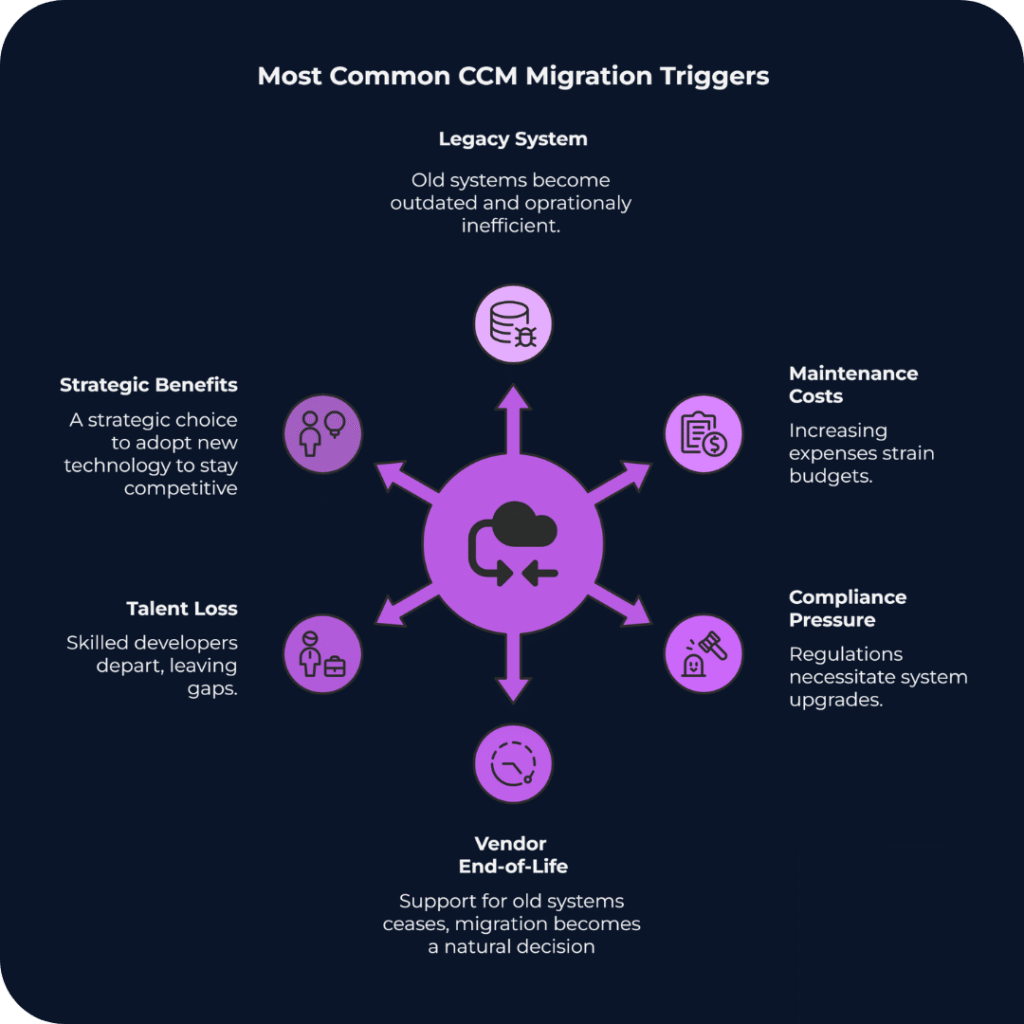
As sooner companies realise the need to modernise, the more chances they have to keep and raise its market share. But what to do, if maintenance of your outdated system is not only expensive, but also has no chances for decent support — both for internal and customer-oriented processes. It’s a clear symptom of a legacy system migration is on demand.

DOPiX (Document Platform in eXcellence), a Customer Communication Management solution, has been widely adopted, particularly in the German-speaking regions. Today, 75% of the top 30 German insurance companies rely on DOPiX, including Generali, ERGO, and AXA.

Quadient (formerly Neopost) acquired DOPiX through the acquisition of ICON Systemhaus GmbH, the German leader in Customer Communication Management (CCM), in June 2016.  This acquisition enabled Quadient to strengthen its CCM offering, especially in the German-speaking market, where DOPiX was widely popular within major insurance companies and financial institutions.

Last news about maintenance suspension for DOPiX changed the game for a significant number of Germany, Austria, Switzerland, and Liechtenstein insurance and financial companies. With some recent news, DOPiX support is prolonged up to December 2026, which gives more time to make a proper legacy system migration to Quadient Inspire.

Background of the Data Migration Project

Our client, a leading insurance group from Wiesbaden, Germany, was deeply reliant on a highly customised DOPiX environment — built over decades with thousands of documents, inconsistent templates and embedded logic difficult to decipher.

Their concerns mirrored what we hear across the industry:

  • “DOPiX is built on obsolete architecture — we can’t find developers who know it any more.”
  • “We’re risking non-compliance because the platform lacks modern controls and traceability.”
  • “Business users can’t adapt documents without relying on IT every time.”
  • “We can’t afford downtime—but we can’t afford to wait, either.”

Business Challenges in Case of Legacy Systems Migration

Displayed as a complex of requirements, which incompletion of them means to be churned by evolving market with following risks:

  1. DOPiX nears the end of its maintenance lifecycle, with official support ending in December 2026. Continuing to rely on it exposes the organisation to growing operational and compliance risks.
  2. There is a rapidly shrinking pool of developers familiar with DOPiX architecture, making it difficult to maintain, scale or troubleshoot the system.
  3. The legacy platform lacks the modern governance features required to meet today’s regulatory standards, including auditability, data handling and secure delivery.
  4. Business users are unable to independently update or manage document templates, relying heavily on IT teams for even basic adjustments.
  5. The system contains thousands of templates developed over years with inconsistent logic, lack of naming conventions and no lifecycle governance, making clean-up and migration extremely complex.

Data Migration Project Goals

Targeting migration, the business wasn’t just betting on system optimisation. Beyond simply replacing old technology, the project focused on preserving business-critical output, enabling non-technical users and laying the groundwork for long-term agility and compliance.

  1. Risk Mitigation: Decommission DOPiX before end‑of‑life without operational disruption.
  2. Seamless Document Transition: Reproduce business‑critical documents in Inspire, retaining output accuracy while introducing structural enhancements.
  3. Business‑User Empowerment: Enable non‑technical teams to manage templates with minimal IT dependency.
  4. Governance and Quality Assurance: Ensure compliance-readiness and maintain audit trails for all communications.

Technical Execution of the Legacy System Migration

To deliver a smooth and risk-free migration, we assembled a dedicated team of senior developers trained in DOPiX and fully specialised in Quadient Inspire, working alongside experienced solution architects, migration specialists, and quality control professionals.

Together with the client, we defined the full scope and testing plan during joint workshops. Sprint by sprint team successfully migrated more than 1200 documents, created in decades and more are on a way. 5000 will be migrated in total. Each sprint follows a consistent rhythm: planning, development, peer reviews, quality checks and sprint reviews.

Here’s how the team designed and executes the workflow:

  1. We start by aligning on the overall migration scope, defining template complexity levels (simple, medium, complex), and setting up validation rules for templates and test data. As new document batches are prepared for the legacy system migration, we revisit this setup phase to ensure consistency and readiness.
  2. The team continuously plans sprints and updates the backlog whenever they transfer a new set of templates and test data to the Inspire environment. Each transfer starts a new development cycle, which the team follows with template and data validation to ensure readiness.
  3. Refinement and enhancement in Quadient Inspire is performing repeatedly across sprints. Developers carefully rebuild each template and improved structure and functionality, mirroring the business intent of the original DOPiX documents.
  4. The team reviews every migrated document through repeated rounds of internal testing, peer review, and quality control. This rigorous process guarantees accuracy and consistency, and the team applies it in every sprint to each new batch of templates.
  5. After internal approval, the client conducts external QA and user acceptance testing (UAT) on each document. Every UAT cycle drives further refinement and approval before production release, creating a loop that continues until the full migration is complete.

Results of the Migration Process: Now and future

  • The team has already migrated around 1,274 templates to Quadient Inspire.
  • More than 150 documents already run live in production.

Final goal: 5,000+ documents migration by Q4 2027

Benefits and Achievements:

  • Averted risk by replacing unsupported DOPiX before end-of-life
  • Empowered business users with a modern, intuitive interface
  • Strengthened governance and compliance through built-in controls
  • Enabled scalability and maintainability for future updates

Value, Uniqueness and Long-lasting Legacy System Migration Result

This project represents a mission-critical transformation tailored to the client’s specific challenges. It stands out not only because of its scale and complexity but also because of how we approached it—with precision, empathy for the business context, and a rare blend of legacy and modern system expertise. The client did not want a cosmetic re-skin; they needed a solution that carried forward the business value embedded in thousands of DOPiX templates while preserving both performance and compliance.

The Quertum team translated the client’s intent with precision. Every migrated document retains its purpose, structure, and output fidelity, while gaining clarity, maintainability, and alignment with modern standards. This project demands a deep understanding of DOPiX’s intricacies, the discipline to recreate business logic inside Quadient Inspire, and the structured approach to deliver it all without disruption.

For our client, this legacy system migration is about modernising with confidence and avoiding system & penalty risks, preserving operational continuity, empowering their teams and staying future-ready in a rapidly evolving market.

Ready to Future-Proof Your Communication Systems?

Don’t wait until support runs out or compliance risks escalate. Whether you’re navigating away from DOPiX or any other legacy platform, Quertum brings the expertise, structure, and precision to deliver seamless migrations — without disruption, without compromise.

Let’s talk about your migration path. Learn more about Migration from Obsolete platforms.

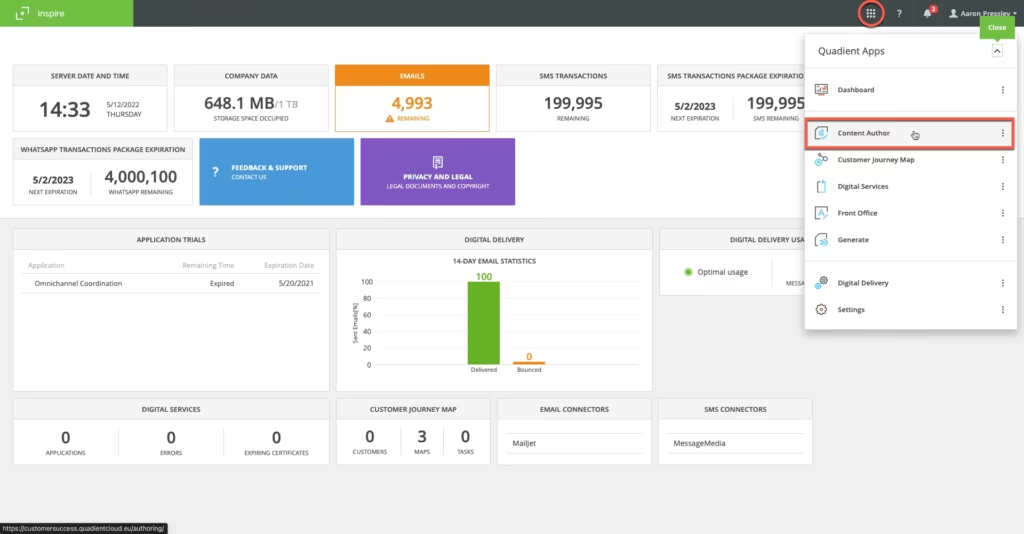
Quadient Inspire Deployment on Azure: PaaS Implementation and Template Migration for a Insurance Company

Quadient Inspire deployment has become a critical step for insurers aiming to stay competitive in a market that demands scalability, efficiency, security, and compliance. Falling short in any of these areas can quickly erode customer trust and expose companies to regulatory risks. For a leading Dutch insurance group, these challenges surfaced when business-critical communications relied on an outdated setup without a dedicated production environment — creating operational risks, compliance gaps, and costly inefficiencies.

Over time, fragmented document templates and manual approval loops slowed communication, increased compliance risks, and weakened brand consistency. The insurer needed not just a new tool, but a controlled, scalable environment that could keep pace with customer expectations and regulatory change.

To address these challenges, the Dutch industry expert Impress BV partnered with Quertum. By combining Quertum’s proven expertise in Microsoft Azure, Quadient Inspire deployment, data migrations frameworks, Single Sign-On, Terraform, and DevOps automation with the Impress’s strong market presence and unique designing experience, we built a secure, scalable, and fully compliant Customer Communication Management (CCM) environment. As a result, the company gained a future-ready Platform-as-a-Service that empowers the business, eliminates risk both for operational, customer success and customer care teams, and ensures every interaction is reliable, compliant, and disruption-free.

Read the scope below to see how it not only became possible, but also brought significant benefits to the end customer.

The client is a reliable insurance company, which is based in the Netherlands. They needed an extensive, flexible, and reliable Customer Communication solution that would allow them to: 

  • Create processes for promoting content and code across environments without disruptions. That means implementing a controlled, automated pipeline that ensures every change, from template updates to code adjustments — moves seamlessly from development to production, reducing downtime and human error.
  • Manage large volumes of customer communications consistently and across multiple channels with no downtime. For example, the insurer previously struggled to send files larger than 10 MB. The new infrastructure ensures stable, high-volume processing for both digital and physical communications, regardless of document size or delivery channel.
  • Integrate and synchronise development, testing, acceptance, and production environments to operations and reduce manual processes. Previously, there was no way to centrally manage or update communications. With the new setup, all environments are synchronised and automated, ensuring version control, consistency, and full operational transparency.
  • Establish dedicated testing environments to ensure flawless performance and quality assurance before deployment.
  • Achieve 100% GDPR and DORA compliance and integrate secure authentication methods such as Azure SSO authentication with their existing Azure infrastructure.

Meeting these requirements demanded more than just incremental improvements — it called for a structured and secure Quadient Inspire deployment on Azure. This approach ensured the insurer could handle high communication volumes without disruption, stay fully GDPR-compliant, and empower both IT and business teams with a scalable, future-ready environment.

Specific Pain Point of Quadient PaaS Implementation: Lack of a Dedicated Production Environment

One of the critical challenges the client faced was the absence of a dedicated production environment.

Because of this, changes to documents and processes were made directly in the live environment, which leads to:

  • Operational risks due to deploying untested code.
  • Service disruptions while making updates directly in production.
  • Data inconsistencies without separate testing and development environments.
  • Increased risk of exposing sensitive customer data and breaching GDPR compliance requirements.

Details in a Nutshell:

  • Service Delivered: Platform as a Service (PaaS)
  • Project Duration: September 2024 – January 2025
  • Key Partner: Impress BV
  • Technological Stack: Microsoft Azure, Quadient Inspire, DevOps Automation Tools, Single Sign-On (SSO), Terraform and Impress Digital Vault

Technical Implementation of Quadient Inspire Deployment

The project started with the deployment of four virtual machines, each dedicated to development, testing, acceptance, and production environments. We provisioned them using Terraform, which ensured consistency and repeatability across the setup. To strengthen reliability, our team configured automated backups with Azure run books, providing both data protection and rapid recovery. In addition, we automated domain certificate renewals, which reduced manual maintenance risks.

Next, we built a robust code and content promotion pipeline that allowed seamless transitions across environments. This streamlined workflow eliminated manual bottlenecks and guaranteed reliable deployments. Furthermore, we peer-connected the virtual machines and integrated their networks into Quertum’s main network—serving as the entry point for multiple projects and enhancing overall collaboration.

Our team installed all necessary Quadient Inspire components, including silent installers for Designer Interactive. We also migrated more than 40 templates and associated processes from the client’s legacy setup to the new Azure infrastructure.

To secure the system, we configured the application gateway and enabled Single Sign-On (SSO) for authentication. Meanwhile, we synchronised all environments with the client’s Azure infrastructure to ensure smooth integration. Finally, we carried out extensive validation and testing to confirm that every template functioned correctly and that the promotion pipeline operated flawlessly throughout the deployment.

To complement the Inspire environment, the insurer integrated Impress Digital Vault, a secure document-delivery platform that ensures confidential communication with customers.

Execution Steps:

While addressing critical business risks such as service continuity, data security, and compliance, Quertum team created the Azure environment from scratch. Each step was designed to mitigate potential disruptions, ensuring that client’s operational activities would remain unaffected during the migration. Moreover, the structured approach guaranteed that all environments were synchronised, robust testing was conducted at every phase, and the final production rollout was seamless and secure.

  1. Azure Environment Configuration
  2. Inspire Installation and Configuration
  3. Pilot Migration
  4. Internal Testing
  5. Integration of Impress Digital Vault for secure document delivery
  6. User Acceptance Testing (UAT) After Pilot Migration
  7. Final Migration
  8. Creation of Code and Content Promotion Processes
  9. Final Internal Testing
  10. Final UAT
  11. Go-Live and Project Closure

Unique Value from Quadient Inspire Deployment:

Quertum team fully managed the infrastructure including synchronisation, certificates, templates, and CRM endpoint integration. The transition to production was completed without a single issue, an achievement that impressed the client. 

By providing dedicated PaaS development for insurance and finance companies, Quertum created separate development, testing, acceptance, and production environments. Therefore, the client could thoroughly test all changes before deployment.

Key Results

100% GDPR Compliance

Single-Sign-On implementation

Full Azure Automation

Zero downtime & seamless migration to production

Massive System Migration and PDF Accessibility Leading Finnish Bank: Compliance and Modernisation Challenge

PDF Accessibility has become central to a major transformation for a leading Finnish bank. Although committed to sustainability and excellent customer service, the bank relied on an outdated document management system that no longer met its needs. To modernise, it chose a Customer Communication Management (CCM) solution with Quadient Inspire. The challenge was to implement PDF accessibility alongside the migration—reducing legacy templates, refreshing CCM processes, and ensuring full readiness for the European Accessibility Act (EAA). The bank’s clear mission was to centralise and streamline document production while maintaining scalability, compliance, and inclusivity across its entire banking group, thereby safeguarding efficiency and customer trust. A critical element of this transition was a large-scale migration, a task often vulnerable to silos and losses. At the same time, the looming EAA deadline demanded rapid adaptation—especially challenging for large, complex organisations.

Service Delivered: Creation of Accessible PDF templates along with system migration from the outdated system to Quadient Inspire
Project Duration: January 2024 – December 2024

Recognising the need for a comprehensive and experienced team of Quality Control specialists, Solutions Architects, and Senior Developers skilled in Interactive, Scaler, Designer, and Project Management, the bank engaged Quertum to support its transformation efforts. Together, we delivered high-demand services that have earned the trust of thousands of clients for decades and helped businesses modernise their Customer Experience (CX).

Business Challenges: PDF Accessibility along the Migration

As the bank sought to modernise its document production processes, several challenges emerged, compounded by the pressure of meeting upcoming accessibility standards by June 28, 2025:

  1. Document interfaces were not aligned with the bank’s branding.
  2. Existing documents did not comply with EAA accessibility requirements.
  3. High operational costs due to reliance on the outdated legacy system.
  4. Inefficiencies in document production and process management.

Project Goals

The primary objective of the project was to facilitate a seamless migration while ensuring compliance with accessibility regulations and improving efficiency. Key goals included:

  • Avoiding interruptions in day-to-day business operations during the transition.
  • Migrating processes and documents from the legacy document management system to Quadient Inspire.
  • Ensuring 100% compliance with accessibility standards for all new documents.
  • Implementing branding details within the migrated documents.

Technical Implementation Overview

The project required a structured approach that combined strategic planning with robust technical execution. The initial phase involved a thorough assessment of the legacy document management system, analysing document structures, workflows, and accessibility gaps. This groundwork enabled the seamless configuration of the new Inspire system to align with the bank’s operational requirements and infrastructure.

A major component of the migration was the complete redesign of document templates. These templates incorporated the bank’s latest branding elements while ensuring compliance with stringent accessibility standards ahead of the EAA deadline. Multi-language support, including Finnish and Swedish, was integrated to accommodate the client’s diverse customer base.

To enhance efficiency, we automated key document production processes using Inspire’s advanced workflow management features. This significantly reduced manual interventions, lowered operational costs, and streamlined document generation processes.

Ensuring accessibility compliance was a top priority. Our team conducted rigorous testing throughout the migration to verify screen-reader compatibility and proper document structuring. Compliance checks were crucial for meeting regulatory requirements and providing an inclusive user experience. Additionally, comprehensive Quality Assurance (QA) testing and User Acceptance Testing (UAT) were conducted to ensure the final solution met all client expectations before deployment.

Execution Steps of PDF Accessibility Implementation

  1. Initial Assessment: Detailed analysis of legacy systems to identify migration challenges.
  2. Planning & Resource Allocation: Development of a migration roadmap, considering system complexities.
  3. Development: Implementation, leveraging Inspire’s advanced features to bridge technical gaps.
  4. QC Testing: Validation of document integrity, accessibility, and compliance.
  5. UAT & Client Approval: Extensive user acceptance testing to ensure alignment with business needs.
  6. Go-Live & Post-Implementation Support: Deployment with tailored support to address post-migration needs.

Unique Value Delivered

The implementation of accessible and compliant PDFs significantly enhanced customer experience, maintained the bank’s reputation, and mitigated EAA compliance risks. Achieving accessibility within the EAA framework posed unique challenges, particularly in preserving the brand’s tone and visual identity. Quertum successfully delivered fully compliant and branded documents that adhered to accessibility standards while maintaining a consistent user experience.

Through this project, the bank achieved an improved document production efficiency and got full accessibility compliance for over 100 documents. The company now benefits from a modern, streamlined document management system that enhances operational efficiency and regulatory compliance.

Key Results

  • Successful migration from the legacy system to Quadient Inspire.
  • Full compliance with EAA accessibility standards with ensured PDF/UA Accessibility
  • 100+ fully accessible branded document templates.
  • Improved operational efficiency and reduced manual workload.

Full GDPR Compliance

100+ documents created both in Finnish and Swedish

Full PDF/UA Accessibility implementation

This project shows how PDF Accessibility and EAA compliance can be achieved seamlessly, even during large-scale migrations. By modernising document production with Quadient Inspire, the Finnish bank not only reduced legacy inefficiencies, but also secured full regulatory readiness and improved customer trust. If your organisation is facing similar challenges, explore our expertise in PDF Accessibility and EAA compliance and discover how Quertum can help you future-proof your customer communications.