Accessibility Tools

Skip to main content

Author: Łukasz Szczepański

Migration Made for You: Quadient vs OpenText Comparison. Which CCM Does More for Your Business?

You might assume that CMM migration begins the moment it appears in a company strategy document. More often, however, it begins with a problem that has been accumulating for 2 or 3 years, and one event that finally makes it impossible to defer.

Sometimes it’s a vendor end-of-life notice that arrives on an otherwise ordinary Tuesday. In other cases, a compliance audit suddenly reframes the platform as a risk rather than an asset. Or a key developer who understood the original implementation leaves, and the team realises nobody can fully explain how the system actually works anymore.

At that point, the discussion changes quickly. The question is no longer whether migration should happen, but which direction makes sense, and how to justify that decision when leadership inevitably asks why this path was chosen.

If this kind of situation is approaching, you’re likely carrying a second question alongside the strategic one: what does the actual migration process look like for Customer Communications, and how do you keep it from becoming a multi-year disruption? We’ve written a practical guide on the six steps that ease legacy CCM replacement that’s worth reading alongside this one.
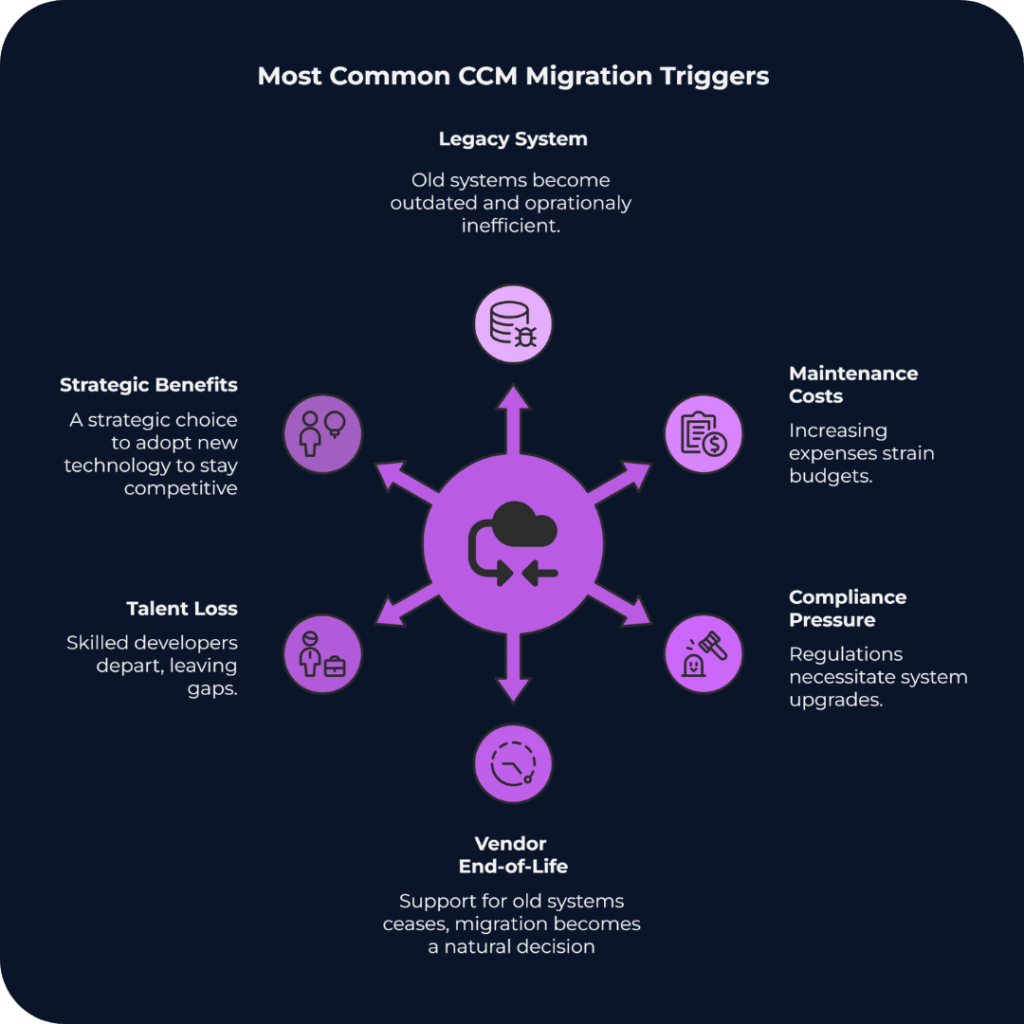
Infographic titled “Most Common CCM Migration Triggers.” In the center is a purple circular icon representing system migration, with arrows pointing outward to six surrounding causes. The causes listed around the circle are: Legacy System (outdated and inefficient infrastructure), Maintenance Costs (rising operational expenses), Compliance Pressure (regulatory requirements forcing upgrades), Vendor End-of-Life (support for the platform ending), Talent Loss (specialist developers leaving the organisation), and Strategic Benefits (adopting new technology to stay competitive). The graphic illustrates that organisations typically migrate customer communications management systems when several operational, financial, and regulatory pressures converge.

Scenario 1: The IT-Centric Bank and the OpenText Path

Take a mid-size European bank processing tens of millions of customer communications annually, operating on CCM infrastructure that has been running on-premise for 15 years without a major change. Statements, policy notices, regulatory disclosures, all generated by a system that nobody is quite sure how to upgrade without breaking something important.

The IT Director has been making the case for modernisation for 3 years. Every year the argument gets stronger. Every year the budget committee asks the same question: but is it urgent? Then the vendor end-of-life announcement lands, and that question stops being useful.

Why OpenText Makes Sense Here

For organisations where the primary CCM concern is governance, not speed or omnichannel agility but audit trails and deep integration with established archive systems, OpenText Exstream has a logic that is difficult to argue against.

The platform is built from HP Exstream, StreamServe, and xPression. That history gives it a functional breadth that few platforms match in high-volume batch environments. Nightly runs of 50 million personalised statements are well within what the architecture handles without drama.

OpenText also integrates tightly with its own portfolio. InfoArchive handles long-term record management, and there are dedicated accelerators for Guidewire and Duck Creek that reduce the data mapping work during implementation. For an organisation already running OpenText for Enterprise Content Management, that existing footprint makes the extension to CCM genuinely lower-friction than starting from scratch.

What the Teams Actually Talk About

In our experience working with banks through this process, the conversation at the architecture level rarely focuses on features. It focuses on:

  • Who owns the complexity after go-live?
  • How the platform behaves during the first major upgrade cycle?
  • What happens if the one certified Exstream specialist on the team decides to leave?

These are reasonable concerns. OpenText requires specialised expertise that is genuinely difficult to hire and retain, and upgrade timelines from legacy versions to the current Cloud Native architecture consistently land in the 12 to 24 month range. In practice it runs closer to 2 implementations in parallel, with the business continuing on the old system throughout.

For an organisation with deep regulatory requirements, an existing OpenText footprint, and the internal capacity to absorb that complexity, the trade-off works. Full implementations typically start at $1M and climb quickly once professional services, migration effort, and internal resourcing are factored in. For organisations without those three things, the difficulty tends to compound over time rather than resolve.

Scenario 2: The Insurer That Needs to Move, Not Just Survive

A European insurer, mid-market in size, that has spent 2 years watching its customer communications fall behind what its digital transformation roadmap was supposed to deliver. The marketing team wants personalisation at scale. Legal needs to update disclaimers faster than the current template pipeline allows. The digital team cannot integrate the mobile app because the legacy CCM engine does not expose reliable APIs.

The platform has run reliably for years, but the pace at which the business now needs to change what it sends, to whom, and through which channel has outgrown what the infrastructure was built for.

What Quadient Inspire Looks Like from the Inside

Across the CCM implementations we work on, Quadient Inspire comes up most consistently in organisations where the core question is not how to preserve existing infrastructure but how to replace it without stopping the business in the process.

The AnyPrem architecture is worth understanding specifically. A template built in Inspire Designer runs on-premise, in a private cloud, or in a public cloud environment without modification. For insurers managing hybrid cloud transitions under GDPR data residency requirements, that portability removes a class of risk that would otherwise need its own workstream.

The unified design environment has a practical impact that takes a few months to show up in the numbers. Managing Print, Email, Mobile, and Web outputs from a single template file rather than six separate variants means less maintenance overhead, fewer consistency errors, and shorter regulatory review cycles when a disclaimer needs updating.

Quadient holds 11% of the global CCM market, the largest individual share according to IDC. Organisations in financial services and insurance select it repeatedly over a long period, which tends to say more about operational reliability than any benchmark does.

The staffing profile is meaningfully different from OpenText. Quadient’s hiring pool is broader, and Quadient University, the vendor’s online training and certification platform, means new team members can reach productive output without relying on whoever built the original implementation. That dependency is a real operational risk, and one most organisations only recognise after someone leaves.

The Cost That Derails Most Migration Budgets

Template migration is consistently where CCM project budgets get revised upward, and where the original timeline estimate stops being credible.

A mid-size insurer accumulates thousands of document templates over a decade. Some are in active use, many are dormant but legally required, and some are genuinely critical and documented only in the memory of someone who retired in 2019. Manual template migration is slow and expensive, and it reliably surfaces legacy decisions that nobody remembered making.

In one recent project we supported, migrating from DOPiX to Quadient Inspire, the largest effort was not the platform installation but analysing and restructuring hundreds of legacy templates accumulated over more than a decade.

Quadient’s InspireXpress tool uses AI to auto-convert legacy templates from competing platforms. It does not eliminate human review for complex logic, but it substantially reduces the professional services hours needed in the early migration phases. For a project where the budget estimate is already moving, that reduction matters.

Focused Quadient implementations for a defined line of business typically take 3 to 6 months. Full enterprise rollouts run 6 to 18 months. The modular licensing structure means organisations can start with specific components, typically from around $500K annually, and expand as requirements grow, rather than committing to full enterprise capacity upfront.

Why the Right Answer Is an Operations Question, Not CCM’s Features List

The comparison between OpenText and Quadient tends to get treated as a feature question. The organisations that make it well treat it as a staffing and operations question as much as anything else.

OpenText Exstream makes sense for organisations where governance is the primary driver: audit trails, archival integrity, and tight integration with an existing OpenText content management stack. For Global Systemically Important Banks (G-SIBs) or large government agencies processing hundreds of millions of pages annually, the operational complexity is the cost of the control, and for those organisations it is a cost worth paying.

Quadient Inspire suits organisations where the constraint is speed: how quickly can a regulatory disclaimer be updated, how much does a routine template change depend on a specialist developer, how reliably can the mobile app trigger a document in real time. The modular pricing keeps the initial commitment lower, and AnyPrem means the cloud transition happens at a pace the organisation controls rather than the vendor’s.

The choice between them depends heavily on what the organisation can realistically sustain over a 3 to 5 year horizon, including staffing, upgrade cycles, and internal appetite for infrastructure complexity. Getting that assessment wrong in either direction tends to be expensive.

CriterionOpenText ExstreamQuadient Inspire
Primary mandateGovernance and archival integrityBuilt for organisations where the audit trail and record management are non-negotiableSpeed and digital channel agilityBuilt for organisations where the pace of change in communications is the primary constraint.
Best fitG-SIBs, government agencies, existing OpenText ECM stackRetail banks, insurers, mid-cloud transition
TCO entry point$1M+From $500K, modular
Implementation timeline12–24 months3–6 months (LoB) / 6–18 months (enterprise)
StaffingRequires certified OpenText specialists. The talent pool is narrow, and knowledge loss when a key person leaves is a documented operational risk.Broader hiring pool. New team members reach productive output faster, and Quadient University provides structured self-service training.
Cloud modelCloud Native (re-platforming)AnyPrem (no refactoring)

How to Build a Migration Case That Survives the Finance Committee

If you are determining whether migration is necessary rather than how to execute it, the architecture is rarely where the resistance comes from. Organisations resist migration because the existing system works, and changing something that works requires a level of justification that maintaining it never does.

A migration case built on “better features” tends not to survive contact with the finance committee. One built on EAA compliance deadlines, vendor end-of-life announcements, or documented scalability failures tends to hold. The difference is that the second set of arguments is about risk that is already present and growing.

The teams that navigate this well distribute the decision across IT, compliance, and finance rather than carrying it personally. They run a pilot before asking for full commitment. They document the external drivers clearly enough that the rationale survives leadership changes.

The trigger event, whether it is an audit finding, a vendor notice, or an outage, is rarely the moment the decision gets made. It is usually the moment the cost of waiting becomes visible to everyone at once.

What a Realistic First Step Looks Like

In banking and insurance, the organisations that move through this process with least disruption tend to start with a narrow scope: one line of business, one document type, one channel. A working pilot changes the internal conversation faster than any business case document, and the migration expands from there at a pace the organisation can absorb.

The projects we support in this space run on Quadient Inspire. The modular structure fits the phased approach well, and the AnyPrem deployment means the organisation does not have to resolve its cloud strategy before starting. If you are currently assessing whether your legacy CCM infrastructure warrants migration, or building a case to present internally, we can share what that process has looked like for similar organisations.


Quadient Inspire Interactive on Azure: Accessibility Implementation and Inspire Scaler Integration for a Dutch Healthcare Insurer

For healthcare insurers the annual policy renewal season is the ultimate stress test. It shows a critical operational threshold where millions of personalised documents must be generated with absolute precision in a strictly limited timeframe. This is how the story behind our partner Impress client began — with no operational slack and a renewal deadline that could not move.

Facts Summary

Client: Leading healthcare insurance company in the Netherlands

Service Delivered: Azure-hosted Quadient Inspire environment setup, migration from Quadient Inspire Designer to Inspire Interactive, template rationalisation, accessibility implementation, and Scaler integration with Impress Connect.

Project Duration: June – November 2025

Challenge: Facing the renewal deadline, the client was constrained by a rigid legacy infrastructure that was becoming unmanageable due to 3 structural bottlenecks:

  • Strong IT Dependency: Every minor change to a policy, such as last-minute pricing tweaks or regulatory disclaimers, required a technical request to developers. However, business teams knew what needed to change but had to wait in an IT queue to execute it.
  • Inefficient Workflow: The team relied exclusively on Quadient Inspire Designer — the core tool for creating document templates and communication workflows in Quadient CCM. While Designer is a powerful tool for technical development, using it for day-to-day business edits is inefficient and blocks agility. The business needed a way to manage content without touching the code.
  • The Compliance Gap: New EU directives required every PDF to be fully accessible and EAA compliant, a capability the existing setup lacked.

To avert operational risks, the client’s primary partner, Impress BV, envisioned a solution: moving the infrastructure to the cloud and empowering business users with Quadient Inspire Interactive.

To execute this complex architectural shift, they engaged Quertum for our specialised engineering expertise and deep Quadient Development experience. In a high-velocity sprint spanning June to November, we re-engineered their workflow onto Microsoft Azure.

The objective was complex: move the infrastructure to the cloud, enable independent content management, and seamlessly integrate with Impress Connect, a modern digital delivery platform, all without disrupting the critical renewal cycle.

The Solution: Engineering Autonomy and Speed

We approached this not as a simple “rehost” migration, but as a complete re-engineering of the document production lifecycle. The existing environment was not just outdated — it structurally limited operational agility. Moving the same architecture to the cloud would have preserved the same bottlenecks.

1. Infrastructure: Building a Resilient Azure Foundation

Autonomy means nothing if the system crashes under load. Instead of retrofitting on-premise servers, we provisioned a dedicated cloud environment in Microsoft Azure.

This required precise architectural decisions. We configured secure networking between the Quertum Azure tenant and the Impress Connect external ecosystem, which ensured strict data isolation for sensitive medical records while maintaining the high performance necessary to handle massive spikes in volume. By leveraging our Quadient Inspire Deployment on Azure expertise, we created a foundation capable of absorbing the renewal season’s pressure without performance degradation.

2. Workflow: From “IT-Dependent” to “Business-Led”

Migrating to Quadient Inspire Interactive was the key to unlocking agility, but simply moving old templates to a new system would have been a mistake.

We performed a comprehensive template rationalisation. Our engineers broke down monolithic, legacy templates into atomic, reusable components. This allowed us to deploy a hybrid workflow:

  • Technical Teams maintain the complex data logic and structure in Designer.
  • Business Teams use the web-based Interactive interface to edit text, update clauses, and approve content instantly.

This shift eliminated the “ticket fatigue.” Marketing and Product teams gained full control over their messaging, reducing the time-to-market for changes significantly.

3. “Shift-Left” Compliance Implementation

Meeting the new accessibility standards was non-negotiable. Rather than treating compliance as a post-processing step, which is computationally expensive and error-prone, we integrated it into the core architecture.

We implemented WCAG 2.1 AA and PDF/UA standards directly at the template level. Logical reading orders, tagging, and artifact handling are now generated automatically by the Inspire engine. This ensures that 100% of documents are compliant by default, removing the operational burden from the product team, a strategy mirrored in our work on EAA-ready Document Communications for Banking.

4. Orchestration: The Nervous System

To unify these components, we configured automation workflows in Quadient Inspire Scaler. This engine acts as the orchestrator, automating the data flow from ingestion to the final handoff to Impress Connect for archiving and distribution.

The Outcome

The project was delivered on time for the renewal season, transforming a legacy bottleneck into a modern, cloud-native content factory. The shift in infrastructure and workflow delivered measurable impact.

As the client’s product lead noted regarding the new system’s performance:

“Generating samples, print streams, and archive output became significantly faster. Based on our performance observations, the processing speed has effectively increased by 2x.”

– Says Head of Operations

The Hidden ROI & Partnership Mechanics

Beyond speed, the strategic approach delivered critical cost efficiency. Building accessibility directly into the migration phase, rather than treating it as post-migration remediation, saved over 90% of compliance costs. This turned a mandatory regulatory burden into a streamlined, cost-effective process.

Success was also driven by a clear separation of concerns. While Impress managed client relations and the delivery platform, Quertum served as the “technical backbone”, handling the complex Azure-Inspire ecosystem. Unlike generalist partners, our combined expertise in both cloud infrastructure and CCM platforms eliminated the integration blind spots that typically derail such hybrid projects.

Key Results

Processing performance doubled after implementation, enabling faster document generation and shorter production cycles.

Gradient blue and green icon featuring the number “24” surrounded by two circular arrows forming a loop, symbolizing 24/7 availability or around-the-clock service.

The platform ensured uninterrupted operation during peak periods, with 0 downtime in the critical processing window.

Circular GDPR icon with a dark blue background, featuring the acronym "GDPR" in white text at the center, surrounded by a circle of twelve yellow stars. The design resembles the flag of the European Union, symbolizing data protection and privacy regulations under the General Data Protection Regulation.

Customer communications fully comply with GDPR and EAA requirements.

Automation and centralized management reduced compliance-related operational costs by more than 90%.

And last, but not least, operations teams gained direct control over communication updates, reducing IT dependency and enabling faster, safer production changes.

What’s Next?

Regulatory deadlines and legacy systems are constant challenges for enterprise leaders. To understand how we handle complex modernisation projects for other financial institutions, explore our Legacy System Migration Case Study.

Quadient Inspire Deployment on Azure: PaaS Implementation and Template Migration for a Insurance Company

Quadient Inspire deployment has become a critical step for insurers aiming to stay competitive in a market that demands scalability, efficiency, security, and compliance. Falling short in any of these areas can quickly erode customer trust and expose companies to regulatory risks. For a leading Dutch insurance group, these challenges surfaced when business-critical communications relied on an outdated setup without a dedicated production environment — creating operational risks, compliance gaps, and costly inefficiencies.

Over time, fragmented document templates and manual approval loops slowed communication, increased compliance risks, and weakened brand consistency. The insurer needed not just a new tool, but a controlled, scalable environment that could keep pace with customer expectations and regulatory change.

To address these challenges, the Dutch industry expert Impress BV partnered with Quertum. By combining Quertum’s proven expertise in Microsoft Azure, Quadient Inspire deployment, data migrations frameworks, Single Sign-On, Terraform, and DevOps automation with the Impress’s strong market presence and unique designing experience, we built a secure, scalable, and fully compliant Customer Communication Management (CCM) environment. As a result, the company gained a future-ready Platform-as-a-Service that empowers the business, eliminates risk both for operational, customer success and customer care teams, and ensures every interaction is reliable, compliant, and disruption-free.

Read the scope below to see how it not only became possible, but also brought significant benefits to the end customer.

The client is a reliable insurance company, which is based in the Netherlands. They needed an extensive, flexible, and reliable Customer Communication solution that would allow them to: 

  • Create processes for promoting content and code across environments without disruptions. That means implementing a controlled, automated pipeline that ensures every change, from template updates to code adjustments — moves seamlessly from development to production, reducing downtime and human error.
  • Manage large volumes of customer communications consistently and across multiple channels with no downtime. For example, the insurer previously struggled to send files larger than 10 MB. The new infrastructure ensures stable, high-volume processing for both digital and physical communications, regardless of document size or delivery channel.
  • Integrate and synchronise development, testing, acceptance, and production environments to operations and reduce manual processes. Previously, there was no way to centrally manage or update communications. With the new setup, all environments are synchronised and automated, ensuring version control, consistency, and full operational transparency.
  • Establish dedicated testing environments to ensure flawless performance and quality assurance before deployment.
  • Achieve 100% GDPR and DORA compliance and integrate secure authentication methods such as Azure SSO authentication with their existing Azure infrastructure.

Meeting these requirements demanded more than just incremental improvements — it called for a structured and secure Quadient Inspire deployment on Azure. This approach ensured the insurer could handle high communication volumes without disruption, stay fully GDPR-compliant, and empower both IT and business teams with a scalable, future-ready environment.

Specific Pain Point of Quadient PaaS Implementation: Lack of a Dedicated Production Environment

One of the critical challenges the client faced was the absence of a dedicated production environment.

Because of this, changes to documents and processes were made directly in the live environment, which leads to:

  • Operational risks due to deploying untested code.
  • Service disruptions while making updates directly in production.
  • Data inconsistencies without separate testing and development environments.
  • Increased risk of exposing sensitive customer data and breaching GDPR compliance requirements.

Details in a Nutshell:

  • Service Delivered: Platform as a Service (PaaS)
  • Project Duration: September 2024 – January 2025
  • Key Partner: Impress BV
  • Technological Stack: Microsoft Azure, Quadient Inspire, DevOps Automation Tools, Single Sign-On (SSO), Terraform and Impress Digital Vault

Technical Implementation of Quadient Inspire Deployment

The project started with the deployment of four virtual machines, each dedicated to development, testing, acceptance, and production environments. We provisioned them using Terraform, which ensured consistency and repeatability across the setup. To strengthen reliability, our team configured automated backups with Azure run books, providing both data protection and rapid recovery. In addition, we automated domain certificate renewals, which reduced manual maintenance risks.

Next, we built a robust code and content promotion pipeline that allowed seamless transitions across environments. This streamlined workflow eliminated manual bottlenecks and guaranteed reliable deployments. Furthermore, we peer-connected the virtual machines and integrated their networks into Quertum’s main network—serving as the entry point for multiple projects and enhancing overall collaboration.

Our team installed all necessary Quadient Inspire components, including silent installers for Designer Interactive. We also migrated more than 40 templates and associated processes from the client’s legacy setup to the new Azure infrastructure.

To secure the system, we configured the application gateway and enabled Single Sign-On (SSO) for authentication. Meanwhile, we synchronised all environments with the client’s Azure infrastructure to ensure smooth integration. Finally, we carried out extensive validation and testing to confirm that every template functioned correctly and that the promotion pipeline operated flawlessly throughout the deployment.

To complement the Inspire environment, the insurer integrated Impress Digital Vault, a secure document-delivery platform that ensures confidential communication with customers.

Execution Steps:

While addressing critical business risks such as service continuity, data security, and compliance, Quertum team created the Azure environment from scratch. Each step was designed to mitigate potential disruptions, ensuring that client’s operational activities would remain unaffected during the migration. Moreover, the structured approach guaranteed that all environments were synchronised, robust testing was conducted at every phase, and the final production rollout was seamless and secure.

  1. Azure Environment Configuration
  2. Inspire Installation and Configuration
  3. Pilot Migration
  4. Internal Testing
  5. Integration of Impress Digital Vault for secure document delivery
  6. User Acceptance Testing (UAT) After Pilot Migration
  7. Final Migration
  8. Creation of Code and Content Promotion Processes
  9. Final Internal Testing
  10. Final UAT
  11. Go-Live and Project Closure

Unique Value from Quadient Inspire Deployment:

Quertum team fully managed the infrastructure including synchronisation, certificates, templates, and CRM endpoint integration. The transition to production was completed without a single issue, an achievement that impressed the client. 

By providing dedicated PaaS development for insurance and finance companies, Quertum created separate development, testing, acceptance, and production environments. Therefore, the client could thoroughly test all changes before deployment.

Key Results

100% GDPR Compliance

Single-Sign-On implementation

Full Azure Automation

Zero downtime & seamless migration to production