Accessibility Tools

Skip to main content

Stage: Awareness

WCAG vs PDF/UA vs EN 301 549: What Each Accessibility Standard Means for Your Business Communication

Three acronyms dominate accessibility compliance conversations in 2025: meet WCAG, PDF/UA, and EN 301 549 standards. Yet most compliance managers struggle to explain which standard applies to their business communications and what is the strategy for its implementation to be compliant. With the European Accessibility Act enforcement deadline behind us and audits ramping up, confusion isn’t just inconvenient but it’s highly expensive.
Learn more about penalties which apply with EAA noncompliance.

This article breaks down what each standard actually does, where they overlap, and how to apply them to your business communications and operations without drowning in technical jargon.

What is WCAG and Why It Became the Digital Accessibility Baseline?

WCAG (Web Content Accessibility Guidelines) is the The World Wide Web Consortium (W3C) framework for making digital content perceivable, operable, understandable, and robust. There are several versions of it, but to stay compliant with EAA the business should apply Version 2.1 Level AA as minimum. This Version is the de facto global benchmark for web accessibility and the foundation for most national laws, including the EAA.

WCAG applies primarily to websites, web applications and digital outcomes (documents, presentations, spreadsheets), but its principles influence everything digital. The standard defines success criteria across four principles: perceivable information, operable interfaces, understandable content, and robust technology compatibility.

What WCAG 2.1 Accessibility Standard Stands for?

WCAG focuses on user experience. Ensuring that people using screen readers, keyboard navigation, or magnification tools can access content without barriers.

For business communication, WCAG compliance means:

  • Proper heading structures for navigation
  • Sufficient color contrast (4.5:1 for normal text)
  • Alt text for images
  • Keyboard-accessible forms
  • Consistent, predictable layouts

Where WCAG Falls Short: While WCAG defines what accessibility looks like, it doesn’t dictate how to implement it for specific formats like PDFs. That’s where PDF/UA enters the picture and makes things right not only theoretically but practically.

PDF/UA: The Technical Rulebook for Accessible PDF Documents

PDF/UA (PDF Universal Accessibility, ISO 14289) is the only ISO standard dedicated exclusively to PDF accessibility. Think of it as WCAG’s technical translator for PDF files.

Where WCAG says “provide text alternatives,” PDF/UA specifies how: through tagged PDF structures, alt text embedded in specific dictionary entries, and defined reading order using structure trees.

Why Does the PDF/UA Accessibility Standard Matter for Business Communication? 

Most banks, insurers, and utilities send thousands of PDFs monthly: contracts, statements, invoices, policy documents. If these aren’t PDF/UA compliant, they’re inaccessible to screen reader users, violating EAA requirements.

PDF/UA compliance requires:

  • Semantic tagging (headings, lists, tables)
  • Logical reading order for assistive technology
  • Embedded fonts and Unicode mapping
  • Tab order definition
  • Alternative descriptions for non-text elements

Real-World Impact: A leading Finnish bank we audited had over 100 PDF templates in its CCM system, including bank statements, insurance contracts, and balance sheets. The system was generating thousands of documents daily, none of which were tagged. Manually remediating each file would have cost around €15–30. By implementing automated template fixes and full accessibility compliance, the bank not only eliminated manual remediation costs but also safeguarded itself against future audits.

Critical Distinction: WCAG checks if content is accessible. PDF/UA defines how to make PDFs structurally accessible at the file level.

EN 301 549: The Legal Compliance Umbrella for EU Markets

EN 301 549 is the European harmonised standard referenced in the EAA. It’s not a separate framework, but a comprehensive specification that incorporates WCAG 2.1 Level AA for web content and adds requirements for hardware, software, documentation, digital outcomes, and support services.

Think of EN 301 549 as the enforcement mechanism: it’s the standard EU member states cite in national laws and the benchmark for conformity assessments.

What EN 301 549 Accessibility Standard Covers Beyond WCAG?

This standard covers:

  • ICT products (hardware interfaces, kiosks)
  • Software applications (desktop and mobile)
  • Documentation and support services
  • Authoring tools (like your CCM templates)
  • Real-time text communication

For business communication, EN 301 549 compliance means your entire documentation workflow must be accessible. It means not just the final PDF, but also the authoring tools, templates, and customer support channels.

Why This Matters for CCM Users: If your Quadient Inspire or OpenText Exstream templates aren’t designed with accessibility in mind, you’re producing non-compliant outputs at scale. Therefore fixing 50,000 documents after the fact is prohibitively expensive compared to fixing the template once.

The standards decoded for communication

StandardCommunication channelsWhat it means for businessWhy to invest in compliance?
WCAG 2.1/2.2Websites, mobile apps, HTML emails, online formsTo make digital content usable for everyone it provides principles: perceivable, operable, understandable, robust. Applies to navigation, colour contrast, alt text and keyboard support across digital communications.Widely adopted benchmark; referenced in many laws and lawsuits. Meeting WCAG ensures your web‑based communications are inclusive and reduces legal risk.
PDF/UA (ISO 14289)Invoices, statements, proposals, brochures, reportsDefines how to structure PDFs so that assistive technologies can read them: tagged headings, logical reading order, alt text, searchable text and keyboard accessibility.Required to meet EAA obligations(and Section 508 in US); Ensures that PDF documents used for billing or marketing are as accessible as your website.
EN 301 549All ICT including websites, PDFs, software, hardwareHarmonised EU standard built on WCAG that adds documentation and testing requirements. Compliance provides a presumption of conformity under the European Accessibility Act (EAA).Proves your products, documents, and systems meet legal accessibility requirements under the European Accessibility Act — helping you avoid fines, win contracts, and serve all users effectively.
BONUS: PDF/A (A‑1a/A‑2a)Archived documentsSpecifies technical requirements for long‑term preservation. Important for records management but does not guarantee accessibility.Use PDF/A for compliance with archiving rules, but add PDF/UA tagging when documents will be read by customers.

How These Standards Overlap and Where They Diverge

Here’s the simplified relationship:

WCAG 2.1 AA = Accessibility principles (what accessibility looks like)
PDF/UA = PDF implementation spec (how to make PDFs accessible)
EN 301 549 = Legal compliance standard (what the EAA requires)

Consequently, EN 301 549 incorporates WCAG 2.1 AA verbatim for web content. PDF/UA aligns with WCAG principles but adds PDF-specific technical requirements.

Divergence Points:

  • WCAG doesn’t specify PDF structure; PDF/UA does
  • PDF/UA doesn’t cover websites; WCAG does
  • EN 301 549 adds hardware, software, and documentation requirements neither WCAG nor PDF/UA address
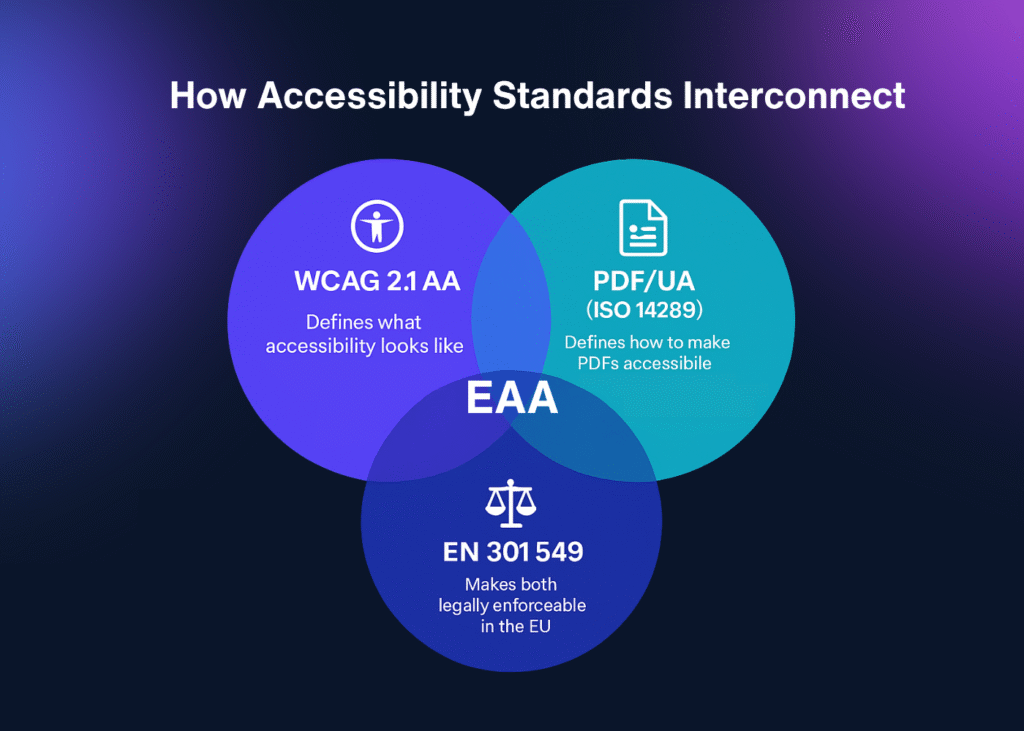
Venn diagram titled "How Accessibility Standards Interconnect". Three overlapping circles represent:

WCAG 2.1 AA – defines what accessibility looks like.

PDF/UA (ISO 14289) – defines how to make PDFs accessible.

EN 301 549 – makes both legally enforceable in the EU.
Their intersection in the center is labeled EAA, showing that the European Accessibility Act connects and enforces all three standards together.

If your business operates in the EU, and produces digital documents, you need all three perspectives which allow you to shape your compliance strategy and stay ahead of the curve. EN 301 549 sets the legal bar. WCAG defines the user experience standard. PDF/UA provides the technical roadmap for document compliance.

Which Standard Should Business Prioritise for Communications Accessibility?

Most compliance teams waste time auditing the same documents against three different checklists — only to discover conflicting results and unclear priorities. The smart approach is simpler: match the standard to your content type, then build from there.

So the answer depends on your content type:

For websites and web apps: WCAG 2.1 Level AA
For PDFs (statements, contracts, forms): PDF/UA (ISO 14289-1)
For EAA legal compliance: EN 301 549 (which references both)

Our team recommends not auditing against three separate checklists. EN 301 549 can be used as your primary framework as it already incorporates WCAG and aligns with PDF/UA. Then apply PDF/UA validation to ensure your documents pass technical checks. Contact us for a free communication accessibility audit.

If you’re using Quadient, OpenText, or another CCM platform, fix accessibility at the template level. One compliant template generates thousands of compliant outputs. One broken template creates thousands of liabilities.

How Quertum Helps Businesses Navigate Multi-Standard Compliance

We work with European banks, insurers, and public sector organisations to ensure their business communication meets WCAG, PDF/UA, and EN 301 549 requirements — without disrupting operations.

Our Approach is designed to meet not the green checkmarks, but reshape the whole communicational landscape and make it truly accessible and future-proofing:

  1. Template Audits: We analyse your CCM templates (Quadient, OpenText) for accessibility gaps
  2. Bulk Document Remediation: Automated tagging + manual QA for existing PDF archives
  3. Compliance Documentation: Detailed technical files proving conformity for regulatory reviews

Final Takeaway: Standards Aren’t Optional Anymore

WCAG defines accessibility principles. PDF/UA specifies how to implement them in PDFs. EN 301 549 makes both legally enforceable across the EU.

Your compliance team doesn’t need to become ISO experts. You need a clear implementation plan, accessible templates, and documentation proving conformity. The businesses thriving post-EAA aren’t the ones debating standards—they’re the ones who fixed their templates six months ago.Ready to audit your PDF templates and ensure EAA compliance? Contact Quertum’s accessibility specialists for a no-obligation assessment.

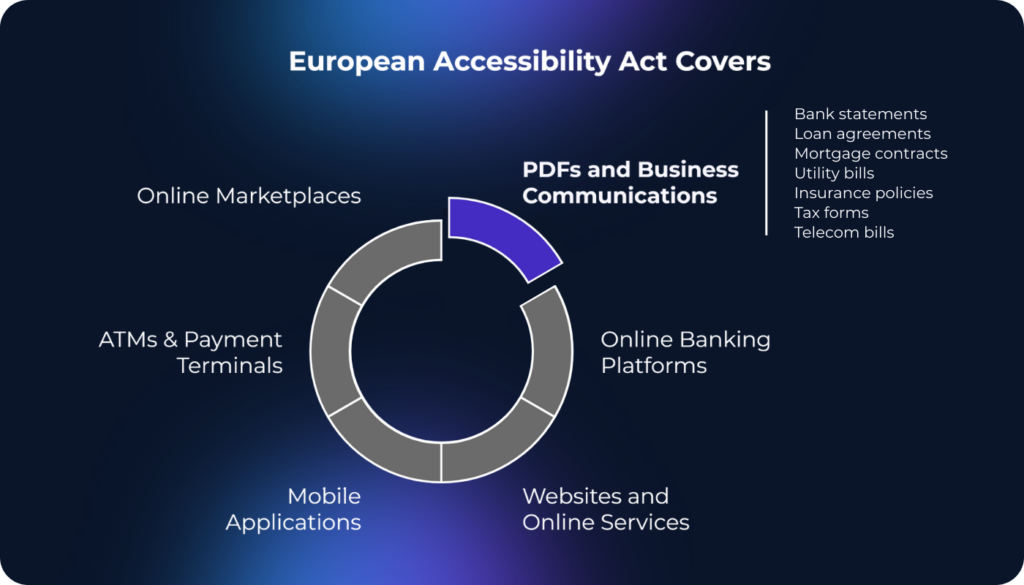
EAA and Accessible Documents: What Business Must Know About

Accessible documents have become a hidden challenge under the European Accessibility Act (EAA) and its implementation. Many organisations are still trying to understand what the EAA means for their processes and management. In this article, we explore the areas most often overlooked by Operational and Product Managers — document libraries, templates, and customer communications. In short, we focus on PDFs, Word documents, spreadsheets, and presentations published on websites, embedded in apps, or made available online — the everyday materials every organisation relies on.

For banking, financial structures, insurance, utility firms or public sector companies the EU Accessibility Act isn’t just another compliance hurdle to jump over. The EAA represents a fundamental shift in how we think about digital communications and user access. Understanding these changes now will save you significant headaches (and budget) down the road.

Read our full guide and discover:

  • How business communications became the new frontier of the European Accessibility Act;
  • What EAA rules apply to documents and communications in Germany, France, Poland, the Netherlands, and the Nordics;
  • How to protect your budget by remediating document templates instead of fixing files one-by-one;
  • Practical steps to future-proof your Document Management Systems (DMS/CCM) for accessibility;
  • Why accessibility isn’t just compliance — but also efficiency, market reach, and brand strength.

Clearing Up the European Accessibility Act for PDFs and Documents 

The most common question we hear is: “Does the EAA actually cover documents, or just websites and apps?” Documents are absolutely must comply with European Accessibility Act, especially when they’re part of digital services and offer a constant communication bridge between business and the client. Perfect example is a bank – PDF statement – client. 

The EAA aligns with POUR accessibility guidelines to ensure digital content is Perceivable, Operable, Understandable, and Robust. Organisations must follow standards like WCAG 2.1 AA for web/mobile content and PDF/UA (PDF/Universal Accessibility) for electronic documents and PDFs to fully comply with EU Accessibility Act. WCAG (Web Content Accessibility Guidelines) covers websites, HTML emails, and other web content, while PDF/UA is the ISO standard for making PDF documents readable via assistive technology.

Key Requirements for Accessible Documents and PDFs

  • Alternative text for images (so screen readers can describe images)
  • Correct document subject, author, keywords for search and indexing.
  • A logical reading order and navigability (using headings, bookmarks, and links for easy navigation)
  • Sufficient color contrast, minimum 4.5:1 contrast ratio for normal text.
  • Proper labeling of form fields for keyboard use, and general compatibility with assistive tech like screen readers and adaptive keyboards. 
  • And many more.

We’ve turned the core accessibility rules into a clear 1-page infographic, which you can share with your team and use to start you accessible business communication journey. Download the PDF Accessibility Infographic here:

In short, digital documents must be properly structured for screen reader compatibility and clear navigation to be accessible for people with impairments.

Think about your customer journey as an EAA auditor: loan applications, insurance policies, investment statements, regulatory disclosures. These aren’t just accessible documents, but the integral parts of your digital service delivery.

When a customer downloads their policy document from your portal, that PDF needs to meet the same accessibility standards as your website, to make the whole communication “omniaccessible”. This creates a ripple effect throughout your organisation. Your Document Management Systems, client portals, and digital workflows all need to ensure accessibility compliance. 


“When we talk about accessibility, we’re not just talking about websites. Every document our customers download — whether it’s a loan offer, an insurance policy, or an investment report — is part of their digital experience with us. If it’s not accessible, we’re not truly inclusive.”

– Says Maciej Majewski, a CEO at Quertum


Accessible Documents and Business Communications in Germany, France, Poland, the Netherlands and Nordics Region

Here’s where things get interesting and slightly complicated. The EAA is a directive, which means each EU country implements it through their own national legislation. This creates variations that matter for your compliance strategy – both for documents, applications, website and offline accessibility.

The EAA’s enforcement framework mirrors the EU’s existing product safety regime, but with adaptations for services. There is no centralised EU “accessibility police”; instead, each Member State has designated one or more national authorities to monitor and enforce compliance within their jurisdiction.

Click on your country to learn more about local EAA regulations, and how to adapt your communications for operating on the region.

Germany: German implementation puts significant focus on financial services accessibility. BaFin has been particularly clear about expectations for customer-facing documents. If you’re serving German customers, your loan agreements and insurance policies are under enhanced scrutiny.

France: French regulations emphasise public service accessibility, with strict requirements for any documents that interface with government processes. Private companies with public contracts face additional oversight.

Poland: Polish implementation includes specific provisions for fintech and digital financial services, reflecting the country’s growing role as a regional fintech hub. KNF (the Polish Financial Supervision Authority) and government accessibility offices are expected to audit customer-facing statements, onboarding documents, and regulatory disclosures.

The Netherlands: Dutch enforcement builds on the existing WCAG-based accessibility law that already applies to public sector websites and documents. The focus is on harmonisation — ensuring that both government and private contractors deliver accessible PDFs, invoices, and digital communications. Enterprises bidding for public contracts must demonstrate full compliance in their document workflows.

Nordics Region: Sweden, Denmark, Finland, and Norway already have long-standing accessibility cultures, often going beyond EU minimums. National agencies place strong emphasis on public procurement and utilities. For example, banking and telecom statements are under scrutiny to ensure accessible billing. Nordic regulators are likely to enforce consistently and demand proof of accessibility at the template level, not just on websites.

The practical takeaway? If you operate across multiple EU markets, you’ll want to meet the highest standard across all jurisdictions. It’s more efficient than trying to manage different compliance levels for different countries.

Accessible Documents for Enterprises: Business Communications Within CCM and DMS

Enterprise Document Management and Customer Communications Management (CCM) systems have traditionally prioritised efficiency, security, and version control. However, with European Accessibility Act (EAA) coming into force, digital accessibility has become a compliance “wild card” that organisations can no longer ignore.

The EAA introduces new requirements that affect:

  • Document Creation Workflows: Every template, automated generation process and approval workflow needs accessibility checkpoints built in.
  • Search and Retrieval: Users with disabilities must be able to find and access documents as efficiently as anyone else. This affects your search algorithms, metadata standards, and user interface design.
  • Version Control: When documents are updated, accessibility features must be maintained and improved, not accidentally removed.
  • System Integration: APIs, third-party connections, and data export functions must preserve accessibility across all touchpoints.

The good news is that most leading DMS/CCM platforms like Quadient Inspire, OpenText or Smart Communications have evolved to support accessibility features. The best practice is to incorporate accessibility at the template and content design stage, rather than fixing documents after the fact.

For example, Quadient Inspire – a leading CCM platform – has introduced robust features to help enterprises meet accessibility requirements. Inspire’s design tools allow template creators to define document structure (headings, reading order, etc.), text alternatives, and other tags so that the output PDFs are compliant with PDF/UA and the output emails or web content meet WCAG standards.

Quadient confirms that its Inspire portfolio can create accessible documents and emails when used properly, and it encourages organisations to bake accessibility into the design phase of communications. This means a bank using Inspire to generate monthly statements can configure templates such that each PDF statement comes out tagged and accessible by default, minimising the need for later fixes.

The silver lining? Addressing these challenges often improves overall system performance and user experience for everyone.

How to Check Your PDFs for Accessibility

The million-dollar question: “How do we assess our current documents for accessibility compliance?” And we’ve got you covered. 

Again we recommend you to check our latest material about PDF Accessibility or Download our Beginner Guide, which will lead you through the complete process of checking, remediation and creation of accessible PDF.

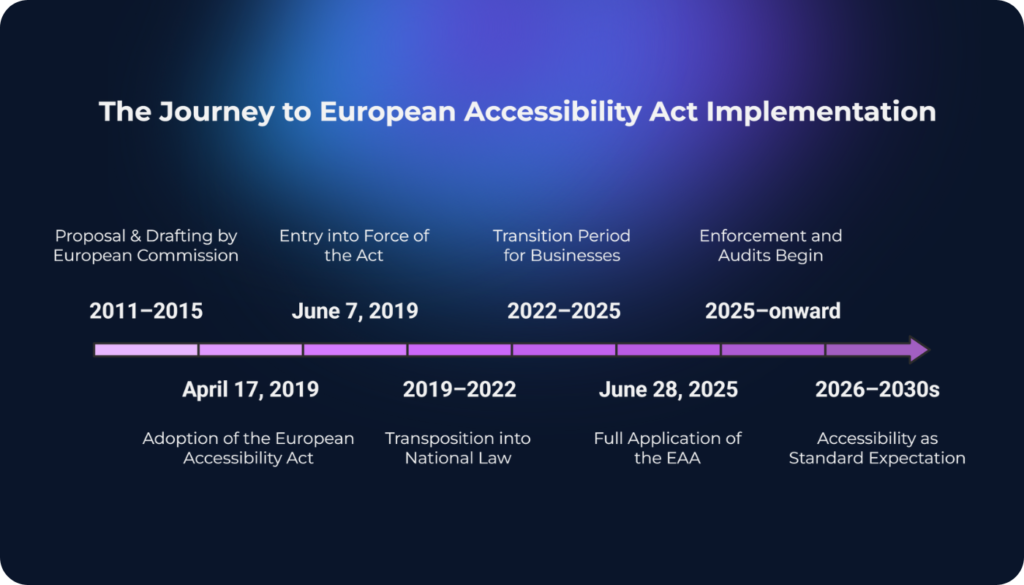
EAA Prediction: What Business Should Expect Next?

Since we’re now past the official EAA implementation date, enforcement is becoming increasingly active. Companies that haven’t addressed compliance face potential penalties and market access restrictions. More importantly, non-compliant businesses may find themselves excluded from public procurement opportunities. Here’s what regulated industries can expect in the coming years:

2025-2026: The Enforcement Ramp-Up
Regulatory audits may begin, particularly in sectors like finance and telecom where the impact of inaccessibility is highest. National authorities are issuing formal warnings and corrective action orders to organisations with non-compliant digital services. User complaint mechanisms are fully operational, meaning individual users and advocacy groups can trigger investigations.

The key shift is that regulators now require documented evidence of progress, not just promises to fix issues eventually. Your business communications, PDFs, and digital portals need to show measurable compliance improvements. In 2026 The first financial penalties are likely to be imposed — particularly on providers who failed to act on earlier warnings.

2027-2029: Market Maturity, Procurement Shifts, and Sector-Wide Compliance Pressure
Accessibility becomes a standard procurement requirement in public tenders and B2B agreements. Public sector buyers, utilities, and large enterprises will increasingly demand EAA-aligned compliance from their vendors and technology partners.

We expect to see industry-wide benchmarking: banks and telecoms will be compared based on accessibility, and those lagging behind may lose competitive ground or face reputational risk. Accessibility will factor into ESG metrics, investor reporting, and even board-level audits — especially in regulated sectors under public scrutiny.

2030: Legacy System Phase-Out
The final enforcement milestone requires all legacy equipment and digital touchpoints to meet current accessibility standards, regardless of when they were introduced.

The Strategic Opportunity Hidden in Compliance Requirements

EAA compliance may seem like just another regulatory task, but accessible documents can streamline operations, lower risks, and build stronger customer relationships. The companies that treat it as “just a tick” usually end up firefighting — retrofitting fixes, patching templates, and paying twice when audits catch what was missed.

The companies that bake accessibility into their document workflows discover something different: efficiency, market reach, and even stronger positioning in tenders.

Here’s what that looks like in the real world:

1. Expanded Market Reach = More Customers Served

Your website may already be compliant. But if a policy document, billing statement, or loan agreement is inaccessible, a customer with low vision or using a screen reader is left out.
Aging customers & people with disabilities benefit from well-tagged, accessible PDFs. For a bank, that could mean tens of thousands of customers able to independently read their monthly statements without calling the hotline.

2. Operational Efficiency = Fewer Support Tickets

Think about the cost of all the “I can’t open my bill” or “this form won’t let me type” calls. Those support requests don’t just frustrate customers, they drain service teams. Well-structured, accessible documents reduce these pain points. Templates that follow standards are easier

  • to process with automation;
  • for customers to navigate;
  • for staff to update.

3. Stronger Brand Positioning = Competitive Edge

Procurement processes are already asking about accessibility. A utilities company bidding for a public contract that can prove its PDFs meet EAA standards has a measurable advantage over a competitor who can’t. Accessibility is a visible signal that you take inclusion and regulatory maturity seriously. That resonates with customers, regulators, and partners.

4. Future-Ready Operations = Built for What’s Next

AI assistants, voice technologies, and automation tools depend on structured content. An accessible document isn’t just better for screen readers today — it’s also machine-readable for tomorrow.

That means your investment in accessible templates pays dividends when future systems pull data from the same PDFs. Whether it’s a chatbot reading out an insurance policy or an AI tool parsing invoices, structured content keeps you ahead of the curve.

Moving Forward: Your Next Steps in Accessible Documents and Communications

You don’t need to fix every communication type overnight. The most effective approach is to start small, focus on the customer-facing documents and PDFs with the highest visibility — account statements, policy documents, regulatory disclosures, billing notices — and build from there. Templates of those business communications are vital.

Here’s how to approach it without overwhelming your teams:

  1. Set Up Continuous Monitoring
    Accessibility isn’t “done once.” Templates change, regulations evolve, and audits are ongoing. Build monitoring and review into your workflows so you’re always one step ahead.
  2. Audit What You Have
    Gather a sample of your recurring PDFs and digital templates. Map what’s customer-facing, what’s critical to compliance, and where accessibility gaps exist.
  3. Prioritise High-Impact Templates
    Focus first on documents that directly affect customer experience or regulatory risk. Loan offers, insurance policies, and bills get far more scrutiny than internal memos.
  4. Build Accessibility Into Templates, Not Files
    Fixing documents one by one is a losing game. Embedding accessibility at the template level means every future statement, invoice, or policy document comes out compliant by default.

This is where our team steps in. We are proud to be a partner of the most well-known banks, insurances and utility companies in EMEA in their PDF Accessibility journey. Together we make compliance scalable. We review your current PDFs, templates, and workflows to identify high-risk gaps. We transform legacy templates into PDF/UA- and WCAG-compliant outputs, future-proofed against audits. Whether you use legacy or modern CCM or DMS, we ensure accessibility is embedded at the system level — not patched after the fact.

EU Accessibility Act in the Nordics: Consistent, Contextual, and Culturally Anchored

In our previous articles, we outlined how countries like France, Poland, Germany, and the Netherlands have implemented the Accessibility Directive, so it’s time to have a closed view to European Accessibility Act in the Nordics region. Sweden, Denmark, Finland, and Norway stand out for its long-standing digital accessibility culture. These countries are not starting from scratch: accessibility is already a legal and social expectation.

In this article, we examine how the European Accessibility Act applies across the Nordics and what companies need to prepare for, whether they operate locally or cross-border.

How the European Accessibility Act Affects Nordic Businesses?

The Nordic approach to the EAA is marked by integration rather than reinvention. Instead of building entirely new frameworks, each country has chosen to embed the EAA into existing national legislation. This reflects the region’s long tradition of treating accessibility as both a legal right and a cultural norm.

  • Sweden has incorporated the EAA into Lag (2023:254), broadening its existing accessibility framework to cover sectors such as banking, e-commerce, transport, and telecom. Oversight is shared between the Swedish Consumer Agency (Konsumentverket) and the Agency for Digital Government (DIGG).
  • Denmark enforces accessibility through Act no. 801 of 07/06/2022, with a strong emphasis on consumer protection. The Danish Business Authority (Erhvervsstyrelsen) is the lead body, taking a guidance-led approach while retaining the power to issue fines and corrective measures.
  • Finland aligns the EAA with Government Decrees 179/2023 and 180/2023, building on the accessibility requirements already established under the Act on the Provision of Digital Services. Compliance is supervised by the Finnish Transport and Communications Agency (Traficom).
  • Norway, while not an EU member, implements equivalent rules via the Anti-Discrimination and Accessibility Act and related ICT regulations. Enforcement is handled by the Agency for Public Management and eGovernment (Digdir), ensuring alignment with the EEA Agreement.

For businesses, this creates continuity with national traditions but also complexity: obligations are consistent in principle, yet enforcement models and regulatory expectations differ across the region. Multinationals must be prepared to navigate these nuances while ensuring compliance with a baseline set of EAA requirements.

What the European Accessibility Act in the Nordics Requires?

The baseline obligations are the same across all Nordic countries, as they derive from the EU Directive:

  • Digital content must comply with WCAG 2.1 AA (websites, apps, PDFs)
  • Products and services must be compatible with assistive technologies
  • Accessibility statements, documentation, and feedback mechanisms are mandatory
  • Labels, instructions, and user interfaces must be legible, perceivable, and understandable
  • Identification, security, and payment functions must meet POUR principles

Banking and e-commerce services carry extra requirements:

  • Identification methods, e-signatures, and payment services must be perceivable, operable, understandable, and robust
  • Financial information must be written at B2 language level or lower, ensuring clarity
  • E-commerce operators must provide information about the accessibility of products and services where available

This mirrors the approach in the Netherlands and highlights how financial services are under special scrutiny across the EU, including the Nordics.

Exemptions and Exceptions for European Accessibility Act in the Nordics

The Nordic countries follow the general EAA exemptions:

  • Microenterprises: Fewer than 10 employees and turnover/balance sheet below €2M are exempt. Regulators in Sweden, Denmark, and Finland nevertheless encourage voluntary compliance to remain competitive in the digital single market.
  • Disproportionate burden: Businesses may be exempt if compliance would create costs disproportionate to the accessibility benefit, based on Annex VI of the Directive. Lack of time or knowledge is not a valid reason.
  • Fundamental alteration: When accessibility requirements would alter the service so substantially that it becomes a different service.
  • B2B services: The EAA applies only to business-to-consumer services, not pure B2B contexts.

Timeline and Transition Rules

The enforcement date is consistent across the EU and the EEA:

  • 28 June 2025: All new services and modified contracts must comply with the EAA
  • Existing contracts signed before this date may run until expiry, but no longer than five years, meaning by 28 June 2030 all must comply
  • Physical products used in service delivery (e.g., payment terminals, e-ID devices) have the same five-year transition period. Products placed on the market before June 2030 may be used temporarily, but must be upgraded or replaced to meet the new requirements.

What Penalties for Non-Compliance in the Nordic Region?

The penalty framework varies slightly across Nordic countries, but follows similar patterns:

  • Administrative fines are the main tool, with amounts depending on turnover and severity
  • Regulators may impose recurring penalties until compliance is achieved
  • In serious cases, providers may face suspension of services or public disclosure of violations

Sweden’s model is considered stricter, with higher fines and stronger inspection powers, while Denmark and Finland lean on consumer law enforcement traditions.

Key Differences at a Glance for Nordic Countries

To make the national differences clearer, the table below outlines how each Nordic country has embedded the EAA into its legal framework, who supervises compliance, and what businesses should be aware of in terms of scope and enforcement.

CountryMain Law / FrameworkSupervisory AuthoritySpecial FeaturesPenalties & Enforcement
SwedenLag (2023:254)Swedish Consumer Agency (Konsumentverket) and Agency for Digital Government (DIGG)Broad scope, covering banking, e-commerce, transport, and telecom; one of the earliest comprehensive accessibility laws in Europe.Fines, corrective orders, and strong inspection powers; considered among the strictest in the EU. Fines range up to EUR 200 000.
DenmarkAct no. 801 of 07/06/2022Danish Business Authority (Erhvervsstyrelsen)Strong consumer protection focus; guidance-led enforcement with emphasis on business accountability.Administrative fines, warnings, and recurring penalties until compliance is achieved. Fines range up to EUR 10 000 for initial non-compliance.
FinlandGovernment Decrees 179/2023 & 180/2023Finnish Transport and Communications Agency (Traficom)  Builds on existing Digital Services Act (2019), where WCAG 2.1 AA was already mandatory for public bodies.Fines and corrective measures, applied proportionately to scale and impact. Fines range up to EUR 150 000.
Norway (EEA country)Anti-Discrimination and Accessibility Act + ICT regulationsAgency for Public Management and eGovernment (Digdir)Applies to both public and private services despite Norway being outside the EU; aligns with EEA obligations.Administrative penalties and corrective measures, supported by Norway’s strong ICT audit tradition.

Summary

The Nordics are well-positioned to implement the EAA thanks to their strong pre-existing accessibility laws. For businesses, this means compliance is not just about meeting EU standards but aligning with national frameworks that often go further.

From Sweden’s early adoption of a broad accessibility act, to Norway’s strict ICT obligations, the Nordic region sets high expectations. Companies operating here must take accessibility seriously, integrate it into product and service design from the outset, and prepare for close scrutiny by multiple regulators.

European Accessibility Act in the Nordics region is treated as integral to society, law, and commerce, rather than as a formal obligation alone.

Career

Keep work human and fair. Come work with us

Join the team which celebrates low bureaucracy and clear work-life balance.

Explore Careers

We overcome customer expectations and serve solutions which influence people’s tomorrow.

Help reshape the way Europe’s most regulated industries communicate. At Quertum we support organizations that serve millions from banks to insurers to public institutions by ensuring their documents, portals, and digital services are not just compliant, but genuinely accessible and user-friendly.

Every checklist you automate, every integration you streamline — it all contributes to better experiences for real people navigating critical moments in life.

We’re a tight-knit team with big impact. And when your ambition meets our culture of clarity, care and curiosity, you lead the digital transformation.

Learn More About Quertum

Benefits & Wellbeing

Highlight perks and wellness support

  • Private Healthcare Package

    Stay healthy with 50% co-financed coverage of medical insurance— for peace of mind when it matters most.

  • Flexible Working
    Hours

    We trust you to do your best work on your schedule — not someone else’s clock.

  • Remote, Hybrid or On-Site Work

    Home, office, or a mix — choose what works best for your lifestyle. Our Warsaw office is always open and welcoming.

  • Flexible Employment Options

    Whether you prefer a Contract of Employment or B2B — we’re good either way.

  • Top-Tier
    Equipment

    We’ll set you up with modern IT gear and everything you need to work comfortably from anywhere.

  • Supportive Team Culture

    Friendly faces, collaborative spirit, and real support from both QA and development teams.

  • Career Planning & Training

    Grow your skills, your confidence, and your role — with personalized plans and training budgets.

  • Growth-Focused Environment

    QA/QC, testing tools, or something new — we’re here to help you level up.

  • Mental
    Support

    Take care of your headspace with access to the Mindgram mental care & well-being platform.

  • Multisport Card

    Move your body, your way — with 50% covered access to gyms, pools, yoga, climbing, and more.

  • Seniority Bonuses & Extra Days Off

    Your time with us matters — and we’ll celebrate it with more time to rest.

  • Employee Referral Bonuses

    Know someone great? Bring them in and earn a bonus when they join.

  • Gifts for the Holidays

    Gifts that will make Christmas even more enjoyable.

Your Space Among Supportive Q-People

You don’t need to be loud to be heard here. At Quertum, we build complex things, but we keep the atmosphere simple: helpful people, honest feedback, and no unnecessary pressure. If you like solving problems with folks who share memes between meetings and actually answer your questions without playing expert — you’ll fit right in.

The truth is, every project has its ups and downs. But when you’re surrounded by people who care (and crack a decent joke at the right moment), even bugs start to feel less annoying. We help each other grow, share what we know, and cheer each other on.

  • “Even though most of our work happens remotely, I’ve never felt more warmly welcomed anywhere. We integrate more here than some teams do in the same office. This company sees people, not just numbers – and that makes me want to give my best every day.”

    Adrian
    Junior Quadient Developer

  • “I truly enjoy being part of Quertum. The supportive and professional environment makes it easy to grow, share knowledge, and keep developing. I especially value the chance to gain further experience through international projects. They give me the opportunity to expand my expertise while achieving meaningful results together with other highly skilled colleagues.”

    Karolina
    Quadient Developer

  • “I really enjoy the relaxed and friendly vibe at my company. Everyone is super helpful and works together as a true team. Plus, the management has a real open-door policy, and the flexible working hours are a huge plus.”

    Robert
    Head of Professional Services

Find your opportunity here

Explore careers at Quertum — transparent & flexible. Plan your path. Learn at your pace. And enjoy working with Q-people — calm, curious, and always in your corner.

Quadient Developer – Permanently Open Position

We are always in seek of talent and experienced minds. Apply for ‘forever-opened position’ as a Quadient Developer by sharing your CV with [email protected]
If you are a beginner in Quadient Development, or you already managed data inputs and outputs across print and digital channels, we want to hear from you.

CCM Developer

  • Level: Junior

  • Type of work: Full-time

  • 6 000 – 8 500 zł

    gross / mth. | contract
    of employment

  • 7 800 – 10 800 zł

    net (+ VAT) / mth.
    B2B contract

View the offer

Continue reading

EU Accessibility Act in the Netherlands: Systematic and Sector-Integrated

In our previous articles, we reviewed how France, Poland, and Germany implemented the EAA, and now we are turning to the EU Accessibility Act in the Netherlands. Dutch law takes a highly structured approach, embedding EAA requirements across existing laws and delegating enforcement to multiple sectoral authorities.

In this article, we break down how the EAA (or Toegankelijkheidsrichtlijn in Dutch) has been transposed in the Netherlands, what it means for businesses, and how companies, whether local or global, must navigate this new legal landscape.

How the European Accessibility Act Affects Business in the Netherlands?

The Netherlands transposed the EAA via the Dutch Implementation Act, passed in April 2024. Instead of creating a single omnibus law, the obligations have been embedded into existing sector-specific legislation.

Examples include: 

  • Telecommunications Act: For telecoms and digital communication services
  • Civil Code: For e-commerce and consumer contracts
  • Financial Supervision Act: For banking and financial services
  • Equal Treatment of Disabled and Chronically Ill People Act: For transport and audiovisual media

This decentralised transposition means that a business operating across multiple sectors, such as a bank that also sells products via e-commerce, will need to comply with several pieces of legislation at once, each enforced by a different authority. While this allows for more targeted oversight, it also makes compliance more complex, requiring cross-departmental coordination and robust legal oversight.

What the EU Accessibility Act in the Netherlands Requires?

Across all sectors, companies must:

  • Ensure products and services are accessible in line with Annex I of the EAA, using EN 301 549 as the functional standard.
  • Publish accessibility statements and implement feedback mechanisms for users.
  • Maintain documentation and evidence of compliance, and take corrective actions when necessary.

These requirements reflect the EAA’s functional performance principles, which focus on how users experience a product or service rather than prescribing exact technical methods. By centring on perceivability, operability, understandability and robustness, the legislation gives businesses flexibility, but also holds them accountable for delivering genuinely usable services. 

Requirements for Banking Services under EU Accessibility Act in the Netherlands

For banking services, the following apply:

  • Identification methods, electronic signatures, security, and payment services must be perceivable, operable, understandable, and robust.
  • Information must be understandable without exceeding B2 level of the Council of Europe’s Common European Framework of Reference for Languages.

Additional Requirements for (Financial) E-Commerce Services

For (financial) e-commerce services, businesses must:

  • Provide information about the accessibility of products and services being sold when such information is provided by the responsible economic operator.
  • Ensure accessibility of identification, security, and payment functionalities when these are delivered as part of a service, making them perceivable, operable, understandable, and robust.
  • Provide identification methods, electronic signatures, and payment services in line with POUR principles.

What are Exemptions for EAA in the Netherlands? 

The EAA in the Netherlands allows exemptions in specific cases:

  • Microenterprises: Businesses with fewer than 10 employees and an annual turnover or balance sheet total not exceeding €2 million are exempt. The AFM encourages these businesses to meet EAA standards where possible to improve competitiveness;
  • Disproportionate burden: When the costs of compliance outweigh the benefits for persons with disabilities, following the criteria in Annex VI of the EAA. Legitimate reasons must be used; lack of priority, time, or knowledge is not acceptable;
  • Fundamental alteration: When compliance would change the essential nature of the service;
  • B2B services: The EAA does not apply to business-to-business services.

Even when exemptions apply, Dutch regulators stress that accessibility should be seen as a market opportunity. Complying voluntarily can open access to cross-border customers, increase brand trust, and reduce the risk of future legal changes removing exemptions altogether. 

If external funding is provided to improve accessibility, providers cannot claim disproportionate burden or fundamental alteration.

Sectoral Implementation & Enforcement of EAA on Dutch Market

Supervision of the EAA accessibility requirements in the Netherlands is divided among:

  • ACM (Authority for Consumers and Markets) – telecom, e-commerce
  • RDI (Digital Infrastructure Inspectorate) – infrastructure-related services
  • CvdM (Dutch Media Authority) – audiovisual services
  • ILT (Human Environment and Transport Inspectorate) – transport
  • AFM (Authority for the Financial Markets) – financial services

The Ministry of Health, Welfare and Sport (VWS) maintains an accessibility monitoring website with detailed enforcement guidelines.

Physical Products Used in Service Provision

If physical products are used when providing a service, such as bank cards, random readers, or e-identifiers, they must also meet the EAA’s accessibility requirements.

There is a five-year transition period for products already placed on the market before 28 June 2025. During this time, services can continue using them, but they must be upgraded or replaced to comply with the EAA before the deadline.

For instance, an older random reader device may not support screen reader functionality or tactile feedback, making it difficult for users with visual impairments. During the transition period, such devices can still be used, but they must be upgraded or replaced with fully accessible alternatives before the 2030 deadline.

Timeline and Transition Rules

  • 28 June 2025 – EAA obligations apply for all new services and modified contracts.
  • Existing service contracts signed before this date can continue without changes for up to five years, until 28 June 2030.

During the transition period, physical products used in providing services must be made accessible before the final deadline.

This dual timeline, services first, products later, means businesses will need to manage two parallel compliance tracks. While the product deadline may seem far away, procuring, testing, and deploying new accessible hardware can take years, making early planning essential. 

This applies equally to banking services and financial e-commerce services.

What are Penalties for EAA Non-Compliance in the Netherlands?

Failing to meet the EAA requirements can lead to significant consequences:

RegulatorPenalty Potential
ACMFines up to €90,000 or higher based on turnover
AFMFinancial penalties and additional sanctions such as market restrictions
Other sector regulatorsSanctions relevant to their domain, potentially including suspension of services

Non-compliance may also lead to service suspensions and reputational damage, as demonstrated in documented cases of enforcement and public backlash.

Summary

The Netherlands embeds EAA obligations into existing sectoral laws, creating a targeted yet comprehensive enforcement model. Businesses, especially in finance and e-commerce, face detailed accessibility requirements for identification, security, and payment functions, as well as clear rules on product accessibility and transition periods. With multiple regulators and penalties of up to €90,000 or more, companies should start preparing now to ensure compliance as soon as possible.

EU Accessibility Act in France: Uncovering the RGAA

In our previous articles, we examined EU Accessibility Act in Poland and Germany have implemented the European Accessibility Act (EAA) or RGAA in French. France, however, starts from a different place – one of leadership. Long before the EAA, French law had already set clear rules for accessibility. The EAA does not reinvent the wheel in France, but it does tighten enforcement, expand scope, and clarify obligations for private sectors.

In this article, we break down how the EAA is being applied in France, and what this means for companies operating locally or across borders. 

France’s Accessibility Evolution: From Early Laws to the EAA

France has been a pioneer in accessibility regulation, starting with Law No. 2005-102 (Montchamp Law), and continuing through the RGAA (Référentiel Général d’Amélioration de l’Accessibilité). Here is why the implementation of the EAA builds on this strong base, but brings in sharper penalties, broader private-sector coverage, and stricter expectations around proof of compliance

When it comes to digital accessibility, France didn’t wait for the European Accessibility Act (EAA) to take action. For nearly two decades, the country has been building a legal and technical framework to ensure that websites, apps, and digital documents work for everyone — including people with disabilities.

It All Started in 2005

France passed its landmark Law No. 2005‑102 (“Loi pour l’égalité des droits et des chances”), a sweeping anti-discrimination law that made digital accessibility mandatory for public-sector websites. This law laid the foundation for what would become one of Europe’s most mature national accessibility strategies.

Enter the RGAA — A Practical Accessibility Rulebook

To turn legal principles into action, France created the RGAA (Référentiel Général d’Amélioration de l’Accessibilité) — a national technical standard that adapts WCAG guidelines into concrete testing rules. Over the years, the RGAA has evolved through several versions, staying aligned with EN 301 549 and WCAG 2.1 standards.

Since 2016, France has also required accessibility statements on public websites and mobile apps, along with regular audits and a clear process for user feedback.

2019: Aligning with the EU Web Accessibility Directive

France was ahead of the curve when the EU Web Accessibility Directive came into force. Through Decree No. 2019‑768, the country reinforced its obligations for public bodies and certain private-sector services like banks and transport. The RGAA remained the go-to standard for demonstrating compliance.

2023–2025: The EAA Expands the Playing Field

With the European Accessibility Act (EAA) now in effect, France has broadened its scope. Decree No. 2023‑931 transposes the EAA into national law, extending accessibility obligations to:

  • E-commerce platforms
  • Banking and payment services
  • Transport apps and ticketing systems
  • Consumer hardware and software interfaces
  • Digital documentation and product info

This marks a shift from “just public sector” to a fully digital economy model — where most businesses will need to prove their services are usable by all.

What French Accessibility Act Requires in 2025?

Businesses must now prepare not just for WCAG 2.1 or EN 301 549 compliance, but for a French interpretation of these standards – codified in domestic law and enforced across multiple sectors. 

France’s implementation adds structure and legal force to accessibility expectations, so companies must ensure that:

  • Digital content follows WCAG 2.1 Level AA and EN 301 549

For PDFs, this means tagging content structures (headings, lists, tables), setting reading order, and ensuring compatibility with screen readers like NVDA or JAWS.

  • Products and services function with assistive technologies like screen readers, voice recognition software, and screen magnifiers
  • Accessibility statements, testing results, and feedback mechanisms are made publicly available
  • Online documentation is accessible and linked clearly from physical products
  • Compliance documentation is maintained in accessible way (technical files, conformity declarations)

Your PDF manuals, onboarding guides, or financial statements must not only be accessible but provably so — through technical files or audit reports.

  • Labels, instructions, and UIs are legible and perceivable for users with disabilities 

These requirements apply to both consumer-facing and B2B products and services, with a particular focus on e-commerce, banking, insurance, utilities, transport, and telecommunications.

What are RGAA Exemptions?

France, like most EU countries, has adopted the microenterprise exemption provided in Article 4 of the EAA. This means that:

  • Businesses with fewer than 10 employees, and
  • Less than €2 million in annual turnover or balance sheet total are exempt from EAA obligations

However, public sector suppliers, service providers, and certain regulated industries may still need to comply, even if technically exempt, due to overlapping laws (e.g. RGAA or sectoral requirements).

How France’s Accessibility Act is Implemented?

France transposed the EAA through a coordinated set of laws, decrees, and orders throughout 2023:

Notably, French law avoids vague language: standards are named explicitly, and enforcement powers are clearly defined.

France’s Extra Requirements of RGAA You Need to Know About

France doesn’t stop just at aligning with the EAA. It adds layers of requirements under existing national frameworks:

  • The RGAA mandates manual audits, accessibility statements, and feedback tools for public websites and apps

Manual audits ensure the real-life accessible usability. That’s why it’s essential to choose the right partner team—one that doesn’t just run documents through tools like the PAC app, but also has proven experience in delivering true accessibility. The handcrafted approach ensures compliance not by ticking boxes on a checker screen, but by testing how people of diverse abilities actually interact with content—making accessibility both compliant and genuinely usable.

  • Even private companies must adopt WCAG-aligned standards when offering public-facing digital services
  • Periodic reporting and public disclosures are required for certain sectors

This layered approach means that simply meeting EAA minimums isn’t enough – local compliance expectations go deeper.

Harmonised Standards to Follow

French regulators reference the same harmonised standards recognised across the EU:

  • EN 301 549 – covers accessibility of ICT products and services
  • WCAG 2.1 AA – the benchmark for accessible web and mobile content

For Physical Products

  • Labels and manuals must support multisensory accessibility: font size, colour contrast, spacing, tactile elements
  • Information must be available in alternative formats and perceivable via vision, hearing, or touch

For Digital Documentation

  • PDFs, instructions, and online help must follow WCAG and be compatible with:
    • Screen readers (NVDA, JAWS)
    • Braille displays
    • Voice commands
    • Keyboard navigation

What are Deadlines and Penalties for RGAA Incompliance?

France’s EAA obligations will apply from 28 June 2025, in line with the EU-wide deadline. The law has been integrated through Law No. 2023-171, Ordonnance No. 2023-859, and Decree No. 2023-931, creating a multi-layered enforcement system.

Enforcement Bodies Rely on Sector Type

  • Market surveillance authorities will oversee products and services falling under the EAA
  • DGCCRF (Direction générale de la concurrence, de la consommation et de la répression des fraudes) will handle consumer market compliance
  • DINUM continues to enforce the RGAA for public-sector digital services, which operates in parallel to EAA requirements

Penalties for RGAA Incomplinace

  • EAA-specific violations are generally treated as Class 5 offenses in France, with fines of up to €1,500 for individuals and €7,500 for organisations, repeatable for ongoing non-compliance

Additional Penalties under Montchamp Law

Under the long-standing Law No. 2005-102 (Montchamp Law), large private-sector companies (annual turnover ≥ €250 million) can face fines of €50,000 for non-compliance with accessibility obligations, plus €25,000 for missing required declarations or accessibility plans. These penalties can recur every six months until compliance is achieved.

⚠️ Fines of €50,000 can apply not only to inaccessible websites — but also to downloadable forms, onboarding documents, or PDF manuals used in public-facing services.

This dual framework means that EAA obligations in France are reinforced by existing national laws that already carry substantial penalties for certain organisations.

Why PDF Accessibility Matters in France’s Compliance Landscape

PDFs remain one of the most widely used formats for digital content — from financial disclosures to user manuals and application forms. Under the French EAA framework, inaccessible PDFs — recurring ones and templates — can be just as non-compliant as broken websites or inaccessible apps.

Here’s where businesses often miss the mark:

  • Visual-only scans with no semantic tags
  • Missing alternative text for diagrams or infographics
  • Incorrect reading order for screen readers
  • Lack of keyboard navigation support

At Quertum, we specialise in auditing, fixing, and validating PDF documents for compliance under WCAG 2.1, EN 301 549, and RGAA 4.1 — helping you avoid fines and protect your brand.

Summary

France’s EAA implementation builds on one of Europe’s most established accessibility frameworks. Businesses must meet both the EU directive’s core requirements and long-standing national obligations under the Montchamp Law and RGAA. This results in broader scope, clearer rules, and a stronger enforcement model. Penalties range from €1,500 for standard violations to €50,000 for large companies, with recurring fines for ongoing non-compliance. Accessibility is not new in France, it is a deeply rooted legal expectation that requires early preparation and continuous compliance.

EU Accessibility Act in Germany: What Business Can Expect from BFSG?

In our previous article, we explored the main pillars and risks of non-compliance with the European Accessibility Act (Directive 2019/882). Now, let’s turn to Germany — where the Accessibility Act becomes national law under the Barrierefreiheitsstärkungsgesetz (BFSG).

Germany’s national implementation of the EAA came into force on 28 June 2025. The BFSG law is designed to bring key products and services in line with accessibility standards, without expanding beyond the EU baseline like Poland does. While it follows the directive closely, the German Act introduces specific rules around exemptions, enforcement, and transitional periods that businesses should pay attention to.

What Sets the German Act Apart? 

Germany has largely aligned its implementation with the requirements of the EU Accessibility Act, introducing specific provisions around enforcement and transitional rules. The national law closely mirrors the directive’s scope and technical standards, relying on WCAG 2.1 Level AA and EN 301 549 as key accessibility benchmarks. The BFSG applies to a defined list of consumer-facing products and services, particularly in the digital, banking, telecom, and retail sectors.

What Products and Services should Be Accessible under German Accessibility Act?

The BFSG applies to a wide range of products and digital services offered to consumers. These include:

Products covered:
  1. Consumer computer hardware and operating systems
  2. Self-service terminals:
    • Payment terminals, ATMs, ticketing and check-in machines
    • Interactive terminals (excluding those integrated into vehicles or transport systems)
  3. Consumer telecom and media devices with interactive or computing capabilities
  4. E-book readers
Services covered:
  1. Consumer telecommunications services (excluding machine-to-machine transmission)
  2. Elements of passenger transport (air, bus, rail, waterborne), excluding local/regional services
  3. Websites and mobile apps
  4. E-tickets and real-time travel information (via interactive screens in the EU)
  5. Interactive self-service terminals for transport services (within the EU)
  6. Consumer banking services
  7. E-books and related software
  8. E-commerce platforms and services

The law applies to both manufacturers of the listed products and service providers offering them to consumers in the EU market, whether operating within Germany or serving German consumers cross-border. It focuses on areas where digital accessibility has the most direct consumer impact, particularly in everyday commercial transactions and public-facing technologies.

How the European Accessibility Act Affects Businesses in Germany?

Germany’s BFSG transposes the EAA almost directly and not beyond, introducing harmonised technical standards but tailoring its rules for enforcement and timelines. For businesses in banking, insurance, telecom, public sector, e-commerce, and transport, this means:

  • All digital content must meet WCAG 2.1 AA accessibility criteria (including accessible PDFs).
  • Products and services must function seamlessly with assistive technologies.
  • Physical product labels and instructions must meet defined legibility standards.
  • Online documentation must be publicly accessible and in an accessible format.
  • Businesses must be able to demonstrate compliance efforts through technical documentation, testing reports, and accessibility declarations.

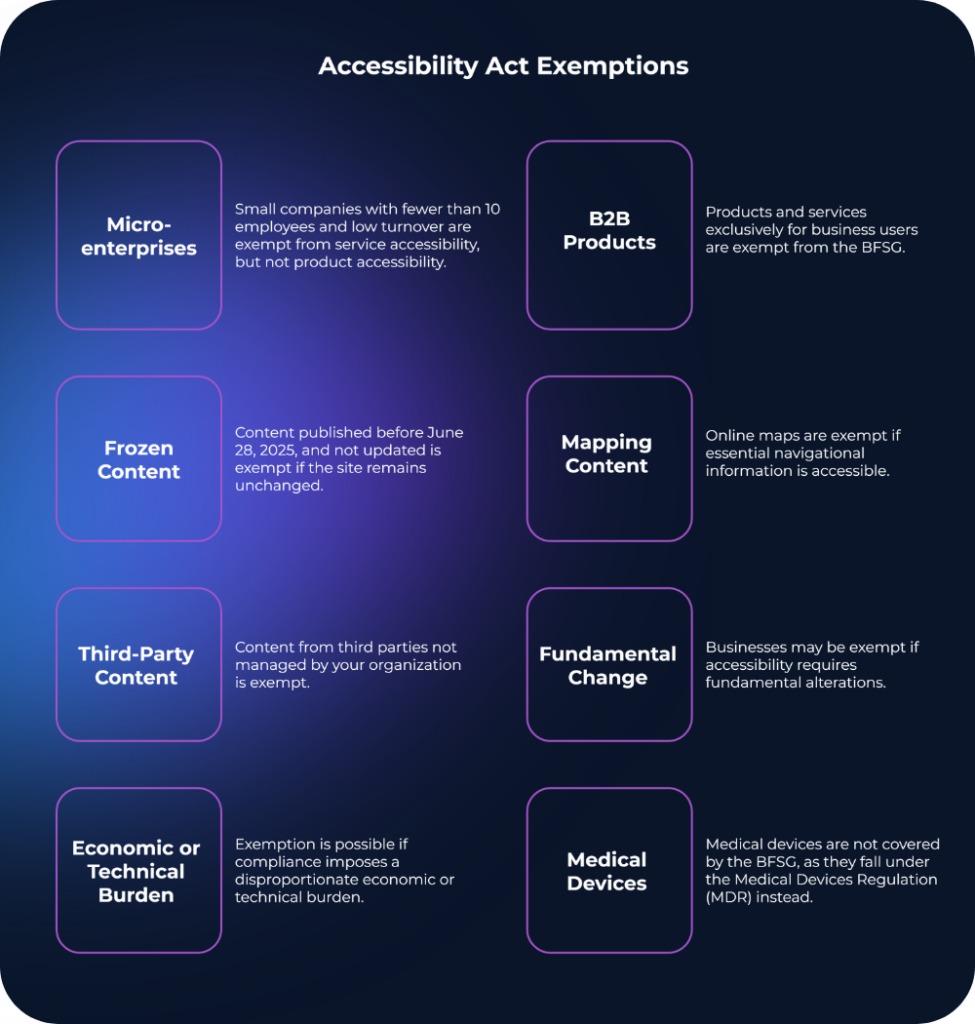
What are Exemptions for German Accessibility Act?

Under Article 4(4) of the European Accessibility Act, the BFSG excludes several areas from its scope:

  • Products and services designed solely for professional or business-to-business use — not intended for consumer markets.
  • The built environment connected to services, such as physical buildings or facilities, which remains outside the BFSG’s remit.
  • Urban, suburban, and regional public transport services — although some elements still fall under accessibility obligations. For example, self-service terminals for ticketing or check-in must comply, while the associated websites and mobile apps are usually regulated under the Public Sector Web Accessibility Directive (2016/2102).

The BFSG also avoids certain broader equality objectives found in other German laws, such as specific protections for women with disabilities or the expanded anti-discrimination grounds listed in § 1 of the General Act on Equal Treatment (AGG).

Exemption for Microenterprises

Microenterprises — defined as having fewer than 10 employees and an annual turnover or balance sheet total under €2 million — are exempt from the BFSG’s mandatory requirements.

This exemption narrows the law’s reach for the smallest businesses, while leaving SMEs and large enterprises fully accountable for compliance.

Controlled Exemptions for Legacy Systems and Contracts

Germany has also introduced targeted transitional provisions to avoid immediate disruption:

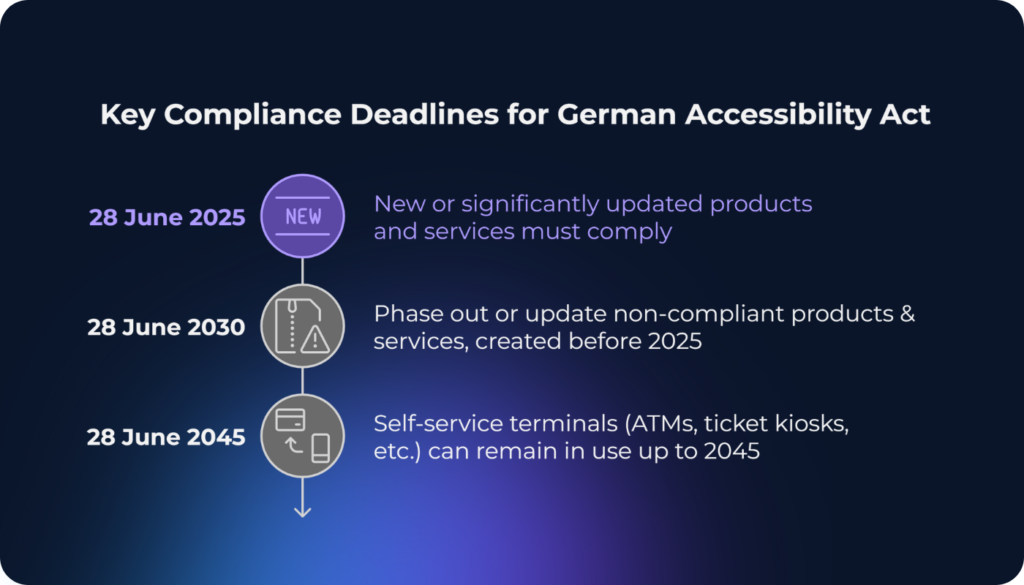
  • Service contracts signed before 28 June 2025 can continue without modification until they end, but no later than 27 June 2030.
  • Self-service terminals (e.g., ATMs, ticket machines, kiosks) installed before 28 June 2025 may remain in operation for up to 15 years from installation, provided they met applicable standards at the time.
  • Existing devices and software are not subject to retroactive changes — but any new deployment after June 2025 must meet BFSG requirements immediately.

These measures create phased compliance pressure: companies have more time to address older assets, but cannot delay upgrades indefinitely.

Considerations for Medical and Digital Health Products

Medical devices themselves are generally excluded from the BFSG. However, exceptions apply if:

  • The device’s software is accessed via a covered product, such as a smartphone or tablet.
  • An online platform sells medical devices or provides related services directly to consumers — such as registration, appointment booking, or e-commerce transactions.

In these cases, the digital interface must meet BFSG accessibility requirements.

Other Notable Exemptions

The BFSG also recognises situations where accessibility obligations do not apply, including:

  • Third-party content not funded, developed, or controlled by the economic operator.
  • Certain local and regional public transport services, unless other German or EU laws impose accessibility requirements.
  • Medical devices, unless accessed through a covered consumer-facing interface, in which case the interface must still comply.

Disclosure Rules for Digital and Physical Accessibility

While the BFSG mandates accessibility, it references “essential requirements” in EU law and harmonised standards rather than prescribing every technical detail.The BFSG applies to a wide range of products and digital services offered to consumers. Two standards are central for proving compliance:

  • EN 301 549 – Harmonised European ICT accessibility standard.
  • WCAG 2.1 AA – International benchmark for digital accessibility, incorporated into EN 301 549.

These standards define measurable requirements for:

For Physical Products:

  • Labels and instructions must have adequate font size, colour contrast, and spacing.
  • Information must be available in multiple sensory forms — supporting users with visual, auditory, or cognitive disabilities.

For Digital Documentation (including PDFs):

  • Documentation must be available online in accessible PDF format meeting WCAG and EN 301 549.
  • The link (URL) to the accessible version must be clearly printed on packaging or product materials.
  • Content must be fully compatible with assistive technologies such as:
    • Screen readers (JAWS, NVDA)
    • Braille displays
    • AAC (Alternative and Augmentative Communication) systems

What are Penalties for BFSG Incompliance?

Germany has introduced clear enforcement mechanisms. Non-compliance can result in administrative fines of up to €100,000, as well as potential market restrictions or product bans. Enforcement will be overseen by designated national authorities – such as market surveillance bodies and state-level regulators (Länder) – who may monitor compliance and act on violations under general fair trading rules.

Businesses should also be aware that failure to comply could invite legal challenges or reputational risks, especially in sectors with high public visibility.

What is a Transitional Periods for Accessibility Act in Germany?

The BFSG enters into force on 28 June 2025, with the following transitional arrangements:

  • Existing service contracts signed before 28 June 2025 can remain unchanged until they end, but no later than 27 June 2030, including streaming subscriptions and similar services
  • Service providers may continue using older products, such as tablets, smartphones or e-book readers, that were lawfully in use before 28 June 2025, until 27 June 2030
  • Self-service terminals installed before 28 June 2025 may remain in use for up to 15 years from their installation date, provided they complied with the rules in force at the time

For example, a telecom provider offering self-service kiosks for SIM registration installed in 2022 can continue using them until 2030, while a new installation after 2025 must meet accessibility requirements from day one. Similarly, online service contracts signed before June 2025 need not be retroactively updated for compliance.

These transitional measures are intended to give businesses time to phase in upgrades without disrupting service continuity.

How Quertum supports your Accessibility Journey and Compliance with EAA?

Navigating accessibility requirements under the European Accessibility Act (EAA) doesn’t have to be overwhelming. Quertum helps you make sense of technical standards like WCAG, PDF/UA, and EN 301 549 — and puts them into action, across your real-world documents and systems.

Whether you’re in banking, insurance, telecom, or the public sector, we help ensure your communication channels are compliant, user-friendly, and ready for the new legal landscape in Germany and across the EU.

With Quertum, you get:

Document audits you can act on
We don’t just flag issues — we tell you what they mean and how to fix them. From PDF templates to legacy systems, we identify the gaps and help you close them fast.

Accessibility retrofitting that fits your stack
We integrate with your existing Document Management Systems & Customer Communication Management systems and your workflows — no need to rebuild from scratch.

Compliance that scales with your DMS & CCM
Accessibility is not a one-time project. We help you set up repeatable, scalable processes to ensure ongoing compliance — across teams, channels, and output.

From legal interpretations to tech implementation, our cross-functional team supports you in translating regulations into practical solutions — without the jargon. Start your accessibility journey with confidence.

Summary

Germany’s implementation of the European Accessibility Act offers clarity and consistency, staying faithful to the original directive while acknowledging industry realities through exemptions and phase-ins. For businesses operating in Germany or serving German consumers, the upcoming enforcement date presents both a legal obligation and an opportunity to embed accessibility into product design, customer experiences, and digital infrastructure.

Taking action now means not just avoiding penalties, but building more inclusive services that meet evolving customer expectations.

Next steps for businesses:

  • Audit your current digital products and services
  • Identify contracts, platforms, and hardware in use before June 2025
  • Begin planning for technical upgrades, staff training, and documentation
  • Monitor upcoming guidance from German authorities

EU Accessibility Act in Poland: Details Business Should Know

The European Accessibility Act (EAA) is reshaping how businesses in Europe design and deliver digital services. In our previous article, we shared the main pillars and risks of being incompliant with the European Accessibility Act. Let’s go beyond the common European directive and dive deeper with state-centred approaches.

In this article, we share all you need to know to operate in an EAA-compliant way in Poland, despite being a local or global company.

How European Accessibility Act Affects Poland Business?

Poland’s national implementation of the European Accessibility Act (Directive 2019/882) goes well beyond the EU baseline — introducing stricter obligations, more detailed formatting rules, and a robust enforcement framework. Businesses operating in Poland must prepare not only for compliance with the directive, but also with a more prescriptive and locally integrated legal environment.

What EAA or PAD (Polski Akt Dostępności) in Poland Requires?

  • Digital content must comply with WCAG 2.1 AA (e.g., readable PDFs, accessible websites)
  • Products and services must work with assistive technologies
  • Clear labelling and instructions with adequate font size, spacing, and contrast
  • Online documentation must be publicly available and accessible
  • Businesses must show evidence of accessibility efforts (technical documentation, testing, declarations)

Exemption for Microenterprises

While the EU directive gives Member States the option to exempt microenterprises, Poland applies this exemption across the board. 

This means:

  • Businesses with fewer than 10 employees;
  • Either less than €2 million in turnover or balance sheet total.

This narrows the scope considerably for very small businesses, while placing greater responsibility on SMEs and large enterprises. 

Controlled Exemptions for Mapping and Navigation

While the EU directive allows certain exemptions for mapping and navigation systems, the Polish Act narrows these significantly. 

Interactive maps and geoportals are only exempt if:

  • The data present is already available in a digitally accessible format, and
  • The service complies with Poland’s separate Digital Accessibility Act (2019), which governs public sector websites and apps.

This layered approach ensures that accessibility gaps aren’t created through overly broad expectations. The relevant provisions are found in Article 4(2)(a).

Other Exemptions of Accessibility Act in Poland

The Act also outlines specific cases where accessibility obligations do not apply. These include:

  • Third-party content not funded, developed, or controlled by the economic operator;
  • Public transport services and local administrative services at the municipal, metropolitan, county, and county-municipal levels, unless otherwise required under other Polish or EU regulations.

These limited exemptions recognise practical constraints while maintaining the overall intent of the law — ensuring accessibility is the rule, not the exception.

Disclosure Rules for Physical and Digital Accessibility

The Polish Accessibility Act does more than require accessibility — it defines how accessibility must be implemented. However, it stops short of listing exact technical specifications. Instead, it refers broadly to “essential accessibility requirements defined in EU law and harmonised standards.”

To navigate this ambiguity, we recommend aligning with the two primary standards recognised across the EU for demonstrating compliance:

  • EN 301 549 – the harmonised European standard for ICT accessibility
  • WCAG 2.1 – the global benchmark for digital content accessibility (incorporated within EN 301 549)

These standards outline specific, testable criteria across both physical and digital domains:

For Physical Products

  • Labels and instructions must meet defined criteria for font size, colour contrast, and text spacing, ensuring legibility for users with visual impairments.
  • Information must be perceivable through multiple sensory channels, supporting accessibility for people with visual, auditory, or cognitive disabilities.

For Digital Documentation

  • Documentation must be made available online in an accessible format, compliant with WCAG and EN 301 549.
  • The web address (URL) for this digital content must be clearly printed on the physical product or its packaging.
  • All content must be compatible with assistive technologies, including:
    • Screen readers (e.g., NVDA, JAWS)
    • Braille displays
    • Alternative and Augmentative Communication (AAC) systems

By proactively meeting these harmonised standards, organisations can demonstrate good-faith compliance with the Polish Accessibility Act and reduce their exposure to regulatory risk.

Tightly Defined Legal Terms of Accessibility Act in Poland

Where the EU directive leaves room for interpretation, the Polish legislation introduces precise legal definitions for key accessibility terms. These include: 

  • User interface accessibility – ensuring digital tools are operable, understandable, and robust for all users
  • Real-time communication – defined to include voice, video, and text channels that enable seamless, synchronous interaction 
  • Alternative and Augmentative Communication (AAC) – explicitly referenced, supporting individuals with speech or language impairments
  • Interoperability with assistive technologies – a requirement for ensuring systems work across platforms and devices, not just within proprietary environments

This increased specificity supports legal certainty and simplifies implementation for both product developers and compliance teams.

Multi-Institutional Enforcement Model

Enforcement in Poland will not rely on a single regulator. Instead, it is distributed across multiple institutions to ensure cross-sector compliance:

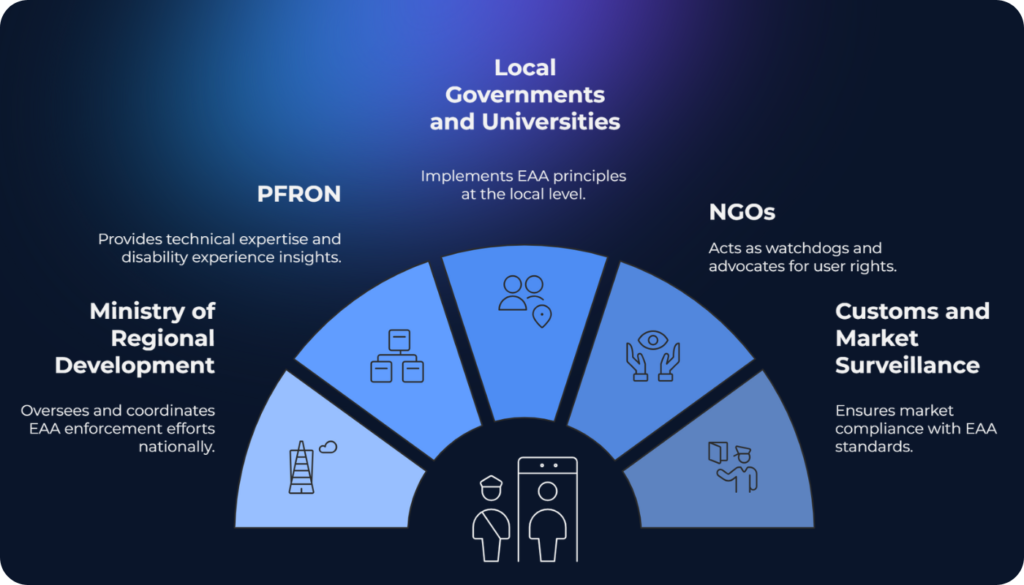
  • The Ministry of Regional Development serves as the coordinating body
  • PFRON (State Fund for Rehabilitation of Disabled Persons) supports monitoring and expertise
  • Local governments and universities are involved in outreach and technical assistance
  • NGOs focused on accessibility provide oversight and advocacy
  • Customs and market surveillance authorities handle inspections and enforcement in import/export and retail contexts
A visual diagram showing key institutions involved in enforcing the European Accessibility Act (EAA) in Poland. At the center, an icon of a police officer and a person stands beneath a security gate, symbolizing oversight. Surrounding them are five labeled segments:

"Ministry of Regional Development" (oversees and coordinates enforcement nationally),

"PFRON" (provides technical expertise and disability insights),

"Local Governments and Universities" (implement EAA principles locally),

"NGOs" (act as watchdogs and user advocates),

"Customs and Market Surveillance" (ensure market compliance).
Each segment includes a corresponding icon. Background is a gradient of dark blue and purple.

Monitoring begins in June 2026, following the mandatory compliance date of 28 June 2025.

Integration Across Over 10 Domestic Laws

To create a consistent and enforceable framework, Poland has embedded the a wide range of existing legislation, including: 

This cross-law integration makes accessibility a mandatory design principle — not a compliance afterthought. It introduces measurable expectations for both product and service delivery, reinforces risk exposure in regulated environments and aligns national policy with EU enforcement strategy. This integration supports systemic change and positions accessibility as a core requirement, not a side consideration.

Summary

Poland’s approach to accessibility is comprehensive and future-facing. For companies operating in Poland, or exporting to it, compliance with the Polish Accessibility Act requires more than checking boxes. It demands deliberate design choices, legal awareness, and operational readiness. Starting early will reduce risk and help businesses deliver inclusive experiences that meet both regulatory and customer expectations. 

CCM Migration: 6 Steps to Ease Legacy System Replacement

Switching to a new Customer Communication Management (CCM) platform? This is great!
Next step is to tackle what often feels like the real challenge — CCM data migration.

Moving off a legacy system typically feels like untangling a web of old templates, clunky approvals, forgotten dependencies and compliance rules. It can be tempting to just recreate the same structure in the new system and hope for smoother results. That rarely works. You end up dragging yesterday’s problems into a tool that was supposed to solve them. 

Whether you’re moving to Quadient Inspire or another modern solution, CCM data migration is more than a technical switch, but your chance to leave behind outdated processes and build faster, smarter, compliant communications.

Here’s how to make that happen. Without turning it into a year-long headache.

1. Don’t Migrate Everything. Migrate What’s Useful.

Legacy CCM systems store thousands of outdated templates. Our advice: don’t transfer all of them.

Instead, treat data migration like a spring-clean. Start by reviewing what’s still being used, what’s outdated and what’s just taking up space.


Ask yourself straightforward: does this template support our customer experience today?


Focus on What Still Matters for customer communication management workflow and take fair actions:

  • Identify what makes your business move
  • Remove duplicates
  • Eliminate broken or non-compliant workflows.

This is your moment to leave behind patchy messaging, mismatched formats and manual workarounds. Moving only what matters helps reduce complexity and significantly speeds up your migration from obsolete systems.

2. Map Dependencies Before They Break Something

CCM communications rarely exist in isolation. They pull data from other systems like CRMs, follow approval flows and feed into archiving or delivery tools. If these connections aren’t mapped early, they tend to create delays, errors, or compliance issues that surface when it’s too late to fix them easily.

Our advice: Speak to the people who work with the content daily – from business users and legal teams to compliance officers. They’re the ones who understand the practical dependencies, the informal workflows and the nuances that might otherwise be overlooked.


Take the time to map where data comes from, who owns what, how sign-offs happen and how outputs are delivered.


If you ignore these connections, your migration from legacy platforms can break essential flows.

A well-structured migration plan starts with a shared, cross-functional view of these interdependencies. Without it, even the best-designed system can stall at the first approval gate.

To sum up this step, proactive migration from legacy system should include:

✅ Interviewing legal, compliance and customer service teams
✅ Documenting data sources, approval chains and delivery paths
✅ Looking beyond technical diagrams (they rarely show the full picture)

3. Rebuild Templates — But Rethink Them First

One of the biggest missed opportunities in CCM migration is treating templates like fixed artifacts. Instead of redesigning them for the new system, many teams just copy what they had before – including the inefficiencies.


Copying old templates into your new system mean copying old mistakes. Use this moment to redesign templates for performance.


Don’t stop at static design. Modern CCM platforms like Quadient Inspire offer far more than just layout control. They support:

  • Reusable content blocks for reducing duplication and simplified updates
  • Dynamic fields, which personalise at scale with data-driven logic
  • Personalisation rules to tailor messaging by customer type, region, or behaviour
  • Shared elements like disclaimers or headers to centralise headers, footers, disclaimers and legal text for consistency

Look for ways to group similar templates, add shared modules (like headers or legal notes) and reduce one-off work. Over time, this helps teams work faster, stay consistent and avoid reinventing the wheel every time messaging changes. 

4. Prioritise Accessibility and Compliance Early

With laws like the European Accessibility Act (EAA) coming into effect and GDPR continuing to guide how organisations handle personal data, it’s important to build compliance and accessibility into the early stages of migration – not treat them as late-stage checks. Our advice: think about accessibility from the early stage of migration, especially now with EAA went life on June 28, 2025. Otherwise, you put the company into a risk to pay twice.

From the start of your CCM data migration, consider:

  • Accessible formats (PDF/UA, HTML)
  • Built-in legal reviews
  • Trackable approvals and audit logs

The best time to embed accessibility and compliance is before anything goes live. Doing it early is faster, cheaper, and far less disruptive than applying fixes under pressure later.


5. Migrate in Phases — Not All at Once

Trying to migrate everything at once often leads to stress, confusion and avoidable mistakes. A phased rollout is more practical and far less risky.

Our advice: Start small, choose channel, team, or type of communication, for example, onboarding emails or monthly invoices. Use that first rollout to test templates, workflows, integrations, and output quality in a real-world setting. The feedback you gather will shape how you scale, helping you avoid errors before they reach a wider audience. 

Running the legacy and new systems in parallel for a short period also builds confidence. It allows teams to compare outputs, validate compliance and flag edge cases before anything is switched off for good.

6. Make Data Migration a Team Effort, Not Just IT Department

Customer communication touches nearly every part of the business:

  • Marketing (tone of voice, branding)
  • Operational (document workflows, SLAs, and service delivery timelines)
  • Legal (approvals, disclaimers, regulatory compliance)
  • Customer experience (usability, accessibility, clarity)

For example, this could mean involving CX and legal in defining template requirements, or having marketing validate tone before rollout, not after.

Our advice: bring the right voices in early, things click into place faster — and the end result isn’t just functional, it actually works for everyone. That’s why migration from obsolete platforms and systems needs to be planned and executed as a joint effort, not something handed off to IT in isolation. Clear roles, open communication and shared ownership are what turn a tech project into a successful business change.


Cross-functional planning ensures that your migration from legacy CCM aligns with your customer journey and brand.


Your CCM Migration Should Work for You — Not Against You

With the right focus, it becomes a chance to simplify, modernise and build a stronger foundation for how your organisation communicates — inside and out. Planned well and done wisely, CCM data migration is more than a technical upgrade. It’s a real opportunity to streamline operations, reduce risk and deliver communications that make sense for legal, operational CX teams and valued by your customers.