

What are DMS, ECM and CCM? How to organise digital document flow and document management in your company

“We already have a DMS, so why would we need CCM?” We hear this in almost every first conversation with an enterprise, and it is a fair question. Both systems handle documents, both sit on the architecture diagram, and in most organisations nobody has written down where one stops and the other begins.
That gap stays invisible until someone asks for a specific document. An auditor wants the exact annex a customer received with a policy renewal two years ago. The signed contract is in the DMS. The approval trail for the template is in the ECM or in the CCM platform itself. But the letter itself was assembled at runtime by a third system, and whether an exact copy was kept depends on how that integration was configured when it went live.
So before comparing features, it helps to see what each system is actually accountable for.
🔍In this article:
- What DMS, ECM and CCM each do today, and which documents each one is responsible for.
- Where the three overlap, and why the ERP or CRM you already run cannot close the gaps between them.
- How to check which layer is missing in your architecture before you buy another tool.
⚡️Key Insights
- The audit gap lives in the integration layer, not inside the software. When an auditor asks for a customer renewal letter from two years ago, systems usually fail, and not in isolation. The template may be approved in ECM or directly in CCM; CCM assembles the letter at runtime. The failure happens in the unowned gap between them. Because if nobody built and maintained the automated return loop that captures the exact rendered PDF, timestamp, template version, delivery channel and delivery status back into the archive, the proof does not exist.
- Direction of flow defines the technology, still. Both systems output PDFs, which creates the illusion that they are interchangeable. They are not. DMS and ECM pull static, pre-existing content inward to govern its lifecycle. CCM takes raw core data, applies legal rules, and pushes dynamic content outward. Forcing an ECM to generate 50,000 regulatory notices breaks down immediately on high-volume throughput, channel fallbacks, delivery receipts, and output standards like PDF/UA.
- CRM generates a dangerous compliance illusion. CRMs and marketing automation platforms handle templates and bulk distribution well, making them tempting alternatives to a CCM. However, they are built for commercial engagement, not legal defensibility. They cannot guarantee strict template version locking, runtime determinism, or audit-grade delivery logs. Meanwhile they also create risk for GDPR and DORA exposure.
- The real communication architectural vulnerability is an ownership vacuum. Organizations often delegate the repository to IT and the communications to Marketing or CX, leaving the integration layer unassigned. Durable architectures require clear owners: IT and Compliance govern retention, lifecycle rules, and archiving (ECM); Operations and CX govern templates, distribution logic, and customer journeys (CCM); and Enterprise Engineering explicitly owns the integration layer that connects the systems.
What DMS, ECM and CCM own, and where the line sits
| Owns | Does not own | Where the line sits | |
| DMS | Documents that already exist: signed contracts, KYC scans, internal policies. Versions, access rights, search. | Creating documents. It has no concept of a template, customer data or a channel. | It receives a finished file from another system and stores it. |
| ECM | The process around content: capture, approval, retention periods, disposal. | High-volume generation of customer-facing output. | It governs the lifecycle of a document once it exists, including when it must be deleted. |
| CCM | Outbound customer communication at volume: statements, policy documents, regulatory notices, built from templates and data. | Long-term archive and records management. | It produces the document, sends it through the right channel and hands an audit trail to the archive: a copy of the document, the template version, the delivery channel and the delivery status. |
More on each layer below, starting with the one every organisation already has.
DMS: the repository layer
A DMS (Document Management System) keeps documents that already exist, controls who can open them and records every change. Standalone products such as M-Files or SharePoint used as a document library are built around one question: where is this file, and who has touched it?
In a bank or insurer, that covers three things that still matter every day:
- Versioning with check-out and check-in, so two people cannot overwrite the same contract, and an auditor can see who changed a clause and when.
- Permissions at role, department or user level, which matters when HR files and credit decisions sit in the same repository.
- OCR and metadata indexing, so a scanned agreement can be found by customer number or policy ID rather than by folder path.
A DMS does not create documents; it receives them. It has no concept of a template, a data feed or a delivery channel, because it was never asked to generate anything. When a DMS serves as the archive for outbound communication, it stores the PDF that another system produced, and only if that system was set up to send it over.
That is why the DMS has stopped being a separate purchase. It now works as the storage foundation inside broader ECM platforms, while standalone DMS remains a practical choice for smaller teams that need order in their files without process logic on top.
What is ECM? When the digital archive comes alive in the process
ECM (Enterprise Content Management) is a term popularised by Gartner around the turn of the century. It is a direct evolution of DMS. While DMS focused solely on files and the archive, ECM extended its scope to all of an enterprise’s information assets: documents, database records, emails, web content, video files and images.
If DMS is responsible for storage itself, ECM answers the question: “What should happen to this content in the context of the whole business?”
How ECM differs from DMS and what it takes to the next level:
- Active workflow and lifecycle: ECM does not just keep a file in the archive; it automates its entire flow, for example multi-step invoice approval, contract verification or handling employee requests.
- Retention policies and compliance: it enforces the legal rules for data storage, knows how long a given record must stay in the system and when it must be deleted securely and permanently, in line with GDPR or sector regulations.
- Integrated ecosystem: ECM connects with the company’s operational systems (ERP, CRM, HR), creating a single source of truth about business processes.
The current perspective: today a classic DMS is simply an internal repository module inside an ECM platform. The ECM category itself has also transformed towards flexible digital services (content services platforms, CSP), but its main role has stayed the same: full oversight of knowledge and processes within the organisation.
What is CCM? Creating and delivering communication at mass-market scale
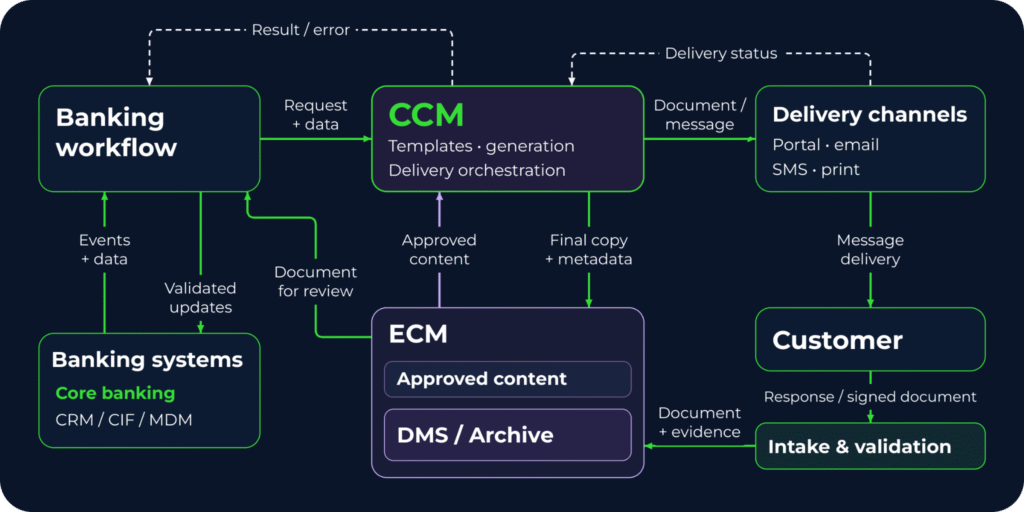
While DMS and ECM manage content the company already holds within its structures, CCM (Customer Communications Management) works in exactly the opposite direction. It is a strategy and technology infrastructure for the automated creation, personalisation and multichannel distribution of outbound communication to customers.
CCM grew out of the mass printing of bank statements and invoices in the 1990s. Today it is an advanced IT layer that combines data from ERP/CRM systems, dynamic legal templates and delivery channels into one secure process. We write more about how mass correspondence evolved into modern relationship management in the article From mass mailing to a customer communication management system.
How CCM complements and differs from DMS and ECM:
- Creation instead of archiving: DMS and ECM store existing files. CCM produces new documents in real time, for example, personalised policies, statements or tariff change letters.
- True omnichannel: while ECM operates on internal processes, CCM delivers communication through the customer’s preferred channel: email, SMS, push notification, the customer portal, traditional mass print or e-Delivery (e-Doręczenia in Polish law).
- Delivery audit trail: CCM takes care of what happens after a document is generated. It records a precise trail: what exactly was delivered, in which template version, to whom and when.
Is DMS part of ECM, and how do they differ?
If DMS is responsible for storage itself and ECM for what should happen to the content, the difference is best seen in a concrete example. It is the difference between a digital archive and active work management.
Take a concrete example. When a leasing agreement enters a DMS, it is simply indexed and stored securely. Any authorised employee can find it easily. In an ECM environment, the same agreement becomes the trigger for a whole chain of events: it starts customer verification, risk assessment and a multi-step approval path and generates a full audit trail in case of an inspection. A DMS simply stores the file. An ECM steers its life.
Historically, these were two separate markets and separate software categories. Today DMS is usually one of the functions of ECM rather than a standalone category. As a standalone product, it still sells, mainly to smaller companies that only need a simple repository without extensive workflow.
The ECM category itself has not stood still either. Gartner popularised the term around the turn of the century, and around 2017 began promoting Content Services Platforms (CSP) in its place, to emphasise the shift from monolithic systems to a modular, API-based architecture. The scope remained the same: storage, classification, workflow, and regulatory compliance. In practice, CSP and ECM are the same category under a new, more flexible name.
How does CCM differ from DMS and ECM, and where do they intersect?
DMS and ECM deal with what the company already has: storage, classification and access control for existing content. CCM works in the opposite direction: it creates new, personalised communication and sends it outwards, to a specific customer, at scale and in line with regulatory requirements. One manages what exists. The other produces what has yet to be created and reach the recipient.
Where do CCM, DMS and ECM intersect?
The point of contact is real, and the flow can run in both directions. ECM can supply shared content to CCM, such as logos, legal clauses or contract templates. It does not have to be the source of communication templates, though: these can be created, versioned and approved directly in the CCM platform.
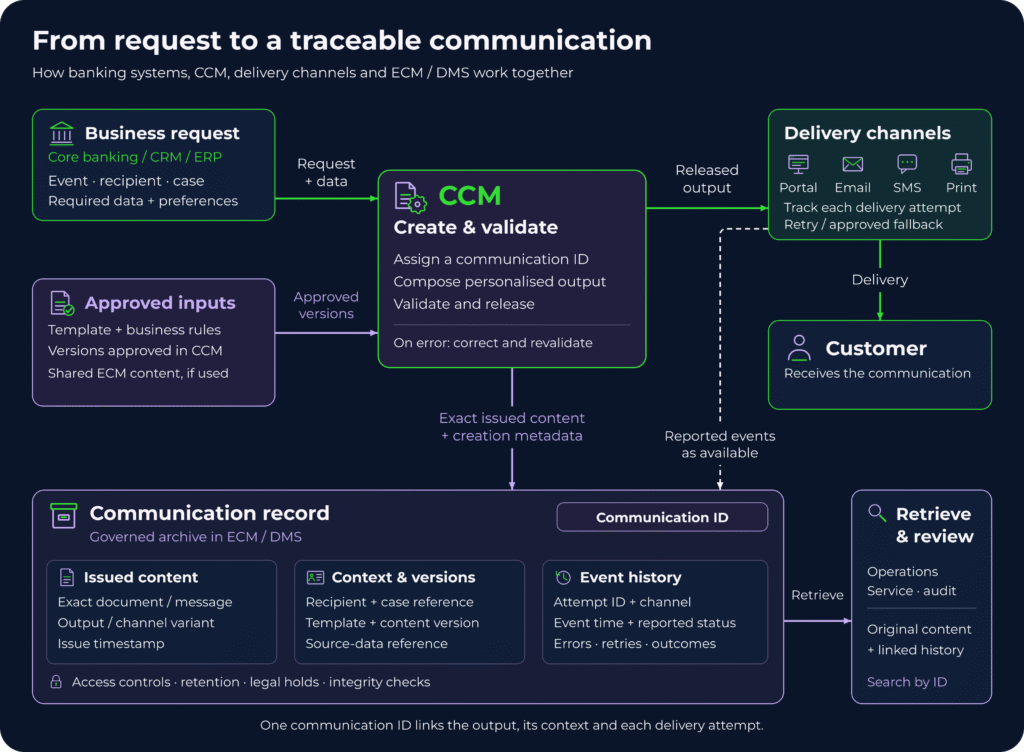
In the other direction, CCM sends an audit trail of each outgoing communication to the archive. Its scope depends on the architecture and on how the systems are integrated. Beyond a copy of the document, a timestamp and recipient details, it can also include the template version, the data used for personalisation, the delivery channel and the delivery status.
This flow needs clearly assigned ownership, and in practice the division of roles is often unclear. The repository usually sits with IT, communication with marketing or CX, and the integration layer between them can easily end up without an owner. That is why it is worth naming that owner explicitly and agreeing on three things:
- what data goes to the archive,
- who maintains the integration,
- and who checks that the audit trail is complete.
DMS, ECM and CCM compared
| DMS | ECM | CCM | |
| Main task | Storing and versioning documents | Managing content and processes across the organisation | Creating and delivering communication to the customer |
| Direction | Internal | Mostly internal, across departments; can also support sharing content with customers | Mostly outbound to the customer; can also support internal user processes |
| Key functions | Versioning, search, checkout / checkin | Retention, workflow, records management, multiple content types | Template management, personalisation, multichannel distribution, delivery audit |
| What it works with | Individual files and documents | Documents, records, web content, media | Templates, customer data, business rules |
| What it does not do | Does not manage organisation-wide policies | Does not produce personalised outbound communication | Is not a system for long-term storage of company content |
| Typical owner | IT or operations at department level | IT, compliance, enterprise architecture | Marketing, operations, CX |
Which channels does CCM support?
As mentioned earlier, in practice CCM supports far more than one or two channels. It adapts the format of the message to where the customer will actually receive it.
- Digital: email with dynamic PDF attachments, SMS, push notifications in a mobile app, messages in the customer area, for example in an online banking portal.
- Physical: automated preparation of packages for mass printing and enveloping.
- Regulated: e-Delivery (e-Doręczenia) and other channels requiring formal proof of receipt.
Practical questions: what does this mean for Product Owners and operations?
Most companies do not build their architecture from scratch. Teams already have a DMS digital archive or an ECM platform in place, sometimes also a CRM or a marketing platform, and are wondering how to arrange their relationship with outbound communication. Here are four questions that come up on almost every implementation.
Will ECM or DMS replace CCM? Where does that impression come from?
No, especially at a regulated scale. The impression comes from the fact that DMS and ECM platforms often have simple notification modules. This works in low-volume internal scenarios. It breaks down where 50,000 personalised letters have to be generated and sent at once, for example about a tariff change: the regulator then asks about template versioning, consistency across channels and proof of which version reached which customer. In banking or insurance this gap immediately turns into a risk of non-compliance with GDPR, DORA or the European Accessibility Act.
Can ECM or DMS handle customer communication?
It can, but only to a very limited extent and only until scale appears. At higher volumes, three things fail first: mass generation of personalised documents, simultaneous handling of multiple channels (email, SMS, print, portal) and the lack of an audit trail. Neither of them usually generates documents compliant with the PDF/UA standard required by the European Accessibility Act since 2025. ECM knows the history and version of the file itself but has no knowledge of the history of a specific delivery to a specific recipient.
Do we need all three systems, and who should manage what?
In a mid-sized or large organisation in a regulated industry, usually yes. They answer completely different business questions, so none of them can replace the others. The division of roles must, however, be unambiguous: IT, operations and compliance manage DMS and ECM (archive, security, retention), while marketing, CX and operations manage CCM (delivery logic, templates, omnichannel).
The most common architectural gap does not lie in the systems themselves, but in the integration layer that connects them: the APIs, message queues and file-exchange processes through which templates, data and copies of sent documents move between systems. This layer often has no clearly defined owner. It is worth assigning it explicitly, for example, to the architecture or integration team, and documenting what data each system passes on and who is responsible for the completeness of the audit trail itself, but at their API touchpoint, which as a rule has no designated owner.
Will a CRM or a marketing platform (ESP) replace CCM?
It may increasingly seem so: modern CRMs and marketing platforms offer templates, automation and email sends that work very well for sales campaigns. However, they are not built for strictly regulated communication, such as bank statements, policies or decisions on changes to terms and conditions. They do not provide full control over the legal versioning of templates or auditability at the level of an individual sent document. We write more about the differences between CCM, CRM and ESP in this article.
How to check what is missing in communication architecture?
Do not start by choosing a new tool but start with an assessment. A sensible audit should start by mapping the current environment: what each system actually does today, who is responsible for maintaining it, and where two applications duplicate each other’s functions.
Once you have mapped your assets, run a simple diagnosis based on two questions:
- Is it about finding, versioning and securely storing existing content? That is a classic task for a DMS or an ECM platform, where retention, access control and efficient OCR matter.
- Is it about producing and mass-distributing personalised customer communication with a full audit trail? That is a task for a dedicated CCM engine, where omnichannel support, dynamic templates and a legal delivery trail matter.
Where the answer is not obvious, or where system functions overlap, that is your architectural gap. That is where it makes sense to start putting your processes in order.
Summary: How to structure DMS, ECM and CCM architecture without duplicating licences?
DMS, ECM and CCM do not compete with each other. They complement each other. DMS is responsible for secure file storage, ECM manages processes and knowledge within the company, and CCM is responsible for automated, compliant communication with customers.
None of these systems on its own will give a complete answer during an audit, just as in the chaos described at the start of this article. The answer only exists once it is clear who is responsible for the integration layer between them. In practice, it is this layer that most often becomes the source of architectural gaps. Before you buy another tool, check whether your architectural gap lies right there.
FAQ
Is ECM the same as CCM?
No. ECM manages the company’s stored content. CCM produces and delivers communication to the customer.
Do we need a separate DMS if we already have ECM?
Usually not. In most implementations today, DMS is a function inside ECM, not a separate system alongside it.
Can a CRM replace CCM in a regulated industry?
For simple communications, partly yes. For communication that requires versioned templates and an audit of each individual send, usually not.
Who should own CCM in the organisation?
Most often marketing, operations or the CX department, depending on who is actually responsible for outbound communication.
Is a content services platform a new category of systems?
No. It is a renaming of what was previously called ECM, reflecting a shift towards a modular, API-based architecture.
Author

Let’s drive your Digital Transformation Together.
Schedule a free consultation with our team to explore how we can help you achieve your goals.
See also

CCM, CRM or ESP? Designing a Communications Architecture for Banks and Insurance Companies

What is Customer Communication Management System. How Quadient Is Transforming BFSI Communications?
