

CX Evolution: From Bulk Communications to Customer Communication Management Systems

Not so long ago, “bulk communications” was a fairly straightforward concept. A document went to print, then into an envelope, then to a mailing house, and the matter was considered closed. Bulk mailing was something you simply had to produce and dispatch efficiently – ideally at volume, without unnecessary complication.
For years, that model held. Paper was the primary medium, and the whole process was logistical rather than communicative. Someone printed, someone packaged, someone sent. You supplied the content, and everything else happened somewhere downstream.
Over time, however, the scope of what we mean by “mass correspondence” or “bulk communications” began to expand. The same piece of information now appears as a letter, an email, a PDF attachment, an SMS and also the banking app notification. The channels have multiplied, but the underlying matter remains the same.
At what point did this stop being a simple process? We’ll figure our in this article.
What Happens When Channels Multiply Without Architecture Transformation?
In practice, this means organisations are managing inbound and outbound correspondence across multiple channels, often without formally treating it as a single coherent process. Physical mail runs through one system, email through another, SMS through a third. Each channel operates by its own rules, and consistency between them typically depends on the goodwill and attention of individual teams, not on process architecture.
The result is divergence. The same information reaches a customer in a different form, at a different time, and sometimes with different details – not because anyone made a mistake, but because the channels were never managed together.
This version of bulk communications already operates inside most regulated organisations. The question worth asking today is not whether you’re running it, but whether you actually control what you’re sending to customers.
Why Mass Mailing and Bulk Communications Became an Operational Problem?
That divergence has a specific origin. On the surface, the processes look orderly. Letters are generated, emails leave the servers, SMS notifications arrive without delay. Each channel does its job, and individual systems, in isolation, meet their stated objectives. The real operational challenges emerge the moment you try to bind all of this into one coherent whole.
In practice, the same piece of information frequently looks different in a letter, different again in an email, and different once more in a PDF attachment. The discrepancies are sometimes subtle, with a different phrasing here, a different ordering of information there, but substantive inconsistencies do occur. This rarely happens through bad intent. It happens because every content change passes through several teams and several tools, each operating by its own logic.
Why Does The Same Message Look Different Across Channels?
The larger the volume, the more visible this becomes with legacy bulk communications tools and systems. Even a minor amendment to terms and conditions, a new legal clause, or an update to contract terms triggers a costly and risk-laden operational cascade. Managing mass mailing and correspondence in a fragmented model is not only risky but it is also extraordinarily time-consuming.
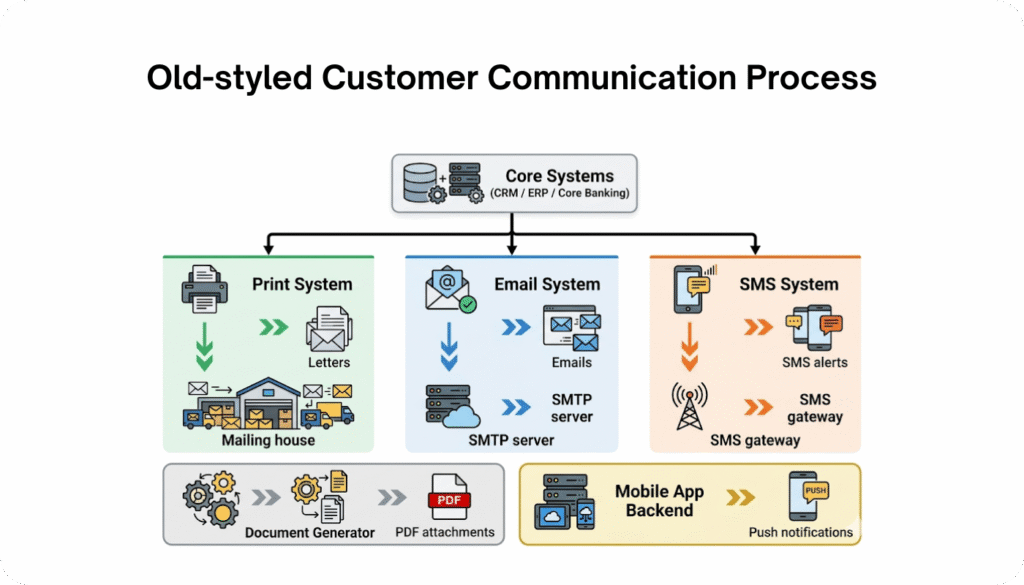
The organisation faces the need to manually apply corrections across multiple systems simultaneously, and in that volume of parallel work, a question eventually surfaces: which version of the message is the authoritative one?
The absence of a single, controlled content source stops being a mere operational inconvenience the moment a complaint, an audit, or the need to demonstrate exactly what & when was sent, comes into play. Reconstructing a complete picture of the communications history tends to be far more complicated than anyone assumed when the process was first designed.
What Are The Real Business Risks of Fragmented Communication?
The result is that bulk communications technic stops being an administrative task closed off at the end of a workflow. It becomes an element of business architecture with direct implications across four areas:
- Content consistency — the same information across different channels may differ in form or meaning, with no single source of truth.
- Change control — updating a single piece of content requires manual synchronisation across multiple systems. This creates the massive overload for IT department.
- Audit trail — reconstructing what was sent and when can be difficult or impossible. The chain of communication stops being clear – this is where customer loses the brand’s earned trust.
- Regulatory compliance — discrepancies between channels create legal and compliance risk.
These are not technical problems, but the consequences of having no shared architecture for managing correspondence and customer communications as a whole.
What Actually Changes When You Introduce Customer Communication Management (CCM) As an Evolution of Bulk Communications?
The answer to these challenges is CCM – a Customer Communications Management system that operates at the level of individual documents and messages. Policies, statements, invoices, payment notifications, transaction confirmations, marketing campaign materials. These are what actually reaches customers and shapes their experience. CCM governs how, when, and in what form that information leaves the organisation and arrives with the recipient.
This is where a distinction often overlooked in day-to-day practice becomes important. CCM is not a text editor or a document composition tool. CCM is a layer that simultaneously manages content templates, customer data, communication channels like PDF, email, SMS, customer portal, and the business logic that drives the send.
Does CCM Connect to CRM, ERP, and Core Systems in Practice?
Instead of several fragmented processes and tools, there is one coherent system managing the entirety of the communications process. For example, the leading Customer Communication Management system Quadient Inspire integrates directly with CRM, ERP, and SAP systems, pulling customer data in real time. Without manual data transfers between systems.
In financial services and insurance, that consistency carries particular weight. Every document sent to a customer serves three roles simultaneously: it is a legal obligation, an element of the customer experience, and a potential source of operational risk. The same invoice or policy document must meet regulatory requirements, be comprehensible to the recipient, and be defensible in the event of a complaint or audit. Without a shared management layer, those three perspectives operate independently – legal in one department, customer service in another, operations in a third. And each running on its own logic and at its own pace of change.
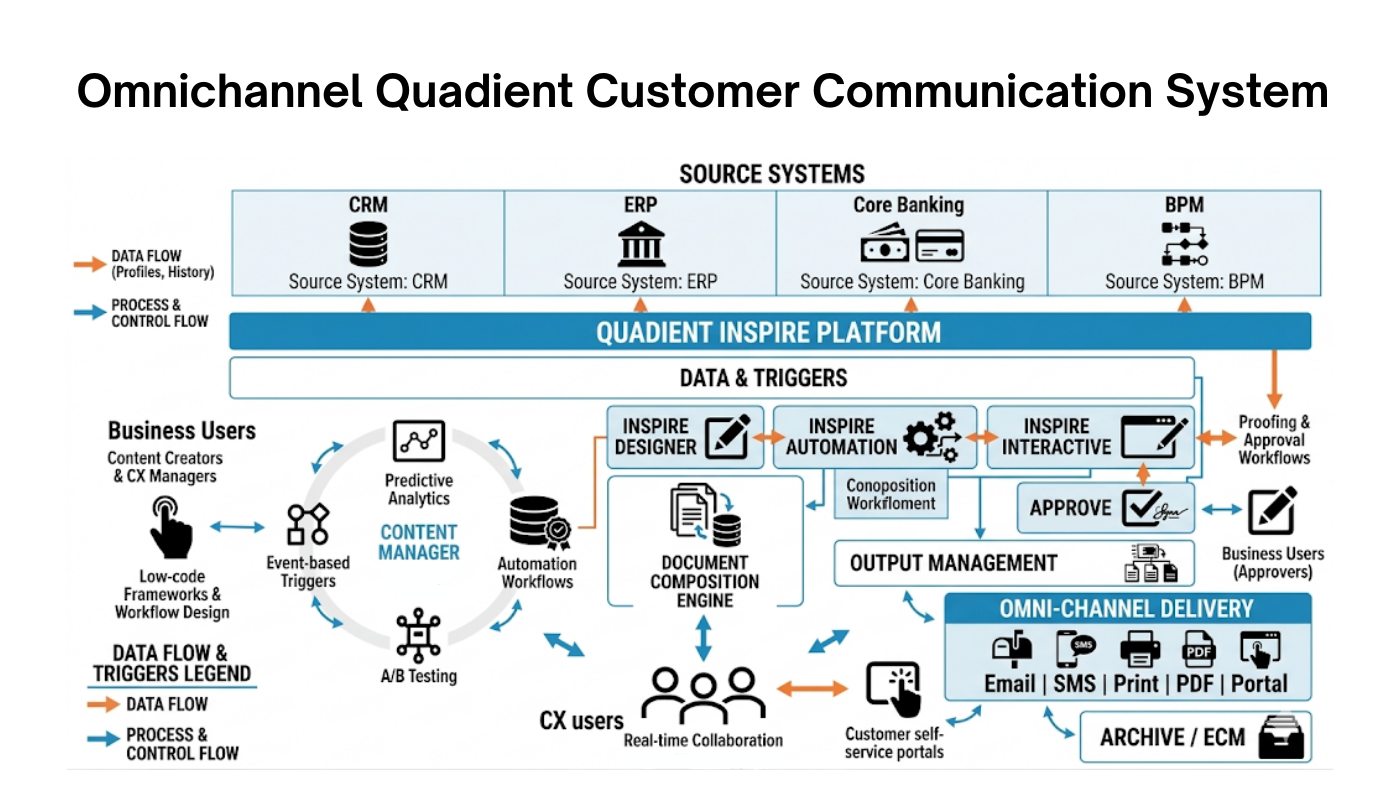
CCM brings order to that space by connecting all the elements in a single system. Automating document and communication management means that handling bulk communications stops being a process coordinated manually between teams. CCM enables the entire process to be controlled, audited, and adapted as requirements evolve. This eliminates the risk of a scenario where a single regulatory update triggers a series of uncoordinated edits across several systems at once.
Why Is Personalisation in Customer Communication Often Misunderstood?
The word “personalisation” is used so frequently today that it has largely lost its original meaning. Many organisations still operate on the assumption that the pinnacle of message tailoring is an automatically inserted first name in an email header. It’s a nice touch, and technically everything is in order. But from a business perspective and from the perspective of the customer relationship it changes very little.
Real personalisation is not about inflecting a surname. It is about taking context into account: who the customer is, where they are in the relationship, and why they are receiving this particular communication in the first place. The same invoice, repayment schedule, or notification of changed terms should look different depending on the recipient’s situation: f.e. their payment history, contract status, and prior interactions with the institution.
In practice, this means the message stops being “mass” in its content, even as it remains mass in its scale. It becomes a specific response to an individual’s situation, even while the organisation is processing a send of thousands of documents simultaneously.
This is exactly where CCM’s role as an interactive customer communications platform becomes visible. The recipient has the sense that the organisation knows their situation and understands the context of the matter, and the organisation does not need to deploy teams of staff to manually tailor each case. It is personalisation that not only looks right, but actively builds customer loyalty and reduces the volume of enquiries reaching the contact centre.
Omnichannel Question: Why the Channels Cannot Operate in Isolation?
Up to this point, we have been looking at the problem from the organisation’s perspective. Fragmented systems, no shared content source, the risk of inconsistency between channels. It is worth looking at the same situation from the other side.
The customer does not see channels – they see one company. They have no interest in whether physical mail runs through a different system than email, or whether the mobile app operates according to its own logic. When communication is inconsistent, the organisation loses credibility. Not because it made a factual error, but because its channels are visibly not talking to each other.
Omnichannel, in this sense, is not a question of how many channels are available. It is a question of continuity between them. A conversation that starts in one place should continue naturally in the next, without having to be re-explained from scratch or corrected for contradictions.
How Does CCM Ensure Consistency Across Communication Channels?
A Customer Communications Management system enables that continuity, because the same logic and the same content serve as the source for all channels simultaneously. The organisation does not have to check whether the email aligns with the letter. The customer does not have to wonder which version of the information is correct. That’s a win-win. Communication becomes a single coherent process, regardless of how many customer touchpoints it spans.
There is also a purely operational dimension. Maintaining separate systems for each channel means separate licences, separate IT teams responsible for integrations, and independent content update processes. Every regulatory change or rebrand has to be carried out multiple times, once in each system. At growing communications volumes, that model stops being efficient. As it scales, maintenance costs rise, the risk of error increases, and dependence on IT resources deepens with every change, however minor. Consolidating channels in a single CCM platform eliminates that redundancy. Instead of coordinating several independent systems, the organisation manages one coherent environment. It includes a direct impact on the cost of handling bulk communications, the time required to prepare a send, and the ability to manage content changes quickly without needing to engage multiple teams simultaneously.
Does Customer Communication Management (CCM) Fit the Organisation Workflow?
Although an increasing share of communication has migrated to digital channels, physical letters remain a meaningful element of mass mailing, particularly where regulations require it or where the nature of the customer relationship demands it. CCM does not remove paper from the communications process.
The logic, content, and personalisation of documents are managed centrally, regardless of whether a document ultimately goes to an email inbox, a PDF file, or print. In practice, this means automating document management across the entire communications process. CCM prepares personalised files ready for mass dispatch, while the print run itself can be handled internally or by an external operator, without an additional layer of manual coordination.
Paper becomes, in this way, one channel within a coherent communications model – not a separate process governed by its own rules. Control over content, document version, and audit trail remains in one place, regardless of which route the document takes to the recipient.
Why CCM Matters Most for Banks and Insurers?
In banking and insurance, customer communication is never neutral as it was before. Every document from a statement to a policy to a notification of changed terms carries specific legal and financial consequences. Even a minor inconsistency between channels can quickly become a complaint, an inspection, or a regulatory problem.
Scale amplifies the effect. A mass send of hundreds of thousands or millions of documents means that what would be a single incident in a smaller organisation becomes a systemic risk. One outdated document version, one delayed content update and the problem suddenly affects thousands of customers at once.
Are Customer Communications Now a Subject to Regulatory Audits?
Regulatory pressure compounds this further. Audits, disclosure obligations, and growing requirements around the accessibility and transparency of communications mean that documents are no longer a by-product of core systems. They become subject to scrutiny — from regulators and from customers alike.
Data security is equally relevant. Mentioned earlier, Quadient Inspire is GDPR-compliant, every operation on customer data is logged, and a full audit trail makes it possible to demonstrate compliance with applicable regulations at any point. The platform holds ISO 27001 and ISO 9001 certifications, which carry direct significance in financial services and insurance during audits and regulatory reviews.
Many institutions in the sector are still operating on CCM systems implemented a decade or more ago. Over the years, those systems have been extended with successive integrations and workarounds, to the point where every content change now requires a disproportionate level of IT involvement. These systems were not designed with multichannel communication in mind, were not built for GDPR compliance, and were not sized for the volumes that are standard in modern customer communications. In practice, they have increasingly become a bottleneck operationally and regulatorily.
What Changes After Migrating to a Modern CCM Platform?
Migration to a modern CCM platform such as Quadient Inspire resolves that problem from a nutshell. Automating communications management and centralising control over send logic eliminates dependence on manual processes and reduces the risk of inconsistency at high communication volumes. Quertum specialises in delivering that transformation from assessing the existing environment, through implementation and testing, to maintaining the production environment.
What Actually Changes When Communication Becomes a Managed System?
Mass mailing, correspondence and bulk communications have long functioned inside organisations as something self-evident – letters go out, emails are sent, documents reach customers. The problem only surfaces when you try to manage all of it as a single, coherent process. Fragmented channels, no shared content source, and systems designed for an entirely different operational reality create a risk that grows in proportion to send volume. In regulated industries such as banking and insurance, that has direct implications for regulatory compliance, customer service quality, and operational cost.
CCM brings order to that space by shifting control over communications from the level of individual systems to the level of one coherent process. Regardless of channel, if it’s letter, email, SMS, or PDF – content, logic, and audit trail remain in one place. That is what a modern Customer Communications Management system is actually for: not simply a tool for sending documents, but the foundation of communications that are consistent, scalable, and in control.
Let’s drive your Digital Transformation Together.
Schedule a free consultation with our team to explore how we can help you achieve your goals.