

What is Customer Communication Management System. How Quadient Is Transforming BFSI Communications?

You have probably faced with situation: One system for print, another for email, another for generating PDFs, and another for SMS. Each follows its own logic and none of them is responsible for what actually reaches the customer.
While banks are discussing how to implement AI agents to their core systems, something really valuable is missed. The customer, which brings not only the investment, but also its trust, ends up receiving different versions of the same message with no connection or common scence. And later the auditor asks which system was binding. The answer takes weeks.
Customer Communication Management changes this model – one place, one logic, all channels aligned.
What is CCM?
Customer Communication Management (CCM) is both a strategy and a system that allows organisations to centrally manage all outbound customer communication, both printed and online ones. This includes letters, emails, SMS messages, push notifications, PDF documents, and bank statements
CCM system is not just another email-sending tool or a PDF generator. It acts as a layer that connects customer data, document templates, delivery channels, and regulatory requirements into a single, manageable process and does so before any document leaves the organisation.
To understand what Customer Communication Management is today, it helps to look at where it comes from – and why traditional mass correspondence is no longer enough. We explore this in more detail in our previus eductaional article on what mass communication really means today.
4 Core CCM Capabilities in Practice
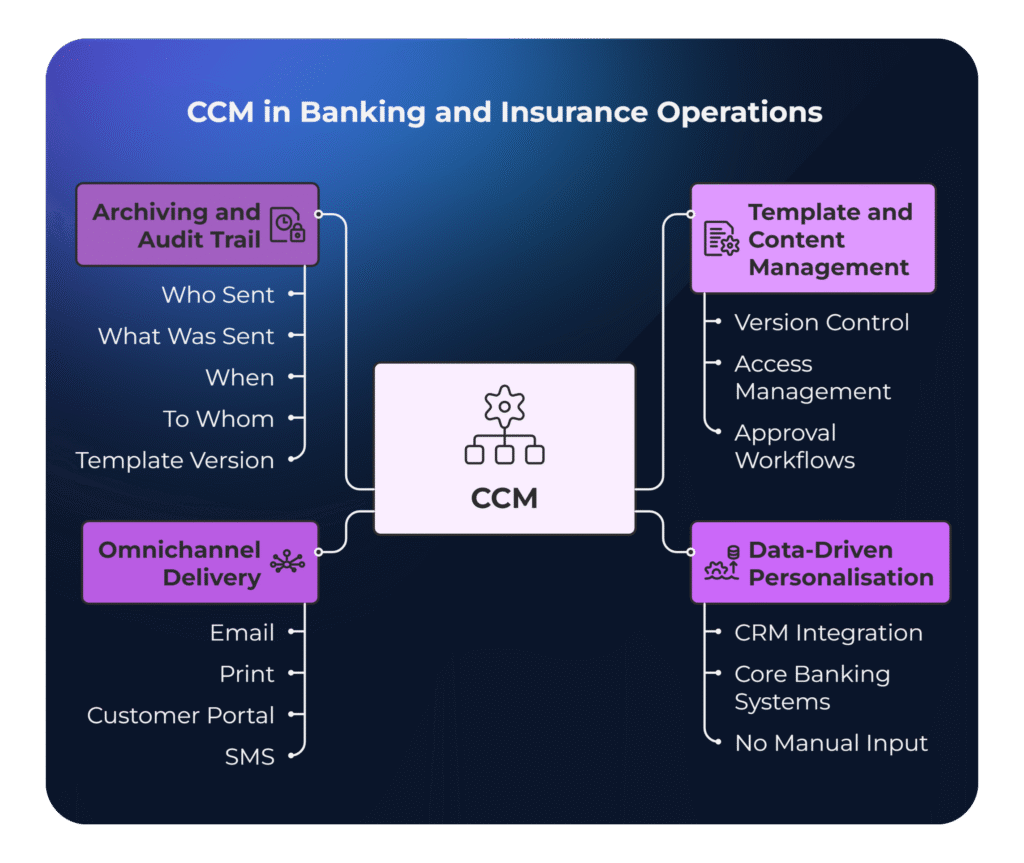
What CCM handles in the day-to-day operations of a bank or insurance company.
1. Centralised template and content management
Instead of dozens of Word files scattered across shared folders and endless email threads with the “latest version of the template”, CCM provides a single repository with version control, access management, and approval workflows. A change made in one place is reflected across all channels at once.
2. Data-driven personalisation – not manual input
Customer data, such as name, product, balance, or interaction history, is automatically pulled into documents from CRM or core banking systems.
No manual copying, no reliance on outdated data, and no errors as a result.
3. Omnichannel delivery from a single process
The same document can be delivered via email, print, customer portal, or SMS – depending on customer preferences and product requirements.
One process, multiple channels, consistent content.
4. Archiving and a complete audit trail
Every document sent is recorded: who sent it, what was sent, when, to whom, and using which version of the template.
Without this, reconstructing communication history during a complaint or regulatory audit turns into manual cross-checking across multiple systems – and rarely results in a complete picture.
Why Banks Try to Build Customer Communication Management System Themselves?
This is a pattern that repeats itself across Central and Eastern Europe.
It often starts innocently: mail merge templates in Word, Excel exports, batch printing. No one sees a problem while there are only two or three channels in play.
Then email is added. Then SMS. Then a customer portal. Then marketing automation.
And each new channel means a separate integration, separate logic, and a separate team responsible for it.
The bank decides to build its own tool.
At first, it works as it works. But three years in, only one developer truly understands how it does its job- and they happen to be on holiday when the regulator asks about a document version from 15 months ago.
A new regulatory requirement is announced. Deadline: 6 weeks.
In a custom-built system, every channel has to be updated separately: a meeting with IT, cost estimation, sprint planning, regression testing – and hoping that no outdated template version is still running somewhere in production.
On a CCM platform, a specialist simply opens the template, makes the change, and sends it for approval. All channels update from a single source.
The real savings don’t come from a single change.
They come from the fact that this cycle repeats multiple times a year – and without a platform, every new channel creates yet another loop.
Key Risk Areas
| Area | In-house solution | Dedicated CCM platform |
|---|---|---|
| Regulatory preasure (e.g. DORA, GDPR, local laws.) | Requires developer involvement | Template-level change, no coding required |
| Audit and archiving | Scattered across systems, compliacted to reconstruct | Built-in, automated, full audit trail |
| Template version control | Multiple versions of the same template – no one knows which is final | Central repository with full version history |
| Document accessibility (WCAG / PDF/UA) | Manual validation or no validation at all | Compliance embedded into templates, not added afterwards |
Each of these areas on its own is an operational issue. Taken together- it becomes a regulatory risk.
Customer Communication Management and Compliance as a Part of the Architecture
Regulations in the banking and insurance sectors evolve constantly. Every change, whether it’s GDPR, EAA, or DORA, directly affects customer-facing documents. Banks and insurers must not only update content, but also be able to prove that their communication was compliant at a specific point in time.
The European Accessibility Act, which came into force in 2025, is a good example. PDF documents must now be digitally accessible, with proper semantic structure, tagging, and compliance with WCAG 2.1 and PDF/UA standards.
Legacy systems – originally designed with a “print-first” mindset, simply cannot meet these requirements without costly workarounds. And workarounds don’t provide auditability, which in a regulatory context effectively means non-compliance.
We take a closer look at why legacy CCM struggles to meet EAA requirements, and what migration actually means in practice, in a separate article.
What CCM Actually Does in Compliance:
In a compliance context, CCM plays a clearly defined role:
- Version tracking: Every document is linked to a specific template version and its deployment date.
- Audit trail: A complete communication log is available on demand, without manually reconstructing history.
- Digital accessibility: Documents compliant with WCAG 2.1 and PDF/UA are generated automatically as part of the template logic, not added at the end of the process.
- Consent management: Every message is sent in line with the customer’s current consents and preferred communication channel.
For a Compliance Manager, this represents a real shift – from “we need to check this” to “we have evidence”.
What is Quadient Inspire? What Its Role in the Customer Communication Management Market?
Quadient Inspire has been a recurring presence in banking and insurance tenders across Europe for years. Organisations that have gone through the migration from legacy systems to Quadient see tangible benefits across IT, compliance, operations, and product teams. With a real proof.
Its 11% share of the global CCM market, according to International Data Corporation (IDC), reflects both this momentum and the fact that the platform performs reliably at scale in production environments.
Quadient Inspire is built in a modular way, meaning organisations can implement only what they need, without committing to the entire ecosystem upfront:
| Module | What it does |
|---|---|
| Inspire Designer | It combines data and design possibilities to produce both electronic and printed output at high volumes. Data manipulation, design creation, impositioning of media and production configuration can all be defined in the user interface of this powerful tool. |
| Inspire Scaler | Handles high-volume document generation in both batch and real-time modes, ensuring the scalability and stability required by IT teams |
| Inspire Interactive | Interactive and personalised correspondence, either at agent level or via self-service. This enables the personalisation of operational communications without the need for additional integrations.Creating document templates without writing code, which also allows, for example, Product Owners and business teams to make changes themselves without involving IT |
The platform integrates directly with CRM, ERP, and SAP systems. Customer data is pulled in real time, without manual transfers between systems.
When It’s Time to Consider a CCM Platform?
Not every organisation needs CCM from day one. But there are clear signals that this decision is no longer “for the future” – it’s overdue:
| Operational signal | What it means in practice |
| Every template change requires developer involvement | IT teams are managing content updates instead of developing systems |
| You handle multiple types of customer documents | Maintaining consistency becomes difficult without central control |
| You operate across multiple channels (print, email, portal, SMS) | No single control point increases the risk of inconsistency |
| You are approaching a regulatory audit | Lack of a full audit trail becomes a real issue, not a theoretical one |
| You are implementing EAA or WCAG requirements | Manual accessibility checks are neither scalable nor efficient |
| You are launching a new product or entering a new market | Each new communication channel becomes a separate IT project without a platform |
| You are going through a merger or acquisition | Integrating communication systems becomes one of the most complex stages of M&A |
If three or more of these sound familiar, it’s no longer a question of whether to implement CCM. It’s a question of when.
Quadient and Migration from Legacy Systems
One of the most common reasons financial institutions turn to Quadient is the need to move away from outdated systems such as StreamServe, DOPiX, ISIS Papyrus, or HP Exstream.
These systems were built in an era dominated by print. They were never designed for omnichannel communication, GDPR or DORA requirements, or digital accessibility standards.
Over time, they have been extended with additional integrations and workarounds, to the point where even a minor content change requires disproportionate involvement from IT. And every new regulation turns into a separate project instead of a simple template update.
Migration is often met with resistance, and if poorly planned, it can lead to the loss of historical templates or disruptions to production processes. Quadient Inspire addresses this with structured migration paths and tools for importing existing templates.
In such projects, the priority is not just moving files, it is preserving output consistency and ensuring operational continuity. A practical example is the migration from DOPiX to Quadient Inspire carried out for a large insurance institution – step by step, without interrupting production.
The CCM Market – Quadient Is Not the Only Player
Quadient Inspire is not the only CCM platform available.
Other key players include OpenText Exstream, ISIS Papyrus, and Smart Communications, Message Point, and others, each with its own implementation model, target customer profile, and trade-offs.
The differences between them go beyond feature lists.
What matters is:
- who within the organisation can operate the platform independently,
- how deeply it integrates with legacy systems,
- and whether it meets compliance requirements without additional overhead.
These are the questions worth asking before even starting a conversation with a vendor.
We take a detailed look at the four leading platforms – their strengths, limitations, and the types of organisations they best suit, in our article on choosing a CCM platform.
Summary
CCM shifts control over document content from IT to the business side. For banks and insurers, this means that responding to regulatory change no longer starts with a meeting with a system architect, it starts with opening a template.
Regardless of the channel – letter, email, SMS, or PDF – content, logic, and audit trail remain in one place.
Quadient Inspire remains one of the few platforms that operates at this scale in real production environments and one that offers well-documented migration paths from systems that many European financial institutions are already looking to move away from.
Let’s drive your Digital Transformation Together.
Schedule a free consultation with our team to explore how we can help you achieve your goals.
See also

CCM, CRM or ESP? Designing a Communications Architecture for Banks and Insurance Companies
