

True Cost of Legacy CCMs: How Systems Like Exstream, DOC1, Assentis, DOPiX, Papyrus Are Quietly Stealing Your Resources

We are seeing a pattern repeat itself across nearly every large-scale Customer Communications Management (CCM) engagement we step into. An organisation runs a legacy CCM platform, the license and maintenance are paid, the output works somehow.
Nobody is asking hard questions about what that system actually costs because the line item in the IT budget looks manageable. In this article we place a stress on costs that stay behind invoices.
The real spend on legacy CCM hides in places that never make it onto an invoice:
- the senior developer who spends 3 weeks on a regulatory change that should take 3 days;
- the WhatsApp channel your competitor launched 8 months ago while your team was still trying to determine if the channel was even possible within the current architecture;
- and the compliance deadline you will meet only by throwing contractors at the problem.
This article looks at 5 specific systems we encounter regularly in the field: Exstream, DOC1, Assentis, DOPiX, Papyrus, and CSF.
The Systems Trusted by Leadership and Questioned by Reality
HP Exstream (OpenText)

Exstream was built in the early 2000s for high-volume transactional document output in insurance and banking. Many organisations still run it for policy documents, statements, and regulatory notices. The pain point in 2026 is architectural: Exstream was designed around batch processing and server-side rendering. Which means connecting it to event-driven flows (triggered emails, mobile push, API-first architectures) requires significant middleware. In our direct experience, organisations on document-centric legacy platforms spend more on integration than on the platform licence itself. And that integration overhead is often what triggers the first serious conversation about Exstream migration.
DOC1 (Now Quadient Inspire)

DOC1 from Pitnew Bower company started as a batch composition engine in European banking and utilities. Quadient acquired and evolved it into the Inspire platform, covering interactive, on-demand, and multi-channel output. What we consistently see, though, is that many organisations still run old DOC1 templates and workflows never migrated to modern Inspire architecture. They are technically on “Quadient” but operationally still on DOC1, with the gap between vendor capability and actual usage sometimes a decade wide. The templates, logic, and data mappings are so embedded that a full DOC1 replacement feels enormous, so teams keep running legacy logic on modern infrastructure, paying current prices for decade-old behaviour.
Assentis DocFamily

Assentis established a strong position in the Swiss and broader DACH banking sector, particularly in wealth management, due to its ability to handle multilingual and highly regulated documentation effectively. However, this very specialisation, built around static and tightly controlled communication scenarios, has become a bottleneck for the current environment. The market has shifted: banks now require omnichannel onboarding, mobile-accessible statements, and real-time notifications. As a result, a platform optimised for complex document production struggles to adapt to dynamic digital channels, forcing organisations to choose between short-term workarounds and full platform replacement.
DOPiX

DOPiX is widely used in the insurance and public sectors across the DACH region and Northern Europe, particularly for the creation and optimisation of printed documents. But at the same time, as businesses shift from “document production” to full-scale customer communication, this architecture begins to limit capabilities. Modern requirements include HTML output, email campaigns, A/B testing, and other digital tools that the platform does not natively support. As a result, organisations are forced either to build parallel solutions or to forgo certain channels altogether.
Papyrus (ISIS Papyrus)
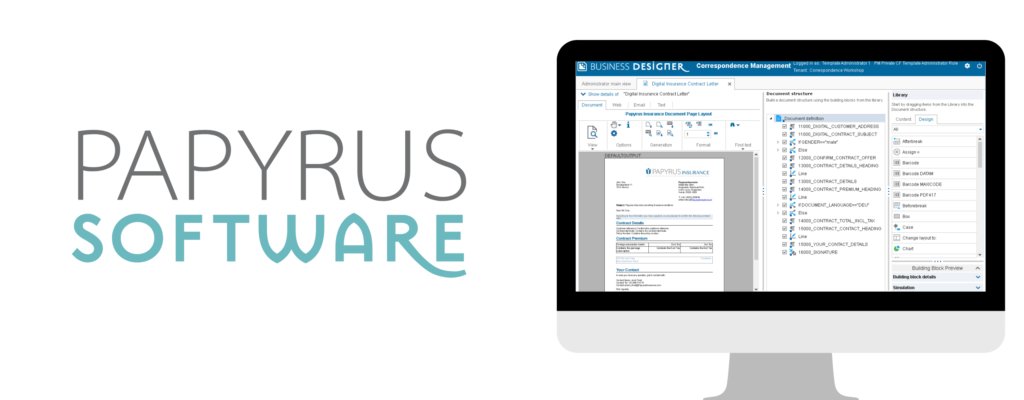
Papyrus positions itself as a combined BPM and CCM platform, and for organisations that adopted it 10-15 years ago for insurance policy correspondence and claims processing, this was a compelling pitch. In practice, this combined architecture creates lock-in: business processes and document templates in the same proprietary system means replacing either one risks disrupting the other. Clients who want to modernise communications first have to untangle them from the process layer, and that alone can take 6-12 months before actual CCM modernisation work begins.
Where the Budget Actually Goes When Supporting Legacy System
These 5 systems differ in architecture and heritage, yet the hidden costs follow the same 4 patterns:
- Talent tax on scarce legacy skills: Dependency on niche expertise that is expensive, hard to replace, and creates operational risk.
- Compliance delays → compounded costs: Delays go beyond fines, driving slower delivery, higher operational overhead, and missed market opportunities.
- Maintenance spiral (cost increases over time): Postponing migration leads to growing technical debt, higher change costs, and reduced system flexibility.
- Legacy trap (classic car effect): Low upfront cost, but high ongoing burden like specialist support, limited suppliers, hidden costs, and time spent maintaining instead of delivering value.
Truly it looks a bit like owning a classic car from the 1990s: the purchase price was settled long ago. But the specialist mechanic, the parts from a single supplier, the fuel nobody tracks, and the weekends in the garage instead of on the road add up to far more than running a modern, low-maintenance vehicle.
The Talent Tax
Finding a developer who knows Exstream’s scripting language, DOC1’s template logic, or Papyrus’s BPM/CCM environment is a scarcity game with predictable consequences. In our experience, senior consultants with deep legacy CCM knowledge command significant premiums over modern full-stack developers. They know they are hard to replace, which shifts negotiating power entirely to the consultant. The talent pool shrinks every year as experienced professionals retire or move to modern stacks, and every month of delayed migration makes the premium steeper.
Compliance Delays That Cost More Than Fines
The European Accessibility Act took its full effect in June 2025, and GDPR enforcement continues to tighten. Each regulatory change triggers a chain reaction across document templates, output channels, data handling, and audit trails. Enforcement under national accessibility laws is already happening across the EU, and the EAA will only sharpen that pressure.
On a modern API-native CCM platform, a compliance update might take a sprint or two. In a legacy environment, that same change can take months: the template has to be modified in a proprietary editor, testing requires a full regression cycle without an automated test suite, and the one person who understands the system is booked out for 6 weeks.
We have written about the specific collision between legacy CCM and the European Accessibility Act in detail. Retrofitting accessibility into a system designed for print-first output is effectively a rebuild of the output layer.
Opportunity Cost: Channels You Cannot Reach
Your competitor sends policy renewal reminders via WhatsApp, your marketing team wants interactive payment links in emails, your product team needs push notifications and in-app messages from a microservice, and operations needs SMS confirmations. All standard in 2026, but if your CCM was built for batch PDF output, each channel requires a standalone integration. Some organisations build a parallel communication layer next to the legacy CCM to support digital channels, and suddenly they maintain 2 systems, 2 sets of templates, and 2 compliance workflows where one should be enough.
This is why organisations that want to expand into digital channels cannot treat them as add-ons. Without a structured migration approach, each new channel simply adds another layer of complexity on top of an already fragmented communication stack.
The Maintenance Spiral
Technical debt on legacy CCM platforms does not grow linearly; it compounds. A workaround you build today becomes a dependency tomorrow. A custom integration becomes something the next developer has to reverse-engineer. A deferred upgrade quietly inflates the eventual migration scope. In our CCM experience, organisations that postpone migration regularly find that the project scope has grown well beyond original estimates, simply because the legacy environment kept accumulating custom logic in the meantime.
The Calculation Nobody Wants to Do
Licence fees are easy to track. The salary premium on a legacy Exstream developer, the 4-month delay on an accessibility compliance project, the WhatsApp channel that launched at your competitor while your team was writing a feasibility study. Those numbers live in different spreadsheets, or no spreadsheet at all.
Staying on a legacy CCM platform is itself a budgetary decision, even if nobody formally approved it, and it carries a compounding price in slower delivery, scarcer talent, growing technical debt, and missed channel opportunities.
Once organisations reach this point, the focus inevitably turns to how to approach migration in a structured and low-risk way. We have explored this in more detail in our overview of legacy CCM migration, including both strategic and operational aspects.
At some point, every organisation running one of these 6 systems will have to add up the full cost of keeping it, and when they do, the support licence will be the smallest number on the page. The only question is whether you run that calculation now, on your own terms, or later, when the next regulatory deadline or channel requirement makes the decision for you.
Let’s drive your Digital Transformation Together.
Schedule a free consultation with our team to explore how we can help you achieve your goals.
See also

Adobe Experience Manager End of Life: What It Means for Communications-Generating Teams in Banking and Insurance

Modernise vs Migrate the CCM: How BFSI Decide on Their CCM Transformation
