

How PaaS Enables Scalable & Controlled Customer Communication Operations in Regulated Industries

09:15 – Compliance flags a mandatory disclosure update. One sentence across all contracts.
09:20 – You calculate the timeline: IT ticket submission, infrastructure review, middleware validation, deployment scheduling, testing windows.
Week 4 – If everything goes perfectly, the change ships. If not, you’re explaining to regulators why you missed the deadline.
Industry data for 2025 suggests that around 20% of consumers switched providers due to poor communication quality, highlighting a direct retention risk for banks and insurers where high-volume, highly adapted content is a baseline expectation. The example above – the story which happens to most of companies in regulated industries, especially with a massive template heriatage.
Most operations leaders managing customer communications in banking and insurance face a complex situation. A single contract wording change, like updating a clause for regulatory compliance or correcting a fee disclosures, requires coordinating across infrastructure teams, middleware specialists, and application developers. And the result is never satisfying: release cycles measured in weeks when the business needs changes in days.
For those who is responsible for document production, communications infrastructure reliability, and operational continuity of CCM-dependent processes, this dependency represents their single largest frustration: they’re accountable for outcomes, speed and reliability but lack control over the underlying technology that determines those outcomes.
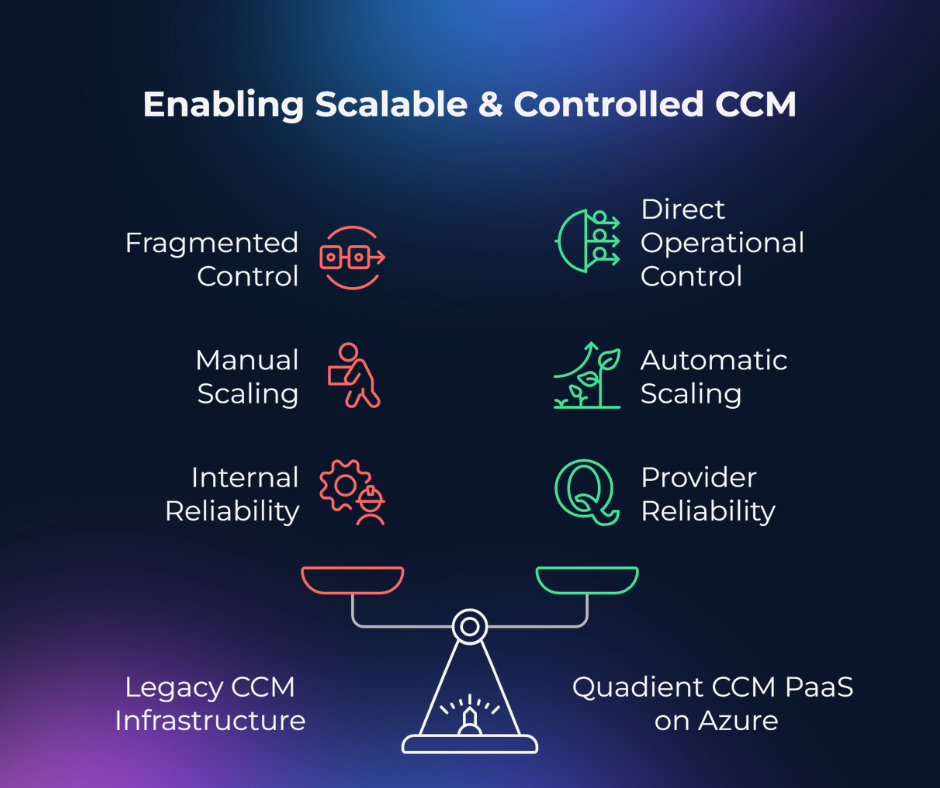
Responsibility is centralised and control is fragmented.
A transition to a Platform as a Service (PaaS) model alters how Customer Communications Management (CCM) is operated, moving it from a cost-driven function to a scalable delivery capability. Deployment architecture becomes an accelerator rather than a constraint: PaaS abstracts infrastructure management, reduces friction in release cycles, and enables faster, safer iteration.
Thus, cloud-based CCM allows organisations to deliver many content and template changes without requiring deep technical intervention for each update.
How CCM Platform-as-a-Service Architecture Changes Operational Control
A transition to Platform-as-a-Service (PaaS) in Customer Communication fundamentally alters the relationship between operations teams and the technology infrastructure. It becomes about shifting operational control from constrained dependency to managed capability.
Responsibility Split Model for Operational Autonomy
PaaS in cloud computing means that the provider handles the complete maintenance of physical servers, network infrastructure, data storage, operating systems, and the runtime environment. Internal teams stop spending their time maintaining infrastructure that does not differentiate the business. CapacityThe company focuses exclusively on business applications and data management.
What remains under operations control: business applications, template management, content authoring, and data governance. This separation matters because it eliminates the coordination overhead that creates operational delays. When template modifications don’t require infrastructure changes, or content updates don’t depend on middleware configuration, operations teams regain direct control over the communication production workflow.
| Stack Component | PaaS Model Responsibility | Impact on the CCM System Operationability |
| Hardware | Cloud Provider | No CAPEX and no responsibility for physical infrastructure maintenance |
| Operating System | Cloud Provider | Automatic security updates and patching |
| Runtime / Middleware | Cloud Provider | Stable and provider-validated runtime environment for document composition |
| CCM Applications | Client / Implementation Partner | Complete focus on design and business logic |
| Customer Data | Client | Full control via SSO and encryption |
The practical impact of this separation becomes clear in routine operations scenarios. Consider a typical example: regulatory requirements mandate disclosure changes across all customer communications as soon as possible.
Traditional Infrastructure: Operations team submits change request. IT infrastructure team schedules capacity assessment. Middleware team validates template modifications won’t impact other systems. Database team reviews data structure changes. Security team approves deployment to production. Testing cycles occur sequentially due to environment availability constraints. Total timeline: 18-25 days consumed by coordination before operations team even begins template modifications.
PaaS Architecture: Operations team accesses test environment immediately (environments provisioned automatically via Infrastructure-as-Code). Template modifications occur directly in Quadient Interactive interface without middleware dependencies. Automated deployment pipeline moves validated changes through test-to-production environments. Security protocols (SSO, encryption) already configured at platform level. Total timeline: 3-5 days from requirement identification to production deployment, with 80% of time spent on content validation rather than technical coordination.
It’s operational reality that eliminates the dependency bottleneck operations managers identify as their primary frustration.
Technical Enablers That Create Operational Capability
Infrastructure-as-Code: Environments On Demand
CCM PaaS leverage Infrastructure-as-Code (IaC) approaches to provision complete environments in minutes rather than weeks. This typically happens on Terraform for Quadient Inspire deployments on Azure.
Development, testing, acceptance, and production environments become identical by design, eliminating configuration drift that creates unpredictable deployment failures. When testing validates functionality, operations teams know production will behave identically. This removes the “it worked in test but failed in production” scenario that creates operational crises during critical deployments.
Capacity scaling occurs automatically in response to processing load, rather than requiring capacity planning, procurement, and provisioning cycles. During peak periods, infrastructure expands to handle volume, then contracts afterwards and operations teams no longer manage capacity constraints manually.
| Metric | On-Premise Infrastructure | PaaS on Azure |
| Environment Launch | Weeks or months | Minutes using Infrastructure-as-Code (e.g., Terraform) |
| Scaling under peak load | Limited by hardware resource | Automatic horizontal expansion |
| Document Processing Speed | Baseline | 2x Increase |
| System Availability | Dependent on local redundancy | Geo-redundancy aligned with Azure service-level availability targets (e.g., 99.9% for specific services under defined configurations) |
Security and Compliance: Built-In Rather Than Bolted-On
- Azure Active Directory (Entra ID) Integration: Single Sign-On (SSO) ensures only authorised employees access CCM systems, with authentication protocols operations teams already use for other enterprise applications. This eliminates separate credential management and reduces security exposure from password-based authentication.
- Azure Application Gateway with Web Application Firewall: Protection against common web attacks (SQL injection, cross-site scripting) occurs at Layer 7, securing web interfaces business users access for template editing. Operations teams don’t manage firewall rules or security patches – platform provider handles this automatically.
- Azure Automation Runbooks: Routine operational tasks like database backups, certificate renewals, system monitoring, execute automatically via configured runbooks. This eliminates manual intervention points that create operational risk whilst reducing operations team workload.
Strategic trade-offs in CCM PaaS implementation
The choice of deployment model always depends on a balance between control, speed to market, and specific national regulatory constraints.
Scenarios Where PaaS Delivers Operational Relief
- Unpredictable activity spikes
This applies when the business has pronounced seasonality or conducts mass marketing campaigns requiring the instantaneous generation of large content volumes. - Hyper-personalisation
This is an emerging practice in customer communications that gained significant momentum in 2025 and is increasingly adopted across regulated communication workflows as AI-driven capabilities mature. By combining real-time data with automation and AI, hyper-personalisation takes traditional personalised communications several steps further. - Business team autonomy
Providing marketing and product teams with the ability to edit text and promotional conditions independently through the Interactive web interface removes delays. This relieves the organisation of ticket fatigue, where specialists wait weeks for developer availability to correct a single clause in a contract.
Why Operations Leaders Choose CCM PaaS?
For Heads of Operations managing customer communication workflows, PaaS resolves a structural mismatch – being accountable for outcomes whilst dependent on technology infrastructure they don’t control.
Traditional infrastructure creates operational dependency chains: template modifications require developer availability, capacity scaling requires infrastructure team prioritisation, compliance implementations require coordination across IT, security, and application teams. Every dependency creates delay, and every delay creates operational risk.
PaaS architecture doesn’t eliminate all dependencies – no operational environment operates in complete isolation. However, it eliminates the dependencies that create operational bottlenecks:
- Template modifications no longer require infrastructure changes. Content updates no longer depend on middleware configuration. Capacity stops being something teams have to predict months in advance, and something they get blamed for when predictions are wrong. Security updates no longer require coordinated deployment windows.
- What remains are business-level dependencies that operations teams expect to manage. What disappears are technical dependencies that created delays operations teams couldn’t control.
Transformation from constrained dependency to managed capability represents the operational value proposition that drives PaaS adoption in regulated industries. The technical architecture matters only insofar as it enables operational autonomy.
The primary concern for any operations leader evaluating infrastructure modernisation: “How do we transition without disrupting customer-facing operations?”
Implementation Which Saves Ages for Operations Teams
The primary concern for any operations leader evaluating infrastructure modernisation: “How do we transition without disrupting customer-facing operations?”
Successful PaaS migrations follow phased approaches designed specifically to preserve operational continuity and eliminate production risk.
Parallel Environment Construction
New PaaS infrastructure deploys fully independently from existing production systems. Operations teams continue business-as-usual while the new environment undergoes comprehensive validation.
This approach was critical for example in a Dutch Healthcare Insurer‘s transformation, where a fully isolated Azure-based environment was deployed and tested independently before any production cutover. This ensured uninterrupted policyholder communications while enabling the platform to handle peak renewal volumes with zero downtime once activated.
Systematic Template Migration
In case of Legacy System Migration projects, templates should be migrated in controlled priority order – either highest-volume communications first or lowest-complexity templates first, depending on operational risk strategy. Each migrated template undergoes full end-to-end validation, including data integration, rendering accuracy, accessibility compliance, and output integrity.
Cutover During Quiet Periods
Final production cutover is scheduled during the lowest-volume operational periods, supported by predefined rollback procedures. This guarantees immediate recovery capability in the unlikely event of unexpected behaviour.
This model enabled regulated organisations to transition fully to Azure-hosted CCM environments while maintaining uninterrupted service delivery during critical business cycles, including renewal periods and compliance-driven document updates.
Knowledge Transfer and Training
Operations teams receive hands-on training in the new operational model before assuming responsibility. This includes Interactive template management, automated deployment workflows, and real-time monitoring dashboards.
As demonstrated in production deployments, business stakeholders gained direct operational control over content changes without relying on developer availability. This removed operational bottlenecks and significantly reduced turnaround time for regulatory and customer communication updates.
Integration capabilities of Quadient and Azure
The synergy between Quadient Inspire and Microsoft Azure creates a secure and productive environment for large-scale communications. This allows for the construction of omnichannel strategies where the customer receives an identical service level regardless of the chosen communication channel.
Security and architectural control
For projects in the financial sector, we integrate the following components to ensure enterprise-grade protection:
- Azure Active Directory (Entra ID)
This enables reliable Single Sign-On (SSO), ensuring that only authorised employees access the system. - Azure Application Gateway with WAF
This provides protection against common web attacks, such as SQL injection and cross-site scripting. Traffic filtering occurs at Layer 7, securing the web interfaces for business users. - Azure Automation Runbooks
This enables the full automation of routine operations, such as creating daily database backups, updating domain security certificates, and monitoring virtual machine status.
Summary
Most organisations don’t adopt CCM PaaS because it is technically superior. They adopt it because waiting three weeks to change a sentence is no longer operationally acceptable.
Platform as a Service (PaaS) becomes the appropriate choice for Customer Communications Management when communication volume is variable, regulatory change is continuous, and business teams require controlled autonomy – without waiting on infrastructure cycles. In these conditions, deployment architecture directly affects delivery speed, compliance risk, and operational cost.
Organisations operating under strict regulatory oversight, managing high-volume personalised communications, and relying on multiple downstream systems benefit from PaaS because infrastructure concerns are removed from the critical path of content delivery. The result is predictable scalability, repeatable environments, and compliance embedded at design time rather than enforced retroactively.
Where these constraints apply, the remaining question is not whether to modernise Customer Communication Management system, but how quickly the organisation can transition without disrupting production workloads. Our managed Quadient PaaS service on Azure addresses this transition through controlled migration, validated architectures, and regulated-industry operating models.
Explore the Customer Communication Management PaaS service to find out how this architecture could be implemented in practice to ease your operational challenges
Let’s drive your Digital Transformation Together.
Schedule a free consultation with our team to explore how we can help you achieve your goals.
See also

Adobe Experience Manager End of Life: What It Means for Communications-Generating Teams in Banking and Insurance

Modernise vs Migrate the CCM: How BFSI Decide on Their CCM Transformation
